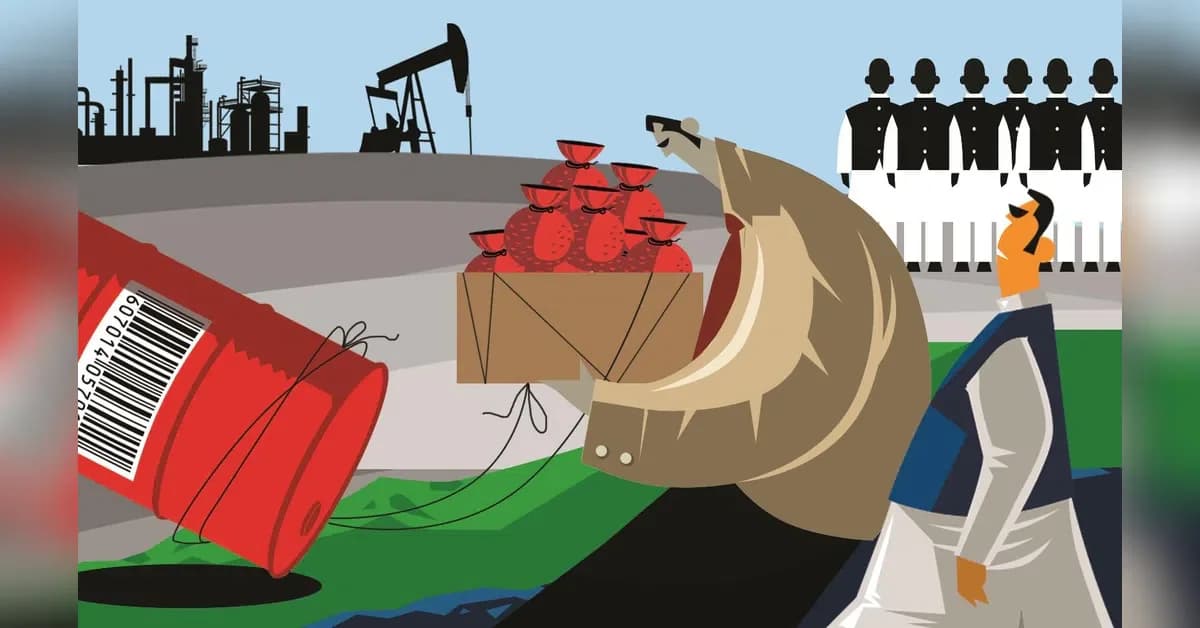
Indian government bonds ended little changed on Tuesday as investors braced for the Reserve Bank of India's policy decision on Wednesday, amid expectations of a less hawkish policy while navigating news flow around the sixth week of the Iran war. According to Reuters, India's benchmark 6.48% 2035 bond yield ended flat at 7.0458%, down 4 basis points from the day's high, as bond yields move inversely to prices. The benchmark Brent crude has jumped over 50% since the war began, creating severe energy shock for India which imports a bulk of its crude and gas needs. Any action on rates is highly unlikely, analysts say, and focus will be on economic projections as well as measures to mitigate currency pressures, traders noted. Bonds and overnight index swaps had aggressively priced in rate hikes due to the escalating Middle East war, but some of these bets are being reversed, as reported by Reuters.
India's high-growth economy is facing a significant impact from the Middle East crisis, with GDP growth forecasts potentially being shaved off by as much as 1% due to the ongoing conflict. According to India's finance ministry's latest monthly review, higher import and logistics costs and a possible decline in remittances from the 10 million Indians who live in the Gulf could end up having a 'significant' impact on economic metrics. The crisis in the Gulf is being transmitted through supply constraints and pressures across sectors, with early indications of some moderation in economic activity. This development comes at a particularly challenging time, as India's ambitions to cross Japan to become the world's fourth largest economy will most certainly be further pushed back by these economic disruptions. The growth revision follows recent downgrades to India's GDP following changes to the statistical base year, making the current challenges even more significant for the country's economic trajectory.
Finance Minister Nirmala Sitharaman delivered a stark warning about the escalating Middle East conflict, describing it as a 'systemic tremor' threatening global energy flows. Speaking at the National Institute of Public Finance and Policy (NIPFP) in New Delhi, she said 2026 has proven more challenging than the year before, with the escalation of the Middle East conflict evolving from a regional security concern into a systemic threat. As per The Times of India, Sitharaman invoked the VUCA framework—volatility, uncertainty, complexity, and ambiguity—noting that it had found its 'truest and most unsettling relevance' in the present decade. She warned that decades of reckless global spending are causing a financial crisis for advanced economies, with global public debt surging to about $106 trillion, exceeding 95 percent of global GDP. Sitharaman emphasized that the escalation of Middle East conflict has evolved from a regional security concern into a systemic tremor threatening the vital arteries of global energy, and hardening the lines of a new, multipolar world order.

India does not see any immediate threat to its fiscal deficit target for 2026-27 despite the financial strain from the ongoing Middle East crisis, according to two government sources. New Delhi had budgeted a fiscal deficit of 4.3 per cent of GDP for the financial year that began on April 1, lower than 4.4 per cent in 2025-26. As reported by The Times of India, officials are not planning an immediate revision to that target even as the Iran war drives up crude oil prices and increases pressure on government finances. "For India to revise its budget projections, the current situation would need to persist for at least two to three months," one of the sources said, as cited by Reuters. Sitharaman highlighted that India has fiscal space, room to maintain capex programme, room for the RBI to cut rates, room to offer targeted support to affected sectors - the dividend of a decade of fiscal discipline.
The Middle East crisis is creating significant pressure on India's currency and financial markets. The Indian rupee has hit record lows and is down nearly 10% against the US dollar in the last year, with experts warning of further declines ahead. According to Bernstein, in a worst-case scenario where the war persists for much of 2026, the repercussions could be 'catastrophic' for the rupee, which could plunge beyond 110 to the dollar. India's benchmark equity indices are already down some 12% since the beginning of the year amid foreign money outflows, eroding the wealth effect that was supporting consumption. The government has responded by proposing a $6.2bn 'economic stabilisation fund' and sought approvals for additional spending on food and fertiliser subsidies, though experts note these resources are 'modest relative to the scale of the challenge'. The RBI is likely to keep interest rates steady when it announces its decision later this week, adopting a 'wait and watch' strategy to preserve flexibility.