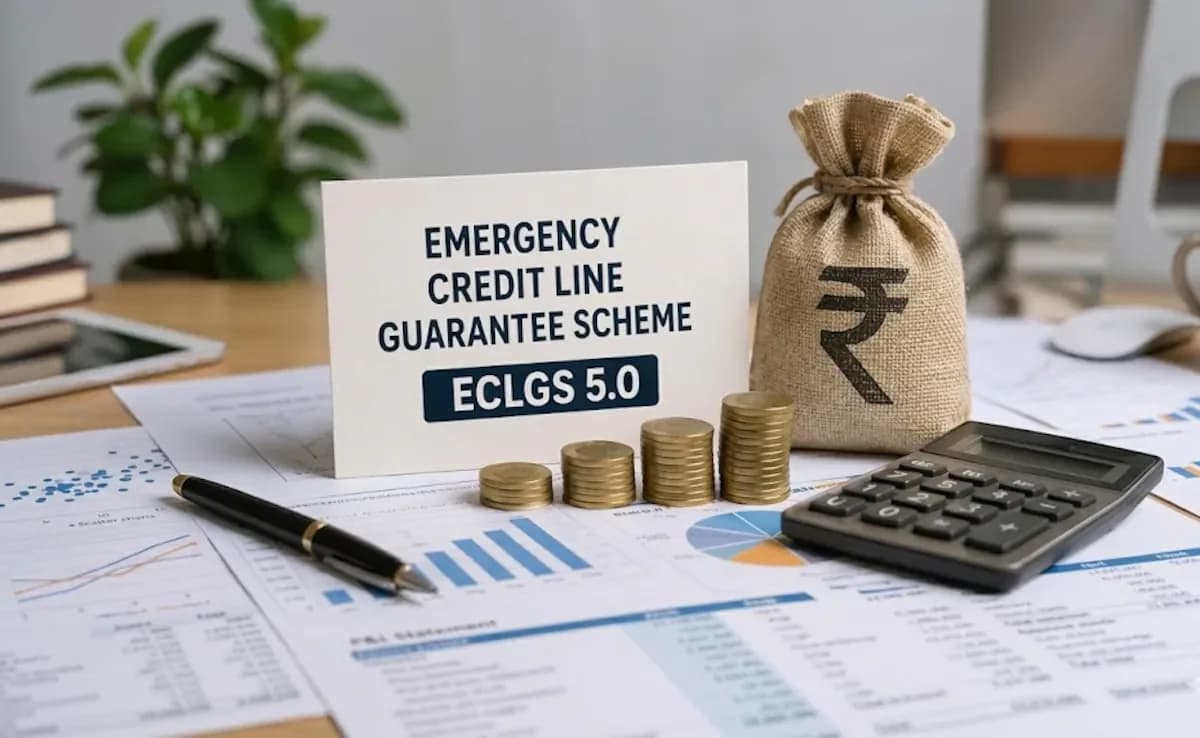
The government's ECLGS 5.0 scheme has received a record 263,000 applications seeking credit support worth ₹1.71 lakh crore, highlighting unprecedented demand for guaranteed credit support among businesses. According to a Department of Financial Services (DFS) official during an inter-ministerial briefing on the West Asia crisis on Monday, the scheme has seen quite rapid pace of credit offtake as it was implemented quickly. The official noted that we have already reached a good number. It is expected that customers will be able to take benefit of the scheme, indicating confidence that credit uptake will continue to rise in the coming months. The strong response underscores continued demand for guaranteed credit support among eligible borrowers, with application volumes touching record levels under the latest version of the ECLGS programme.
Banks have successfully sanctioned ₹35,194 crore in emergency credit under the Emergency Credit Line Guarantee Scheme (ECLGS) 5.0, aimed at supporting MSMEs and industries impacted by the ongoing West Asia crisis. According to reports from The Economic Times and The Hindu BusinessLine, the scheme, approved by the Union Cabinet on May 5, aimed at providing additional credit flow of ₹2.55 lakh crore, including ₹5,000 crore for airlines hit by the geopolitical crisis. As per the latest data, 79,950 of these applications involving ₹35,194 crore have been sanctioned, while guarantees worth ₹15,720 crore have been issued. The sanctioned amount represents about 13.72% of the total guaranteed amount of ₹2.55 lakh crore available under the scheme.
The finance ministry has directed public sector banks to build additional provisioning buffers against emerging stress in retail, MSME and agriculture loans, as rising early-warning accounts and uncertainty stemming from the West Asia conflict could trigger higher provisioning burdens under the proposed expected credit loss (ECL) regime. According to Mint, the directive was conveyed by the department of financial services to the chiefs of 12 PSBs in a review meeting last week, with the ministry seeking to strengthen monitoring and recovery efforts to prevent these accounts from slipping into non-performing assets. At the end of FY26, the average SMA ratio across the 12 PSBs stood at 3.19% of gross advances, with stress most pronounced in retail loans (6.17%), followed by MSMEs (5.01%) and agriculture (3.86%). Overall, state-run banks reported nearly ₹4.03 trillion worth of SMAs, with the finance ministry wanting banks to strengthen balance sheets ahead of the proposed rollout of the RBI's Expected Credit Loss framework likely from FY28.
India's MSME credit portfolio continued to expand in April 2026, but growth momentum has slowed sharply amid geopolitical uncertainty, with early-stage stress beginning to emerge across key segments. According to CRIF High Mark, the MSME portfolio outstanding stood at about ₹46 trillion at the end of April 2026, up 12.8% year-on-year, but growth between December 2025 and April 2026 slowed to 3.1%, compared with 9.7% in the corresponding period a year ago. The moderation reflects the "potential impact of global uncertainty into domestic MSME credit supply" as reported by CRIF High Mark. The slowdown has been most visible in manufacturing and trade, which together account for over 60% of MSME credit outstanding.
Manufacturing credit growth eased significantly to 4.3% between December 2025 and March 2026 from 10.4% in the year-ago period, with manufacturing credit contracting 3.1% between March and April 2026. Trade credit fell 2.1% during the same period. Within manufacturing, CRIF High Mark noted that shipping and transport, food processing, and auto and ancillary businesses witnessed the sharpest declines, with portfolio outstanding in food processing falling 17.2% between December 2025 and April 2026. The micro segment, which accounts for nearly 86% of active MSME loans, has also come under pressure with portfolio outstanding contracting 3.1% between December and March, compared with growth of 3.4% in the corresponding period last year.