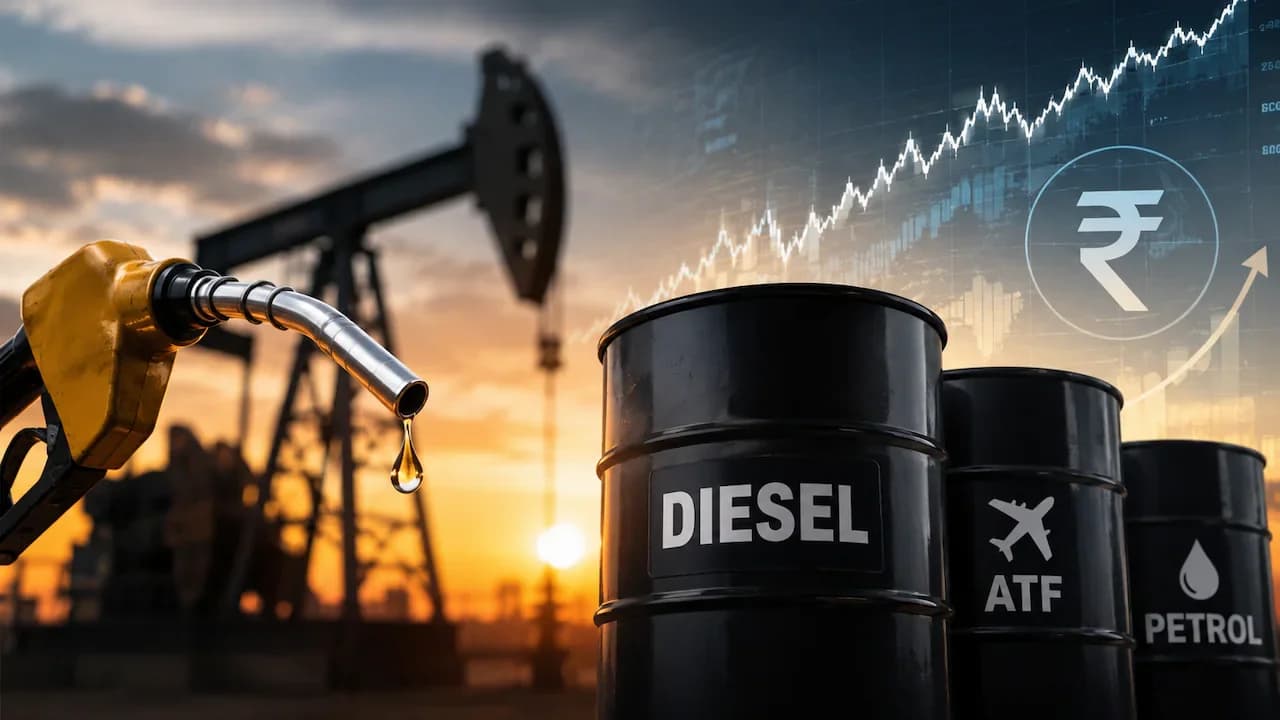
The government has implemented significant changes to export duties on petroleum products as global oil prices continue to ease. According to the latest finance ministry notification, diesel export duty has been reduced to ₹8.5 per litre from ₹14 per litre, while aviation turbine fuel (ATF) export duty has been cut to ₹7.5 per litre from ₹12.5 per litre. The revised rates took effect from July 1, 2026 and will remain effective for the fortnight beginning July 1. As reported by Reuters, these windfall tax reductions reflect the sharp decline in oil prices from peaks above $126 per barrel, driven by easing geopolitical tensions and the restoration of shipping through the Strait of Hormuz. The Finance Ministry had previously lowered the export duty on diesel by ₹5.5 per litre from ₹14 per litre during the fortnightly review on June 16.
In contrast to the diesel and ATF reductions, petrol export duty has been increased to ₹4 per litre from ₹1.5 per litre to ensure adequate domestic supplies. According to the finance ministry notification, this increase applies to the Special Additional Excise Duty (SAED) on petrol exports. The duty increase aims to maintain sufficient fuel availability for the domestic market amid changing global price dynamics. The petrol export levy was originally introduced with effect from May 16, following the initial imposition of export duties on diesel and ATF on March 27.
The duty revisions reflect the sharp decline in oil prices from peaks above $126 per barrel, driven by easing geopolitical tensions and the restoration of shipping through the Strait of Hormuz. According to economists and analysts cited by Reuters, Brent crude is forecast to average $84.50 per barrel in 2026, down from a previous forecast of $90.44 per barrel made last month. The reduced fears of prolonged supply disruptions have contributed to the lower price projections.
The government has expanded export exemptions for public sector oil companies, extending them to Mauritius and the Maldives in addition to the existing exemptions for Nepal, Bhutan, Bangladesh and Sri Lanka. As reported by Reuters, these exemptions were originally implemented when the export levies were first imposed, and have now been broadened to include additional regional markets. At the time of imposition of the export levy, exemption was provided for exports of petrol, diesel and ATF made by public sector oil companies to Nepal, Bhutan, Bangladesh and Sri Lanka. The Finance Ministry has now expanded that exemption to include exports by Public Sector Oil Companies to Mauritius and the Maldives.
Separately, state-owned oil marketing companies have provided relief to commercial establishments by reducing the price of 19-kg commercial LPG cylinders by up to ₹183.5 from Wednesday. This price reduction will provide significant cost relief to restaurants, hotels and other commercial establishments that depend on LPG for their operations. The windfall tax was originally introduced to ensure adequate domestic availability of petroleum products and discourage excessive exports during periods of elevated global crude oil prices triggered by the conflict in West Asia.