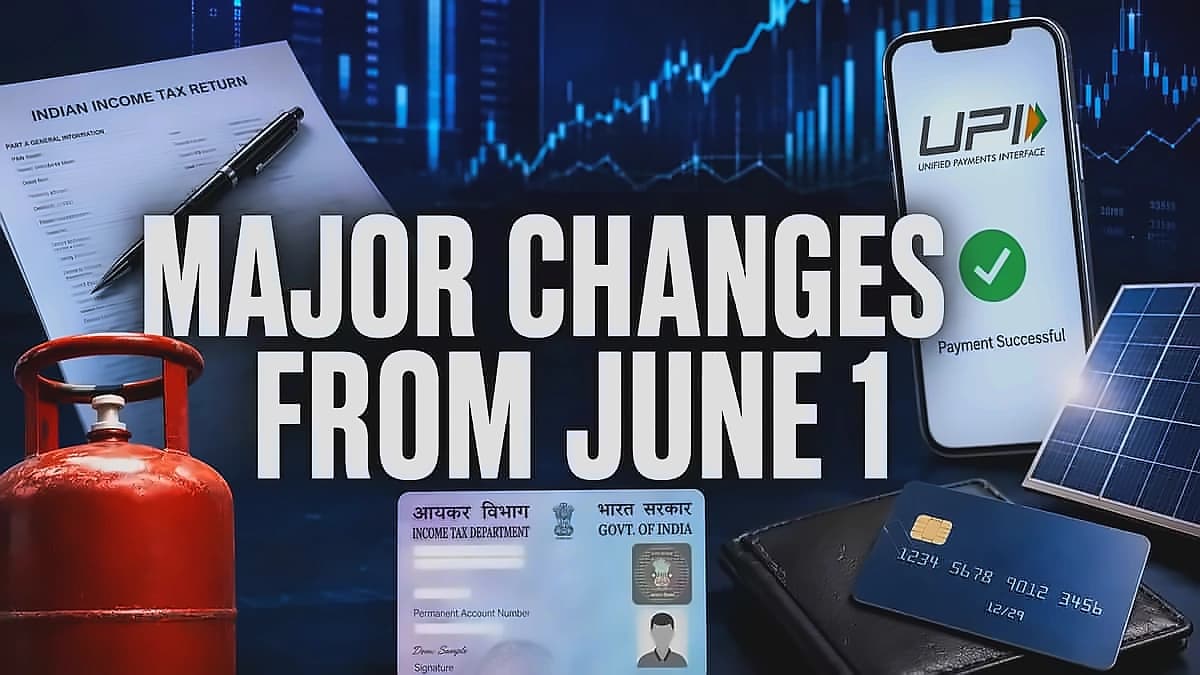
The most significant change from April 1, 2026, is the implementation of the new Income Tax Act, 2025, which will replace the decades-old 1961 Income Tax Act. According to reports from Mint, this new legislation will mark the beginning of the financial year 2026-27 (FY27) and is expected to impact a wide range of users, including taxpayers, bank customers, and digital payment users. The new Act, passed by the government, represents a comprehensive overhaul of India's tax framework, with the number of tax rules reduced from 399 to 190 and tax forms reduced from 511 to 333 to make the system easier for businesses and taxpayers to use. However, certain transitional provisions specify the continuation of proceedings under the old Act to avoid disruption in pending matters and ensure a smooth transition. The new law introduces a unified concept called the "Tax Year," replacing the previous dual system of Financial Year (FY) and Assessment Year (AY), with income earned from April 1 onwards being reported within the same tax year.
Starting April 1, 2026, all digital payment transactions in India must comply with two-factor authentication (2FA) norms as per the Reserve Bank of India's 2025 directions. As reported by Mint, while no specific factor has been mandated for authentication, the digital payment ecosystem has primarily adopted SMS-based One Time Password (OTP) as an additional factor. The rule applies to all entities in the payment ecosystem, including banks and non-bank players, marking a significant shift toward enhanced digital transaction security. These directions will come into effect on April 1, 2026, unless stated otherwise for specific provisions, as per the RBI statement.
Several major banks have announced changes to ATM withdrawal charges effective April 1, 2026. According to Mint reports, HDFC Bank will treat UPI withdrawals at ATMs as regular ATM withdrawals when calculating the monthly free transaction limit. Once the free limit is exhausted, customers will be charged ₹23 plus applicable taxes per transaction. Currently, savings and salary account holders get five free cash withdrawals at HDFC Bank ATMs, while at other bank ATMs, customers are allowed three free cash withdrawals in metro cities and five in non-metro cities. Multiple reports suggest that Punjab National Bank (PNB) and Bandhan Bank have also announced modifications to ATM cash withdrawal policies, fees and restrictions, with the revised changes taking effect on April 1, 2026.
The National Highways Authority of India (NHAI) has revised the FASTag annual pass fee for FY2026-27, with the increased fee applicable from April 1, 2026. As reported by Mint, the cost of the FASTag annual pass will increase by ₹75, bringing the total from the current ₹3,000 to ₹3,075. The new rate applies specifically to non-commercial vehicles such as cars, vans and jeeps equipped with a valid FASTag, covering approximately 1,150 fee plazas on National Highways and National Expressways nationwide. FASTag recharge can be done via the Rajmarg Yatra App or the official NHAI website, with the annual pass getting activated within two hours of payment.
The tax exemption on employer-provided meal cards has been significantly increased to ₹200 per meal, up from ₹50 earlier. According to Mint reports, the updated rules allow individuals who receive meal coupons, meal vouchers, meal cards (Pluxee/Sodexo/Zaggle), or subsidised food from office cafeterias to claim tax deductions of up to ₹1 lakh annually. This benefit covers food and non-alcoholic beverages provided by companies and is available under the old tax regime. Meanwhile, no changes have been made to income tax slabs from April 1, 2026, as there was no announcement of changes during Budget 2026 under both old and new income tax regimes.
Starting April 1, 2026, PAN applications will require additional supporting documents beyond Aadhaar, making this the last chance to apply through the simplified Aadhaar-based process. As per Mint reports, the PAN name will be as per Aadhaar only, with the name on the card being removed. New PAN application forms are expected to be introduced, replacing the current forms, and PAN can become inoperative if not linked to Aadhaar within the prescribed time. Taxpayers cannot claim income-tax refunds if their PAN remains inactive, and it can only become operative again after completing Aadhaar linking and paying prescribed fees. Applicants can apply for a PAN Card using only their Aadhaar card until March 31, 2026, after which additional documents will be required to apply for PAN. Under the new rules, PAN applications using Aadhaar alone are no longer permitted, with applicants now required to use category-specific forms: Form 93 for individuals, Form 94 for companies, Form 95 for foreign individuals, and Form 96 for foreign entities. Additionally, PAN is mandatory for below high-value transactions:
For PAN applications, credit card statements up to three months old may be used as proof of address, and all new credit card applications now require a PAN.