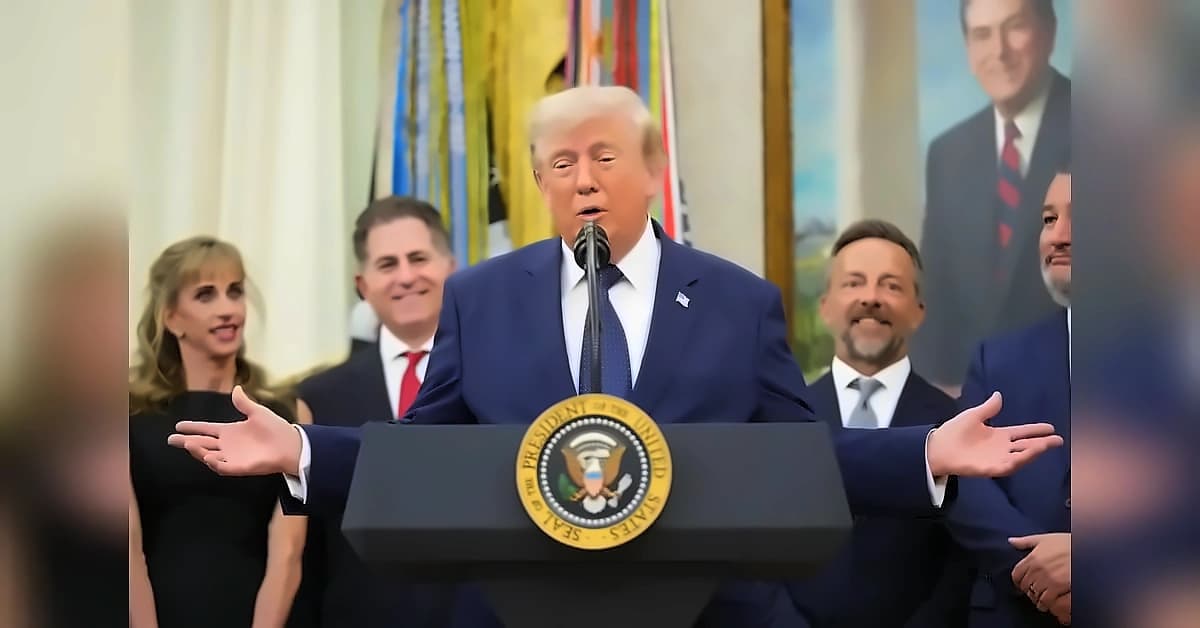
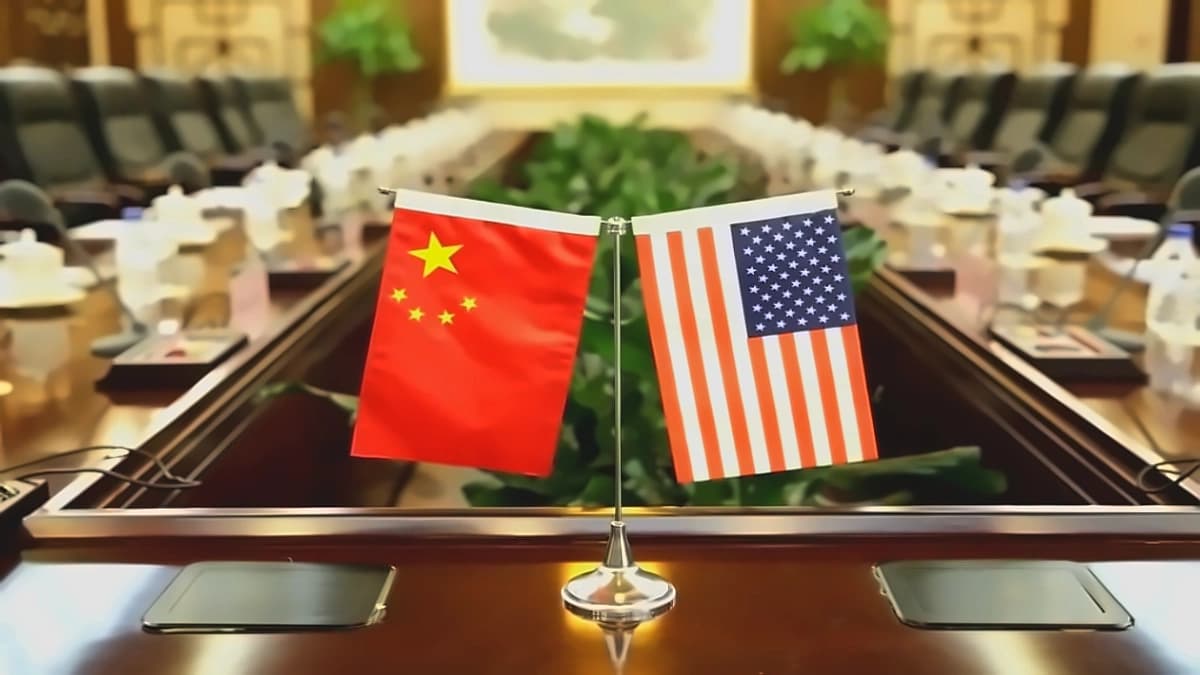
President Trump arrived in Beijing on Wednesday evening, greeted with pomp and pageantry ahead of his high-stakes summit with Chinese President Xi Jinping. Trump was greeted on the red carpet by Chinese Vice-President Han Zheng, one of China's top leaders, marking a show of respect from Beijing after a lower-level leader received Trump on his last visit. The US president was accompanied by his son Eric Trump and a delegation of major American tech industry leaders, including Tesla's Elon Musk, Nvidia's Jensen Huang, Apple's Tim Cook, BlackRock's Larry Fink, and Boeing's Kelly Ortberg. As reported by multiple sources, Trump posted on social media ahead of his landing: 'I will be asking President Xi, a Leader of extraordinary distinction, to 'open up' China so that these brilliant people can work their magic, and help bring the People's Republic to an even higher level.'
President Trump arrives in Beijing with the Iran war on shaky ground, creating an unenviable position for seeking President Xi Jinping's help in the Middle East. According to latest reports, the ceasefire faces potential collapse, making unilateral countering of China's support to Tehran a resource-intensive proposition. U.S. forces needed for potential blockades on Iranian ports may be strained to continue maritime interdictions, while China has proven increasingly willing to circumvent U.S. sanctions. Trump may therefore seek commitments from Xi to cease some aspects of support for Tehran if hostilities resume, though the question remains whether Xi will try to dissuade Trump from resuming combat operations or simply ask for a U.S. concession in another theater in return. Shortly before departing for China, Trump told reporters in Washington he and Xi will have a 'long talk' about Iran, but insisted 'I don't think we need any help' in resolving the conflict. New reports highlight how the Iran war is accelerating geopolitical realignment across the region, with Israel saying Prime Minister Benjamin Netanyahu secretly travelled to the UAE in March for talks with Sheikh Mohammed bin Zayed, which Israel described as a 'historic breakthrough' in relations between the two countries. However, the UAE's foreign ministry denied the trip took place, stating that 'any claims regarding unannounced visits or undisclosed arrangements are entirely unfounded unless officially announced by the relevant authorities in the UAE.'
China may offer to work with the United States on reopening the Strait of Hormuz, a key sea route through which 40 percent of China's oil imports are shipped. As reported by Reuters, Dr. Li suggests the Chinese side may reach an agreement with the US saying 'Let's work together to persuade Iran to keep the strait open,' while also likely wanting assurances that the United States would not blockade the waterway. China has prodded Iranian officials to negotiate with the United States but remains wary of becoming entangled in a war it sees as largely Washington's to resolve. However, China has competing interests, wanting to open the strait while also maintaining Iran as a strategic ally in the Middle East. A Chinese supertanker carrying 2 million barrels of Iraqi crude sailed through the Strait of Hormuz on Wednesday, marking the third known passage by a Chinese oil tanker through the channel since the U.S. and Israel launched strikes on Iran on February 28. Iranian officials have signalled they see control of the strait as a long-term strategic goal, with an army spokesperson stating that supervision of the passage could generate revenue amounting to twice Iran's oil income, while strengthening its foreign policy leverage. Tehran has cut deals with Iraq and Pakistan to ship oil and liquefied natural gas through the waterway, according to sources with knowledge of the matter, with Iranian officials saying 'After this war ends, there will be no place for retreat.'
The Iran war is causing significant disruptions to global energy markets, with global oil supply expected to fall by around 3.9 million barrels per day in 2026 and undershoot demand due to disruptions caused by the conflict, according to the International Energy Agency. More than 1 billion barrels of Middle East supply have already been lost as a result of the war, with Iran striking the UAE more than its other Gulf neighbours in response to the U.S.-Israeli attacks. Iran's foreign minister Abbas Araghchi recently traveled to Beijing in a not-so-subtle reminder of China's influence over its West Asian partner. As noted by Li Daokui, a prominent economist at Tsinghua University, the Iran issue actually helps China, providing important economic leverage over Tehran that Beijing could use to pursue its primary goal of prying the United States away from Taiwan. However, analysts suggest that while Xi might agree to nudge Iran's leaders back to the negotiating table, China's leader will be reluctant to cut economic support for Beijing's most important partner in the Middle East or to stop supplying it with the dual-use goods its military needs.
The summit opens just after the United States announced its most serious Iran-related sanctions on Beijing to date, targeting one of China's largest refineries and forty associated shipping companies. These sanctions address the fact that Beijing still has huge leverage over Tehran by virtue of its status as the largest buyer of Iranian oil. However, there are no guarantees that this U.S. economic pressure on China will translate into pressure on Iran. For one thing, ceasing oil purchases would mark a significant shift in Chinese relations with Iran—one that the Islamic Republic and other governments could perceive as betraying a partner and acquiescing to U.S. interests at a time when Beijing wants to present itself as a strong, reliable power. China may also conclude that angering Tehran would be more costly in the long term, since the regime seems likely to control future shipping flows through the Persian Gulf—the source of roughly 50 percent of China's oil imports and a destination for many of its exports. Secretary of State Marco Rubio told the Fox News 'Hannity' program that the United States hopes to convince China 'to play a more active role in getting Iran to walk away from what they're doing now and trying to do now in the Persian Gulf,' while noting that 'We've made clear to them that any support for Iran would obviously be detrimental for our relationship.'
The summit's most significant focus remains Taiwan arms sales negotiations, with Trump planning to discuss the issue despite potential violations of the Six Assurances commitment. According to Reuters, the Trump administration has already delayed announcing a $13 billion package of arms sales to Taiwan to avoid angering Xi. For Trump to put Taiwan arms sales on the table could represent a departure from decades of American foreign policy, depending on how the topic is broached. Among more hawkish Chinese scholars, the Iran war has exposed US military weakness, giving Beijing confidence to push on Taiwan issues. However, a bipartisan group of US senators sent a letter directly to Trump calling on him to affirm US support for Taiwan and remind China's president of the $14bn arms sale to Taiwan approved in Congress last year. The letter stated: 'You can make clear to Beijing that as you seek to level the economic playing field, American support for Taiwan is not up for negotiation.' For Beijing, the summit represents less about extracting specific concessions and more about redefining the terms of engagement between the two superpowers. Xi will seek validation that his country, the world's second-largest economy, is now an equal to the United States, as he faces mounting scrutiny over his military campaign in the Middle East. Trump returns to a more assertive China than the one he visited in 2017, as he faces mounting scrutiny over his military campaign in the Middle East.
Ultimately, China wants more stability and continuation of the trade truce, seeking no more tariffs, no export controls, and no sanctions imposed on its companies. As reported by Reuters, Amanda Hsiao from Eurasia Group's China Practice notes that Beijing has been building up what Xi calls 'national self-reliance' in technology, trade, and science since the last leaders' meeting six months ago. To help set a positive tone, China may commit to purchases of Boeing aircraft, American soybeans, and US beef, which Hsiao describes as an acceptable price for stability. However, China has learned from watching the United States that it should be cautious about getting too entangled in the Middle East and was likely to resist requests to apply decisive pressure on Iran. The meeting will include Thursday's welcome ceremony with Xi at China's Great Hall of the People, a state banquet, multiple bilateral meetings, and a 'friendship photo' in Beijing's Zhongnanhai Garden, with Trump leaving China on Friday following tea and a working lunch with Xi.