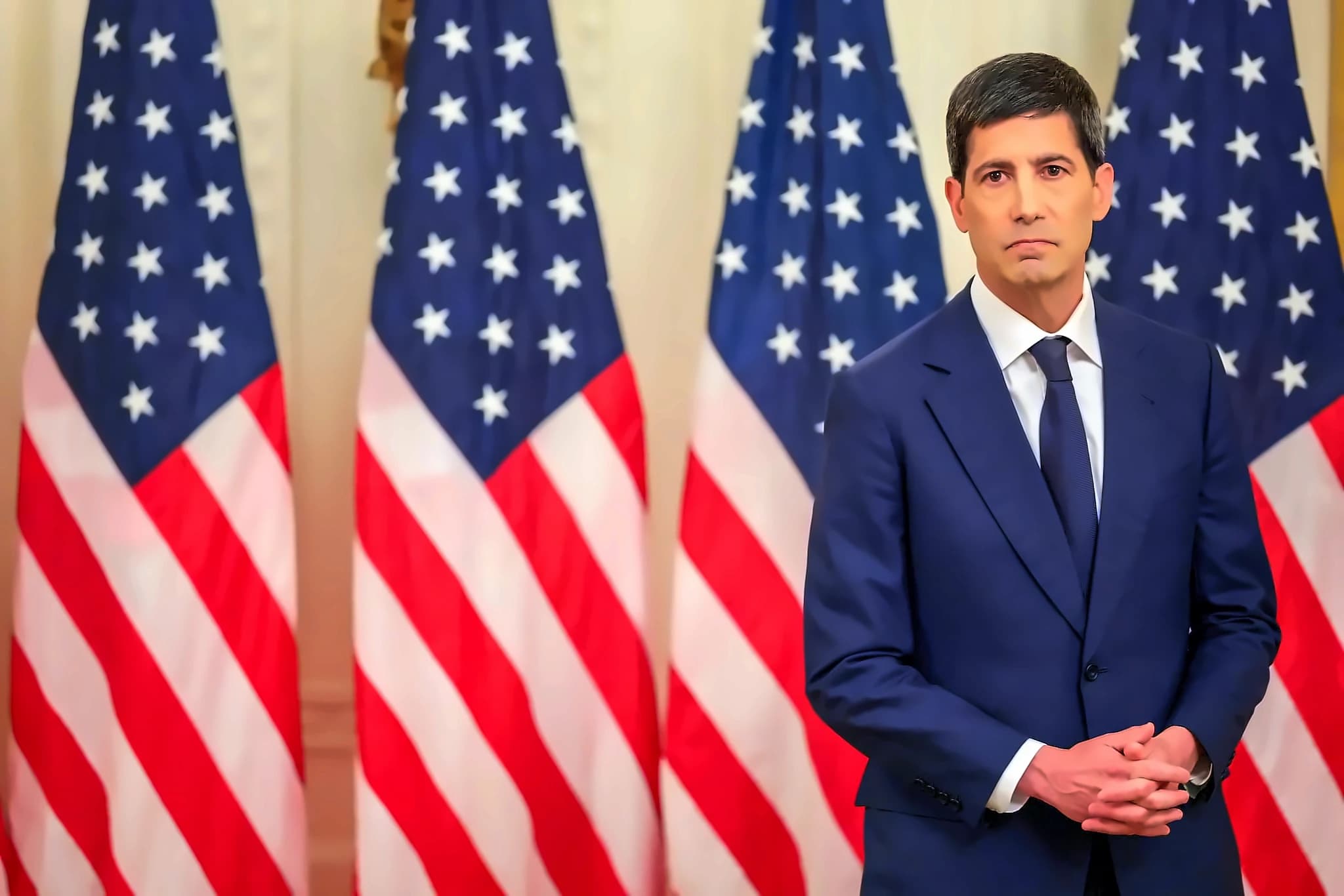
US stock futures are rising with the Federal Reserve's first policy meeting under new Chairman Kevin Warsh taking center stage, as markets navigate a significant rotation away from crowded trades. According to Investing.com, the market is broadening but not without bruises, with the Dow pushing into fresh record territory while the S&P 500 cooled after flirting with all-time highs, and the Nasdaq 100 dropped around 2%. This rotation represents a shift from asking how many cuts are coming to asking how many hikes are on the table, with the curve pricing roughly a one-in-three chance of a hike by September and a very good chance by year-end. The equal-weight index was higher even as energy was weak, financials improved, and semiconductors were sold, indicating this is rotation rather than liquidation. The absence of fresh Middle East news probably helped, with activity levels described as only a 4 out of 10, with the floor skewed more toward the sell side.
Wall Street is preparing for a holiday-shortened week with the Federal Reserve's first policy meeting under new Chairman Kevin Warsh taking center stage. According to reports from Livemint.com, market participants are seeking signals on how the new Fed chief intends to address lingering inflation concerns while balancing economic growth. The FOMC interest rate decision is scheduled for Wednesday, June 17, along with Fed Chairman Warsh's press conference, which will provide crucial insights into the central bank's monetary policy direction. Fed funds futures are pricing in near-certainty that the bank will leave its target rate unchanged tomorrow at a 3.50%–3.75% range, with standing pat also expected to prevail for the next several FOMC meetings. However, Bloomberg Economics expects the dot plot to shift the median to no cuts this year (from one 25-bp cut in March), with potential scope for a 25-bp cut in Q4 as inflationary effects of the Iran war gradually fade. BofA expects Warsh to argue that recent supply shocks are temporary and that the Fed should remain focused on longer-term disinflation trends. The real question is not whether the Fed moves now, but how Warsh frames the reaction function. The market has shifted from asking how many cuts are coming to asking how many hikes are on the table, representing a dramatic narrative shift in Fed expectations.
Oil was the first domino to fall, with crude slipping below $80 not just a headline price move but the market saying the barrel is no longer being treated like trapped inventory behind a geopolitical gate. According to Investing.com, the war premium is bleeding out of the front of the curve, Gulf barrels are being repriced as available again, and the physical market is no longer paying up for scarcity insurance. Persian Gulf exports are now expected to normalize to pre-war levels by the end of July rather than the end of August, with Brent and WTI seen around $80 and $75 in the second quarter of 2026, then $75 and $70 on average in 2027. The more important signal comes from the physical market itself, with Dubai crude structure weakening sharply, with prompt M1 M2 and M2 M3 spreads now in contango, reportedly near six-year lows and weaker than even pre-war levels. Dubai spreads moving into contango suggests Gulf supply is no longer being priced as trapped inventory, with Dubai spreads weaker than even pre-war levels - not a whisper from the paper market but the physical barrel waving a very large flag. Lower oil pulls inflation pressure out of the system, drags bond yields lower, gives rate sensitives some breathing room, and allows investors to start rotating rather than liquidating.
Major US stock indexes have experienced significant cooling after torrid runs earlier this month, with technology shares leading the declines as the market corrects crowded trades. As reported by Reuters, the benchmark S&P 500 was last down more than 2% from its record closing high from June 2, while the Nasdaq Composite had slipped about 4.5% from its high that day. The pressure point was obvious, with semis, memory, software and optical names all coming under supply as investors trimmed the AI infrastructure trade after a monster run. The reported cancellation of a Microsoft cloud deal with Oracle hit the market at exactly the wrong moment, fueling one of the largest Dow-versus-Nasdaq divergences of the year. AI capex beneficiaries were still being bought on dips, while the most crowded optical and infrastructure expressions were trimmed, that is dispersion, not capitulation. SpaceX was another rocket on the screen, keeping pushing higher after its blockbuster debut, at one point extending gains toward 50%, but the move is being driven by a float so tight it can turn every marginal order into a moonshot, with only around 4.2% of shares available to trade on day one.
The US and Iran are preparing to formally sign an interim peace deal that's left both sides claiming victory, with details of the accord still emerging and leaving many European governments, energy investors and shipping companies with reservations about how fast the Strait of Hormuz can return to pre-war conditions. Brent crude prices ticked up in early Wednesday trading after tumbling nearly 5% in the previous session to settle below $79 a barrel, with the recent pullback in oil prices alleviating fears that rising energy costs could fuel inflation again. The US dollar slid to a 10-day low against major currencies on Monday after the preliminary U.S.–Iran peace deal sent oil tumbling and lifted demand for riskier assets. Gold climbed over 2% on Monday after the U.S. and Iran reached an interim peace deal, which pushed oil lower and eased worries about inflation and higher interest rates. In Europe, Euro Stoxx 50 and DAX futures climbed 1.7% while FTSE 100 Futures added 0.77%, with U.S. futures also rallying, with S&P 500 up 2.11% and Nasdaq jumping 2.88% amid a broad risk-on surge. The market finally realized that pricing in peace in the Middle East is the easy part. The harder part starts now, because once the geopolitical smoke begins to clear, the broader index has to thread the needle through the plumbing underneath it.
Investors are particularly focused on understanding Warsh's policy approach and communication style as he takes the helm. As Reuters reports, "As we've seen at times in the past, it can be a bit of a challenge for a newer Fed chief to get the message right, to stick the landing," said Jim Baird, chief investment officer with Plante Moran Financial Advisors. "The market is watching and parsing every word that's said." Warsh was picked by President Donald Trump, who railed at the central bank and prior Fed Chair Jerome Powell for not cutting rates more to his liking. Warsh was nominated in January amid hopes for rate cuts as inflation cooled and hiring slowed, but the war with Iran reversed that: energy prices rose, inflation hit a three-year high, and hiring surprised to the upside. Fed fund futures suggest market expectations that the central bank will increase rates by the end of the year, according to LSEG data, with recent solid employment data and consumer inflation increasing at its fastest pace in three years leading investors to think the Fed will focus on containing inflation. The main challenge is that the macro dynamics likely to drive the direction of inflation in the months ahead are beyond the Fed's power to influence through policy decisions, with the key variable being the US–Iran peace deal, which will determine the pace of energy exports through the Strait of Hormuz. The market has priced out the easy part of the Middle East war premium, but now it has to trade Warsh, AI policy risk, and the coming stock supply wave.
Geopolitical factors are expected to remain on investors' radar during the week. According to Livemint.com, the G7 summit in France, along with ongoing events in the Middle East, could influence market sentiment and drive volatility across asset classes. US financial markets will remain closed on Friday in observance of the Juneteenth holiday, resulting in a shortened trading schedule for the week. This closure may affect trading patterns and market liquidity throughout the week. Leaders gathering at the G7 summit in Évian-les-Bains will be watched for any progress on a potential agreement between the U.S. and Iran, with energy markets remaining highly sensitive to developments. The summit's location in Évian-les-Bains adds to the geopolitical focus, while a sense of divergence within the club of advanced economies is already crystallising after the European Central Bank delivered its first interest-rate increase since 2023. More than 20 central banks accounting for upwards of 40% of world output between them are slated to make rate decisions, pointing to how the week may largely bookend the first half of 2026. Among the highlights further afield, officials in Brazil and Russia may cut borrowing costs, while a Czech hike could also materialise.