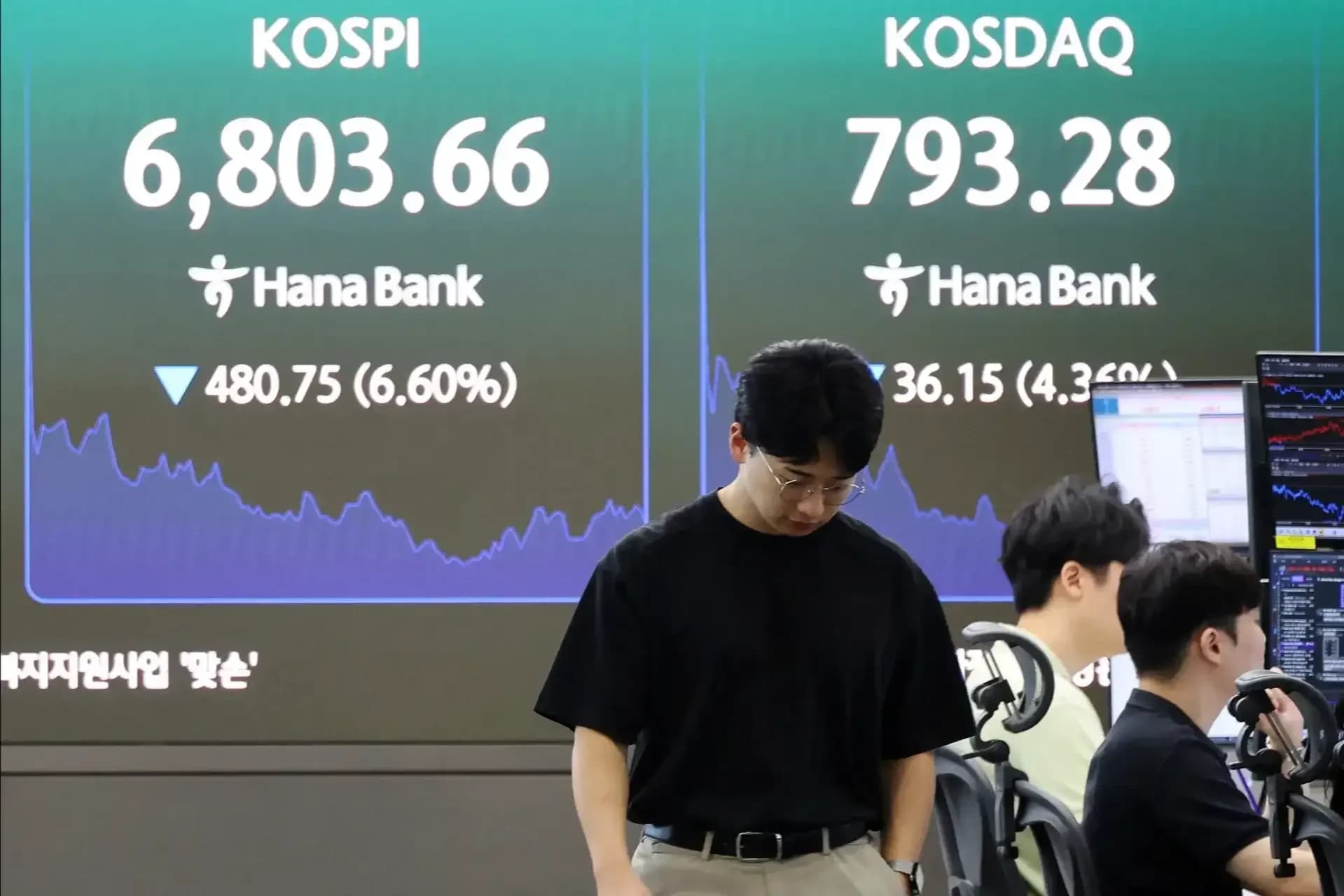
South Korean stocks swung to a significant gain after Samsung Electronics reported better-than-expected earnings and the government announced additional measures to help stabilize the market. The benchmark Kospi Index climbed 4.5% after slumping a combined 16% over the two previous sessions, demonstrating remarkable resilience following the devastating sell-off. However, global institutional investors remain reluctant to return despite the market's attractive valuations. According to Bloomberg, global funds have withdrawn a net $12 billion this month and are rethinking their approach to Korean equities. Pictet Asset Management's Young Jae Lee stated that "the biggest problem for Korea is volatility is too high," noting that "we can't just put [money] into a very gambling type of situation."
The market's extreme volatility is proving too much for global institutional investors to stomach, despite the attractive valuations. The Kospi 200 Volatility Index has surged to 87, more than triple its December level, according to Bloomberg. Robeco's Joshua Crabb acknowledged that "Korea's valuations have come down to attractive levels, but also remains wary of volatility." Fidelity International's Ian Samson noted that "the volatility means that from a portfolio construction perspective, we have to be careful about buying too aggressively." Eastspring Investments' John Tsai cited heavy use of retail margin loans as a key factor, with loan balances falling 14% from the peak to 33.2 trillion won ($23 billion) as of July 28.
South Korean financial regulators announced fresh restrictions after a meeting between Bank of Korea Governor Rhee Chang-yong and the heads of the country's financial watchdogs on Wednesday evening. The new measures include limits on individual investments in single-stock leveraged ETFs and higher trading costs for such products, as announced by the finance ministry. However, analysts question the effectiveness of these new rules, with Kim Jin-wook from Citi Korea suggesting that "a broader market stabilisation mechanism, such as a liquidity support fund, would likely have a greater impact." An anonymous head of research at a Seoul-based brokerage noted that the investment cap was introduced "hastily and was unlikely to significantly reduce volatility." The analyst pointed to Hong Kong's regulatory changes as more effective because they reduced forced selling during market stress, while South Korea's new rules do not require existing investors to reduce their holdings.
The recovery in South Korean markets was primarily driven by strong quarterly results from domestic chipmakers, with Samsung Electronics' semiconductor unit reporting an operating income of 89.2 trillion won in the June quarter, significantly beating analyst estimates. Samsung shares jumped 7% after its semiconductor unit reported operating income of 89.2 trillion won in the June quarter, significantly beating the average analyst estimate of 79.3 trillion won. Group-wide net income came to 71.3 trillion won, also surpassing market expectations. SK Hynix Inc. gained 2.4% after losing almost a quarter of its value in the past two days, contributing to the broader market recovery. According to The Economic Times, SK Hynix was up 2.4%, while Samsung Electronics rose 7%, contributing significantly to the market's upward movement. Despite these strong corporate earnings, Samsung Electronics and SK Hynix together reported quarterly profits totalling about 150 trillion won, or roughly $100 billion, the disconnect between strong fundamentals and severe market declines underscores the scale of the ongoing correction.
The market collapse has intensified political pressure on the government, which had previously supported the strong equity rally. Finance Minister Koo Yun-cheol faced criticism from opposition lawmakers over the introduction of leveraged investment products, with the minister apologizing and acknowledging that the products had been introduced "without sufficient consideration." Public anger has spilt onto the streets, with protesters placing condolence flower wreaths outside the National Assembly in Seoul to criticize the authorities' handling of leveraged investment products. The selloff has overshadowed robust corporate earnings from the country's largest chipmakers, with the market plunging about 40% over the past month, wiping out more than $2 trillion in market value from the benchmark KOSPI since its record high in June. The sharp reversal has disproportionately affected retail investors who borrowed heavily to invest during the rally, including young investors, retirees and households.