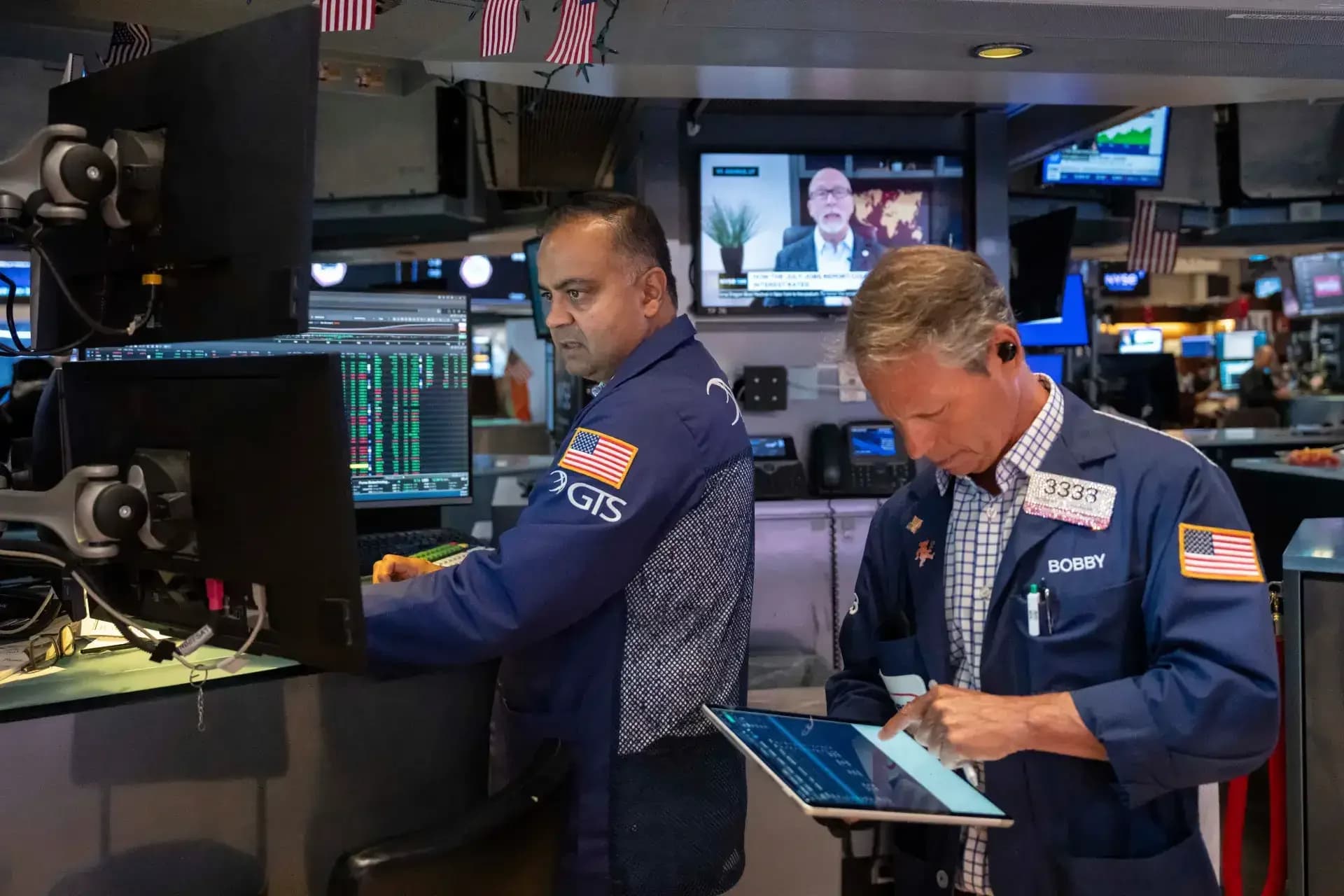
Wall Street investors are closely tracking the Federal Reserve's Jackson Hole economic symposium from August 27-29, which will offer crucial insights into policymakers' discussions when they decided to keep US interest rates unchanged. According to Reuters, the symposium is seen as the next major opportunity for policymakers to provide greater clarity on the outlook for inflation, economic growth and interest rates. Investors are looking less for a specific rate signal and more for a clearer framework from policymakers on how they intend to balance inflation risks with economic growth. The uncertainty has kept markets focused on real Treasury yields, which reflect bond returns after adjusting for inflation and are an important driver of asset valuations. Higher real yields can put pressure on technology stocks and other long-duration assets by raising financing costs and reducing the relative appeal of future earnings. Fed Chair Kevin Warsh's first major speech on Friday, August 28, at 10 a.m. ET, adds another potential volatility catalyst before Labor Day, with markets having been treated to volatility catalysts in recent years from this annual gathering of central bankers.
Quarterly results from major US retailers will provide fresh insights into consumer spending and US economic health during the week ahead. As reported by Reuters, Walmart, Target, Home Depot, Costco, Kroger and Albertsons are among the major retailers scheduled to report their results, along with other companies like BHP Group, Baidu, Lowe's, Alibaba, and Alibaba. These earnings will be particularly important given the recent weak retail sales data that contributed to US stocks retreating from their all-time highs. The retail sector's performance will help investors gauge consumer confidence and spending patterns, which are key indicators of overall economic health. Upcoming results from Walmart and chipmaker Analog Devices are expected to provide further insight into consumer demand and the broader health of the US economy. According to Investing.com, Home Depot and Lowe's should tell us what expensive mortgages and frozen housing turnover are doing to big-ticket home spending, while Target gives a cleaner read on discretionary wallets, and Walmart sits much closer to the centre of the consumption machine. Walmart is expected to post nearly 9% EPS growth and 5% revenue growth, while Target is projected to report 13% higher EPS and 4% revenue growth, with investors focused on comparable sales, e-commerce, digital advertising, and grocery performance.
Investors are entering the next week with renewed focus on corporate earnings to offset concerns over interest rates, inflation, and geopolitical tensions. According to Reuters, around 85% of S&P 500 companies reporting have beaten earnings estimates, with profits up 32.7% excluding mark-to-market gains at Alphabet and Amazon. The S&P 500 reached a record high on Thursday as technology stocks advanced and weaker-than-expected US producer price data boosted expectations that inflationary pressures may be easing. Stocks and the S&P 500 technology index have posted modest gains last week, with investors remaining alert to the possibility of renewed inflation. AI-related infrastructure spending has been a particularly strong theme during the current earnings season, with spending by Big Tech companies on AI expected to exceed $700 billion this year, up from around $400 billion in 2025. Investors have been encouraged not only by earnings and revenue beats but also by upbeat corporate guidance, with relatively few companies issuing negative outlooks. As noted by Investing.com, corporate earnings have become an increasingly important substitute guidance system for the market, and this week the retailers effectively become macro data in their own right. NVIDIA (NASDAQ:NVDA) reports on Wednesday, August 26, with a whopping 50% bottom-line EPS growth rate expected, something normally seen only coming out of a steep profit recession, driven by AI capex, gains on equity securities, and tariff refunds. Multinational corporations also benefited from 2025's "Liberation Day," while higher oil prices for the Energy sector and World Cup spending for consumer stocks contributed to broad-based gains.
Several economic reports are scheduled during the week that could influence Federal Reserve monetary policy expectations. According to Livemint, investors will receive preliminary US purchasing managers' data for August, along with the Empire State manufacturing survey and the Philadelphia Fed manufacturing survey. July industrial production and housing-starts data are also scheduled for release. Additionally, US government bond markets will remain in focus with the Treasury scheduled to auction $16 billion of 20-year bonds on Wednesday, followed by an $8 billion sale of 30-year Treasury Inflation-Protected Securities (TIPS) on Thursday. The economic calendar includes reports on Empire State Manufacturing Survey for August, Housing Starts for July, Industrial Production for July, and US Flash PMIs for Manufacturing and Services for August. As reported by Investing.com, housing starts for July is forecast to decline by 8.0%, reflecting payback from last month's outsized increase in multi-family housing starts, while housing permits are expected to show a modest increase of 0.1%. The week will conclude with preliminary August readings for the manufacturing and services PMIs, which may influence expectations for the Fed's next steps and set the tone for discussions ahead of the Jackson Hole symposium. July CPI rose just 0.1% last month, bringing the annual rate to 3.4%, with core CPI increasing by 0.2%, while core CPI over the previous 12 months was verified at 2.5%, matching January and February for the lowest since March 2021. Wholesale prices were flat in July with a significant 0.7% drop in goods prices, though core PPI rose 0.4%, and Wall Street economists predict a 0.22% uptick in the core PCE Price Index. Implied odds of a September Fed rate hike eased following the dovish data, with traders now seeing roughly a 30% chance of a September rate increase, down from about 52% a week earlier.
US stocks opened mixed and little changed on Monday as investors weighed the risk of renewed tensions between the US and Iran and prepared for the Federal Reserve's latest meeting minutes and earnings reports from major retailers. According to Investing.com, the Dow Jones Industrial Average fell 69.3 points, or 0.13%, to 53,663.11, while the S&P 500 rose 4.9 points, or 0.06%, to 7,790.68, and the Nasdaq Composite gained 55.5 points, or 0.21%, to 26,784.65. Wall Street ended last week mostly higher, reaching a new record as softer inflation data reduced expectations of a Federal Reserve rate hike in September. According to the CME FedWatch Tool, traders now see roughly a 30% chance of a September rate increase, down from about 52% a week earlier. Oil prices extended last week's strong gains on Monday, supported by uncertainty over Middle East diplomacy and the effective closure of the Strait of Hormuz, with Brent crude up 0.5% at $89.00 a barrel and US West Texas Intermediate futures rising 0.4% to $82.70. The US dollar fell 0.3% to a more than two-month low of 99.33 as weaker US economic data—including contracting July payrolls, subdued inflation, flat producer prices, and a 0.6% retail-sales decline—prompted traders to reduce expectations for further Fed rate hikes. Despite potential complications from oil prices and geopolitical developments, many investors see corporate America as the strongest current defense against broader risks, with earnings strength continuing to outweigh macroeconomic uncertainties. The Cyclospora outbreak has taken its toll on names like Sweetgreen and Yum! Brands, while Chipotle has been stung by reduced burrito demand following the multi-state jalapeño Salmonella outbreak, though these may be one-offs. Papa John's International suspended its dividend on August 6, sending shares tumbling 17%, which stood out within the Consumer Discretionary sector amid a light year for dividend cuts.