
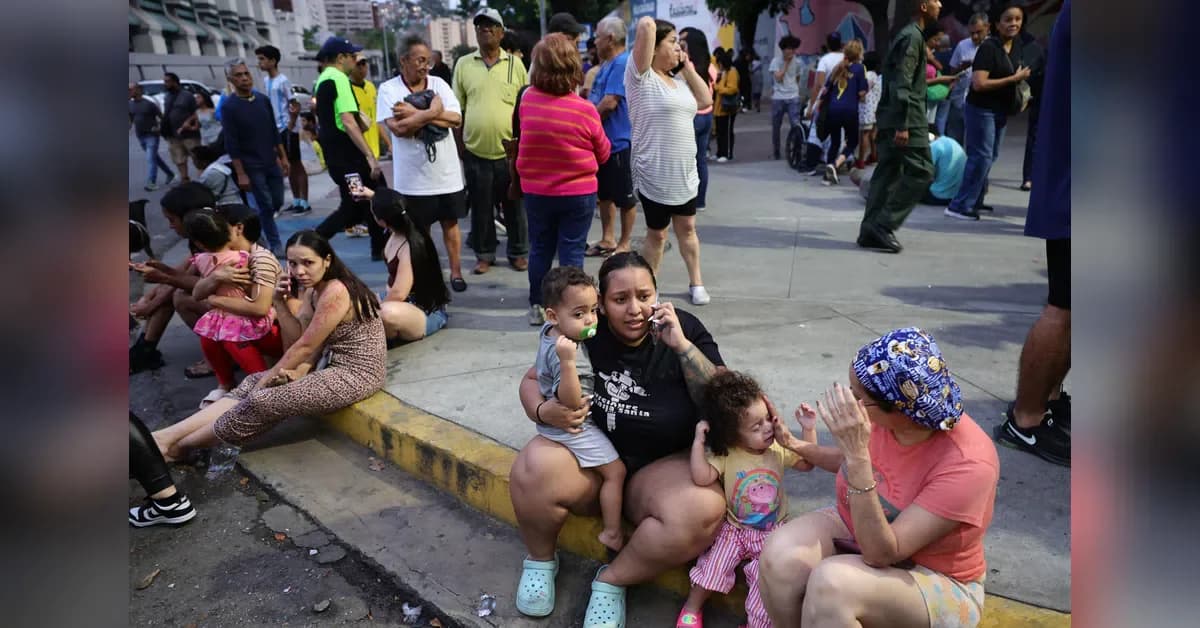
A magnitude 7.2 earthquake struck Wednesday evening and was followed less than a minute later by a magnitude 7.5 quake, according to the US Geological Survey. The temblors were centered northwest of the industrial city of Valencia in Yaracuy state, causing widespread destruction across Venezuela. As reported by BBC News Mundo, the natural disaster has killed at least 235 people and injured more than 4,300 others, with thousands reported missing as of Thursday afternoon. The disaster has severely impacted emergency response capacity in a country already struggling with years of political and economic turmoil. The US Geological Survey estimates the potential loss of life at more than 10,000, though this toll could increase significantly as rescue efforts continue.
The earthquakes caused extensive material damage, with some 250 buildings damaged in the hard-hit state of La Guaira on the central coast. According to BBC News Mundo, "dozens" of buildings have collapsed in the most affected state, with before-and-after pictures showing a 10-storey hotel reduced to rubble. Simón Bolívar International Airport in Maiquetia was severely damaged, forcing it to close and making rescue operations more challenging. The twin quakes impacted at least five other Venezuelan states, with many places experiencing outages of electricity, water and gas supply amid continued aftershocks. The government has created an initial $200 million reconstruction fund using International Monetary Fund resources to finance repairs to infrastructure, hospitals and housing.
By Thursday afternoon, planes with help from the US, Spain, Mexico, Qatar and the UN had already departed toward Venezuela, as reported by BBC News Mundo. Rescue teams were expected to arrive from countries including Colombia, Panama, Dominican Republic, and El Salvador. President Donald Trump said the US stands ready to help, with the US Treasury Department issuing a license authorizing all earthquake relief transactions that would otherwise be prohibited by sanctions. The US is mobilizing $150 million in aid, with search-and-rescue teams, medical resources and humanitarian assistance being deployed to Venezuela. Germany said it's ready to deploy up to six military aircraft to help with relief efforts, while El Salvador President Nayib Bukele said 300 rescuers and paramedics, along with 50 tons of equipment, medicines and essential supplies, were ready to depart for Caracas. US Secretary of State Marco Rubio said the US response would be "big, fast and effective."
The disaster will place further strain on Venezuela's oil-based economy, which is already grappling with one of the world's highest inflation rates and recurring power outages. According to BBC News Mundo, there were no immediate reports of extensive damage to Venezuela's oil facilities, with the country's refining hub in Paraguana continuing to operate normally. Chevron Corp., the leading private-sector oil producer in Venezuela, said its business remains operational and all employees are accounted for. Most ports continued to operate, though some oil loadings were suspended at the El Palito terminal in Carabobo state.
Bonds issued by the government and state-owned oil company Petróleos de Venezuela SA fell across the curve amid concerns around the nation's emergency response capacity and economic impact. As reported by Business Standard, sovereign notes due in 2031 were down by 1.3 cents on the dollar in afternoon trading on Thursday, falling below 54 cents. The industrial chamber Conindustria said damage assessments are underway, while people across Venezuela were frantically searching for missing relatives with social media filling with photographs and appeals for information.
