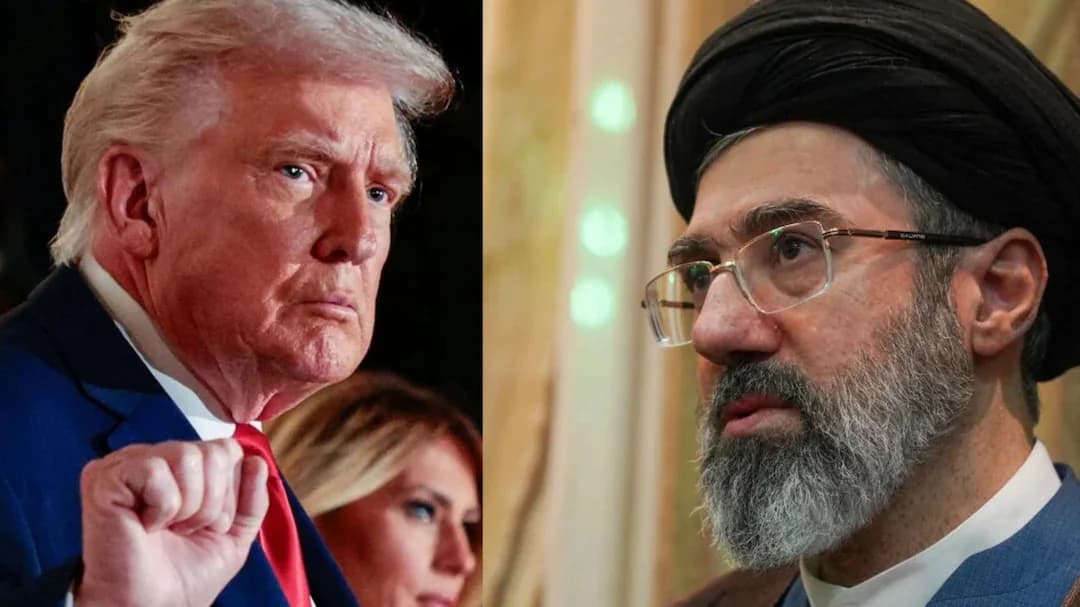
The White House on Wednesday called Iran's supposed draft proposal for peace a 'complete fabrication' as President Donald Trump met with his Cabinet to work on a deal. 'This report from Iranian-controlled media is not true, and the MOU they're released is a complete fabrication,' the White House Rapid Response team stated on X. 'Nobody should believe what Iranian state media is putting out. FACTS MATTER.' The rejection comes after Iran's state broadcaster, IRIB, reportedly claimed the draft memorandum of understanding included an agreement for the US to withdraw its naval blockade, while Tehran would allow shipping traffic to return to prewar levels within a month of implementation. However, the reported proposal does not appear to mention Iran's nuclear program or its stockpile of highly enriched uranium — a key issue for the Trump administration.
US forces conducted defensive strikes against Iranian targets on Wednesday, shooting down four Iranian attack drones in the Strait of Hormuz and striking a launch site in Bandar Abbas. As reported by Fox News, War Secretary Pete Hegseth stated that the US is prepared to 'finish the job' if negotiations with Iran fail to prevent Tehran from obtaining a nuclear weapon. Hegseth emphasized that 'So whether it is through the efforts of your negotiators that they ensure that they never have a nuclear weapon, or we have to go back to the War Department to finish the job that way, we're prepared to do that.' The strikes come as US-Iran peace negotiations remain deadlocked and fresh exchanges of fire continue to rattle a fragile ceasefire, with Iran calling recent US actions 'gross violations' of the agreement.
Despite military tensions, President Trump said Wednesday that Iran is 'negotiating on fumes' and accused Tehran of abusing delay tactics to 'outwait' him on denuclearization. According to Fox News, Trump stated that 'Iran is very much intent, they want very much to make a deal – so far they haven't gotten there.' The president emphasized that 'Either that or we'll have to just finish the job' if diplomatic efforts fail. Secretary of State Marco Rubio indicated there has been 'some progress and some interest' in negotiations, but warned that 'the next hours and days will determine whether diplomacy can succeed.' The economic pressure is mounting, with Iran running dangerously low on oil storage capacity and potentially facing a 'point of no return' in 4-6 weeks according to former Energy Secretary Dan Brouillette.
The US has implemented a 'world-class blockade' that has prevented Iran from bringing anything in or out through its ports, as reported by Fox News. War Secretary Hegseth credited Operation Epic Fury for bringing Tehran to the negotiating table, stating that 'And in the during that time we put in a world-class blockade and they haven't been able to bring anything in or anything out from Iranian ports – and we know from the Intel, that they are their economy is hurting big time because that is their lifeblood.' The USS Abraham Lincoln continues conducting daily flight operations in support of ongoing US military missions across the Middle East, with USS Central Command reporting 109 commercial vessels have been redirected under the blockade. Iranian officials have accused the US of 'gross violations' of the ceasefire and expressed 'zero trust' after recent attacks on southern Iran.
Iran's military posturing continues despite mounting pressure, with the Islamic Revolutionary Guard Corps warning Wednesday that its forces are 'lying in wait' if President Trump restarts combat operations. As reported by Tasnim news agency, Mohammad Akbarzadeh, deputy political chief of the Islamic Revolutionary Guard Corps Navy, stated that 'The possibility of war is low because of the enemy's weakness; the armed forces are lying in wait with full magazines.' Iranian officials have also accused the US of 'gross violations' of the ceasefire and expressed 'zero trust' after new attacks on southern Iran. The Iranian state TV reported that a draft framework for a potential agreement would require US military forces to withdraw from the vicinity of Iran and lift the naval blockade, while Iran would commit to restoring commercial transit ships moving through the Strait of Hormuz to pre-war levels within one month.
Oil prices experienced significant volatility following the latest developments, with Brent crude falling more than 5% after Iranian state TV reported a potential deal framework. According to CNBC, Brent crude futures climbed to about $96.20 per barrel, up roughly 1.27%, while West Texas Intermediate (WTI) futures gained 1.16%, rising to $90.64 per barrel from around $89.60. The market reacted to both the potential deal framework and increased tanker traffic through the critical waterway. President Trump said Wednesday that gas prices will 'come down a lot' after being pressed on economic pressure to reopen the Strait of Hormuz, telling FOX Business that 'It'll come down to where it was before' and predicting prices would return to lower levels 'shortly after that whole excursion ends.'