Wall Street analysts are drawing a clear line between two of AI's biggest stock winners, with 43% upside potential for Nvidia versus 16% downside risk for Micron Technology. According to latest analyst data, 69 analysts covering Nvidia see $300 price target, representing a 43% increase from current levels near $210. In contrast, 49 analysts on Micron call fair value just $949, roughly 16% under today's price of $1,133. The consensus reflects structural differences between the companies' competitive positions in the AI infrastructure market.
AI infrastructure has emerged as one of the clearest revenue-growth engines in the technology market, driven by the buildout of compute, storage, memory, networking, power, cooling, and data-center capacity needed to train and run increasingly large AI models. According to IDC, global AI infrastructure spending is expected to reach $487 billion in 2026, representing a 53% year-over-year increase, even after the market's unusually sharp expansion in 2025. Gartner has also forecast worldwide AI spending to rise 47% in 2026, with AI-optimized servers and broader infrastructure buildouts accounting for a major share of that growth. The scale of the investment cycle is now large enough to reshape several hardware and industrial supply chains at once, with Dell'Oro Group expecting global data-center capital expenditure to approach $1 trillion in 2026 and reach $1.7 trillion by 2030.

NVIDIA Corporation (NASDAQ:NVDA) powers nearly 90%+ of AI training compute globally and delivered exceptional growth with revenue of $81.6 billion, up 85% year-over-year, while data center revenue rose 92% to $75.2 billion in its fiscal Q1 2027 results. The company's next-generation Vera Rubin GPU platform is set to ship later this year, with CEO Jensen Huang telling analysts that every major frontier model company will adopt it immediately. Despite that momentum, Nvidia trades at 32 times earnings, essentially its cheapest valuation in seven years, with Wall Street forecasting adjusted earnings growth of 43% annually through fiscal 2029.
The skepticism on Micron Technology stems from memory chips being commodities, with products from different manufacturers being largely interchangeable, leaving Micron without a durable competitive advantage. Industry leaders Samsung and SK Hynix both gained DRAM and NAND market share at Micron's expense in the most recent quarter, with their larger production capacity giving them a structural edge. The HBM memory boom is expected to peak around 2028, after which sales are projected to drop sharply. According to The Motley Fool, Micron's adjusted earnings are forecast to grow at 13% annually through fiscal 2029, with the company trading at 48 times earnings that trajectory makes the current valuation look stretched against Nvidia's cheaper multiple and faster growth outlook.
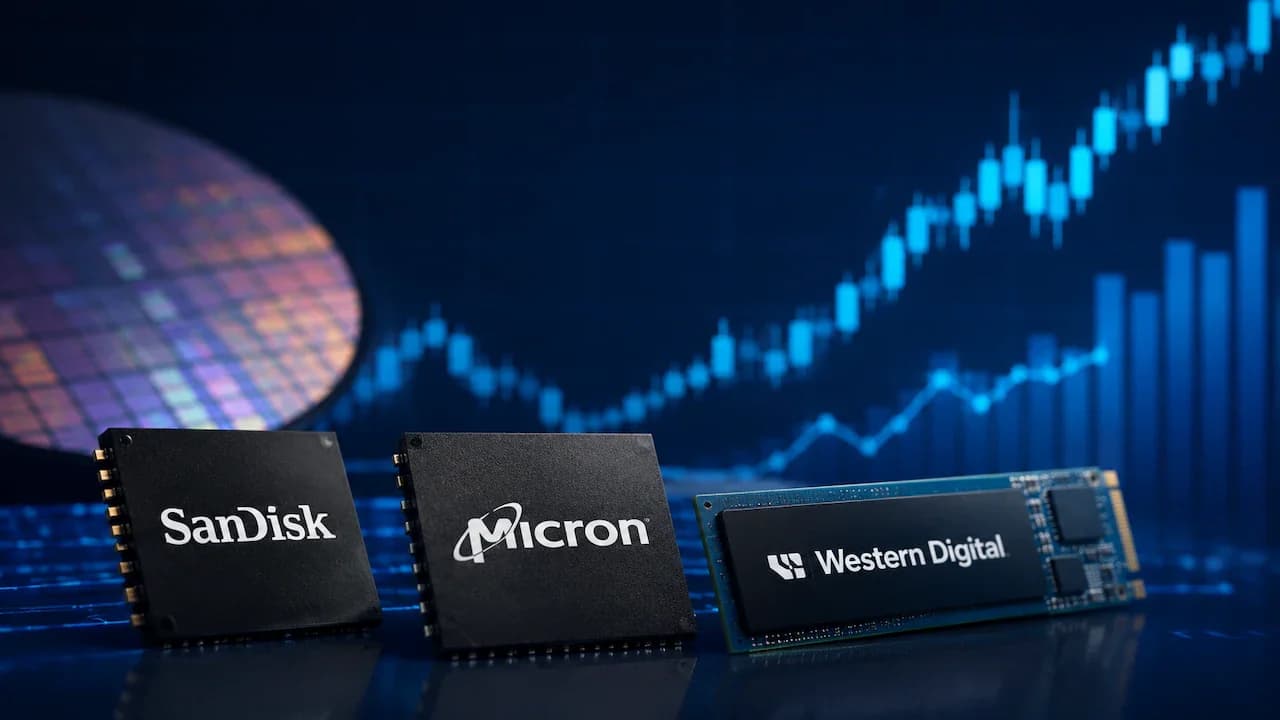
Two major stocks—Sandisk and Western Digital—even gained more than tenfold during this period. As reported by The Economic Times, this exceptional performance highlights the magnitude of the AI infrastructure investment wave that has swept through the technology sector. The market analysis suggests there is a great near-term buying window for many of the high-flying memory and other technology stocks, with the last correction in AI-related stocks lasting only four trading days. The analyst community has revised consensus earnings estimates up 4.8% in the past month, which typically precedes future earnings surprises. With average AI and data center stocks having a 3-year order backlog, the sector is expected to deliver spectacular performance through 2029, with Nvidia fundamentally superior stocks potentially up 80% to 100% by year-end.