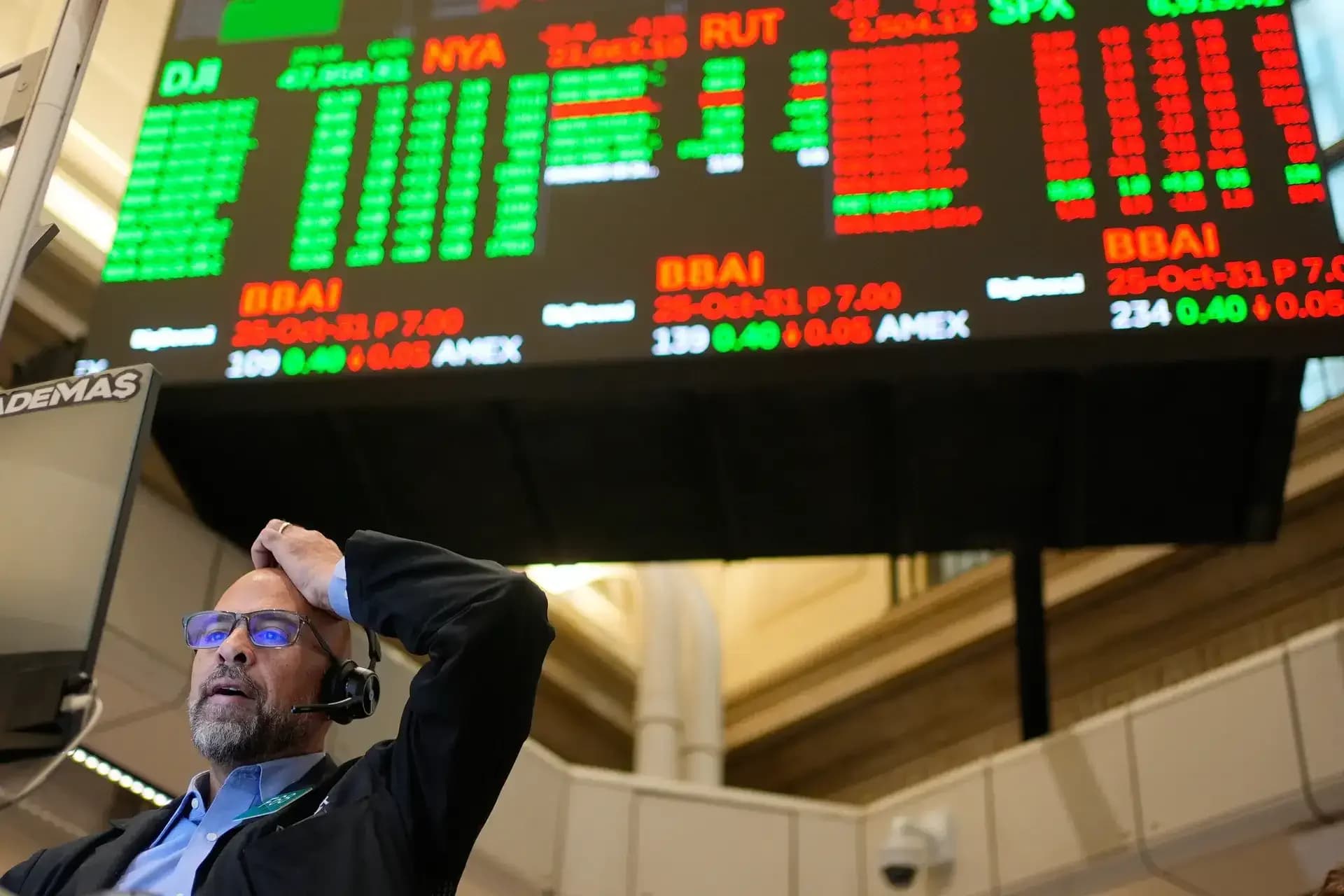
US equity markets displayed contrasting performance on Tuesday, with the Dow Jones Industrial Average achieving a new record close of 51,999.67, marking its third consecutive record close and scoring a new all-time intraday high of 52,190.29. According to latest reports, the Dow Jones gained nearly 328 points, or 0.6%, to set a record for the second straight day, with the index having gained over 2,000 points during its four-day winning streak. The S&P 500 declined 0.6% on Tuesday, while the Nasdaq fared worse, ending with losses of 1.2% dragged lower by chip stocks. The divergent performance was primarily driven by investor rotation out of technology stocks and into cyclical sectors, with the Dow outperforming the tech-heavy Nasdaq by nearly 1.5 percentage points as oil prices continued their decline. The Dow's record performance was boosted by old economy stocks as investors rotated away from chipmakers and into sectors benefiting from lower energy costs. Investor confidence was further bolstered by news of a tentative peace agreement between the United States and Iran, which is expected to restore stability to energy supply chains and reopen the Strait of Hormuz.
Technology stocks faced significant selling pressure throughout the trading session, with chip stocks suffering substantial losses as the rotation away from technology continued. According to latest reports, Nvidia declined 2.4%, Broadcom fell 4.4%, and Micron Technology dropped 6.2%, representing the heaviest weights pulling the S&P 500 lower. The PHLX Semiconductor Index (SOX) slumped nearly 6%, erasing all of Monday's gains, while mega-cap tech stocks were mixed, with shares of Alphabet (GOOG), Apple (AAPL), and Meta (META) each rising about 1%, and Amazon (AMZN) finished Tuesday's session flat. The technology weakness came despite earlier gains from SpaceX shares, which rose 4.8% for its third straight gain since its debut on the U.S. stock market, as the company announced it's moving forward with its purchase of Cursor, a popular AI coding assistant, valuing it at $60 billion. SpaceX had at one point surpassed both Microsoft and Amazon in market cap during the session, with the company's stock up 60% from its IPO price of $135 per share and trading at $2.72 trillion market cap compared to Amazon's $2.65 trillion. SpaceX briefly overtook Microsoft as the fourth-largest company by market capitalization, though it has since slipped back to fifth position, with the company's stock up 60% from its IPO price of $135 per share and trading at $2.72 trillion market cap compared to Amazon's $2.65 trillion. SpaceX announced before market open on Tuesday that the company has agreed to acquire Cursor, in a deal that will value the AI coding start-up at $60 billion, contributing to the underperformance of the S&P 500 and Nasdaq recently as investors chose to take profits from the SpaceX listing to invest in Elon Musk's trillion-dollar startup.
Oil prices sank again Tuesday and dropped below $80 per barrel for the first time since early March, with Brent crude futures falling 5.1% to settle at $78.96 per barrel. As reported by Business Standard, this marked the first settle below $80 a barrel for both benchmarks since early March. The oil price decline offered significant support to equities despite the broader market weakness, with investors betting that lower energy prices will spur a re-acceleration in the U.S. economy. The oil price movement came as markets began pricing in the Strait of Hormuz reopening, with President Trump and his team offering optimistic assessments that the strait will be demined and fully reopened by Friday. However, significant hurdles remain in the negotiations, including what to do with Iran's nuclear program, and the hope on Wall Street is that this agreement will mean a long-term fix to a conflict that has worsened inflation around the world. The price of Brent has come down sharply from its $100-plus level of a few weeks ago, though it could still take months for the energy industry to get back to full speed. The nearly 5% decline in oil prices impacted the energy sector, notably dragging down shares of major firms like Exxon Mobil while boosting fuel-sensitive industries like cruise lines.
Market participants are widely expecting the Federal Reserve to hold interest rates at the current 3.50% to 3.75% range when the policy update is released on Wednesday afternoon. As reported by Business Standard, the Federal Reserve began its own meeting on what to do with interest rates Tuesday, with its the first meeting under the Fed's new chair, Kevin Warsh who was nominated by President Donald Trump. Trump has been pushing for lower interest rates, which would give the economy a boost but also threaten to worsen inflation. The widespread expectation, though, is that the Fed will leave its main interest rate alone again, with the street awaiting commentary from new Fed Chair Kevin Warsh and the Fed dot plot. Economists warn that if Warsh does not participate in the dot plot projections, something he has been vocally against as he believes it limits the Fed's decision-making ability, it will send a wrong signal to the markets. The Fed is widely expected to leave interest rates unchanged tomorrow, but investors will be eager for clues as to how policymakers are thinking about resurgent inflation.
U.S. government bond yields retreated significantly on June 16, with the 10-year Treasury yield falling to 4.43% from 4.47% late Monday and from 4.56% earlier this month. The downward movement reflects easing pro-inflationary concerns following the Middle East peace announcement, providing some relief for mortgage rates and broader borrowing costs. The bond market's response to the geopolitical developments suggests that investors are pricing in reduced inflationary pressures from the de-escalation of Middle East tensions. This treasury yield decline provides additional support for equities as investors reassess the inflation outlook and its impact on monetary policy expectations. High yields in bond markets worldwide caused by expensive oil prices have threatened to slow economies and undercut prices for all kinds of investments including stocks and crypto currencies. High yields have already sent mortgage rates higher and a report on Tuesday said construction crews broke ground on far fewer new U.S. homes in May than economists expected.