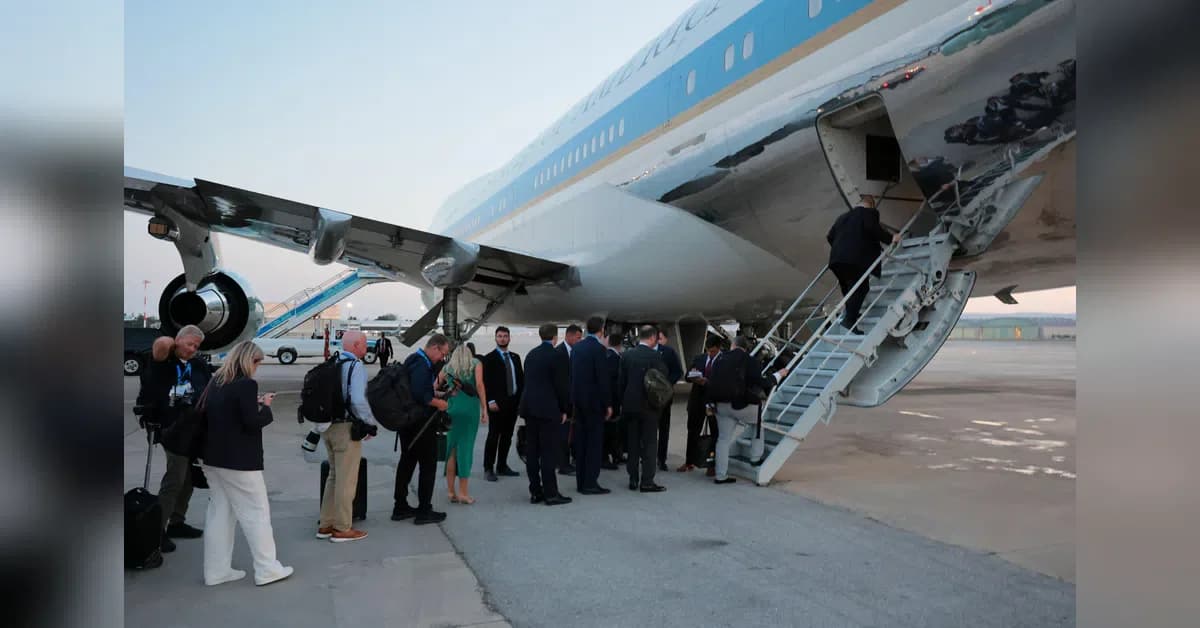
The USS George Washington is departing the Pacific and expected to replace the USS Abraham Lincoln in the Middle East amid growing concerns about mental health and supply issues aboard the long-deployed carrier. According to reports from NDTV, the Lincoln has had its time at sea extended from its original May return date to support operations against Iran. The lack of a US carrier in the Pacific may be short-lived if the Navy deploys another in the next couple of months, but it shows how the open-ended operations with Iran are running some American sailors ragged. As reported by Associated Press, Trump has relied heavily on aircraft carriers to support military operations during his second term, with the Ford returning home in mid-May after the longest deployment since the Vietnam War.
As reported by NDTV, Greg Poling, director of the Southeast Asia Programme at the Centre for Strategic and International Studies, noted that "the administration says that the Pacific is supposed to be the most important behind the Western Hemisphere," but instead, the US is "doing the exact opposite" of its previously expressed goal of pulling out of the Middle East. American allies in the Pacific are unsettled over the unpredictability of the Republican administration, while Beijing "is quite happy with US distraction, with the frustration of US allies and partners." According to Associated Press, Evan Sankey, a policy analyst at the Cato Institute who focuses on U.S. policy toward China, said aircraft carriers provide psychological assurance to U.S. allies, and the absence of carriers in the region "adds to the general sense that the U.S. is distracted by events in the Middle East."
According to NDTV, China conducted naval exercises this week with Indonesia and recently has shown signs of aggression toward Japan and the Philippines, two key US allies that also have territorial disputes with Beijing. China carried out military drills this month near the Scarborough Shoal in the South China Sea, where both China and the Philippines have claims. Last month, a Chinese guided-missile destroyer conducted a live-fire exercise off Japan's southernmost island of Okinotori. As reported by Associated Press, Bryan Clark of the Hudson Institute noted that "they're using this as part of the narrative to demonstrate to the Philippines, to Japan, to Indonesia and others that the U.S. is not the big dog in the western Pacific anymore." Clark explained that "they would just prefer that countries in the region decide that China is the bigger power and the U.S. is not able to guarantee their security anymore."
As reported by NDTV, the USS Gerald R. Ford returned home in mid-May after an 11-month deployment, the longest since the Vietnam War, during which it supported the US fight against Iran and the capture of Venezuela's then-leader, Nicolás Maduro. The Ford had experienced a fire in a laundry space that forced the carrier to turn around and return to the Mediterranean Sea for repairs, leaving hundreds of sailors without places to sleep. Meanwhile, the Lincoln has spent a record uninterrupted time at sea of more than 240 days. According to Associated Press, Robert Farley of the University of Kentucky noted that "people don't get enough rest. It's psychologically exhausting. And R&R is part of keeping the crew healthy." Democratic politicians have been calling for investigations and greater visibility into conditions aboard the ship.
According to NDTV, Michael Swaine, a senior research fellow in the Quincy Institute's East Asia Programme, questions the future need for aircraft carriers as warfare rapidly changes, noting that carriers can be more easily targeted with drones and missiles. Top Navy officials have indicated a desire to move away from heavy reliance on carriers, with Adm. Daryl Caudle, chief of naval operations, telling The Associated Press in February that he wants to convince commanders to use smaller, newer ships and other assets instead of consistently turning to huge aircraft carriers. As reported by Associated Press, Clark noted that "we'll end up with a maintenance debt that needs to be paid for the next few years" and "we'll probably have less carrier presence than we've had in the previous years because carriers will be lined up to get into the shipyard."