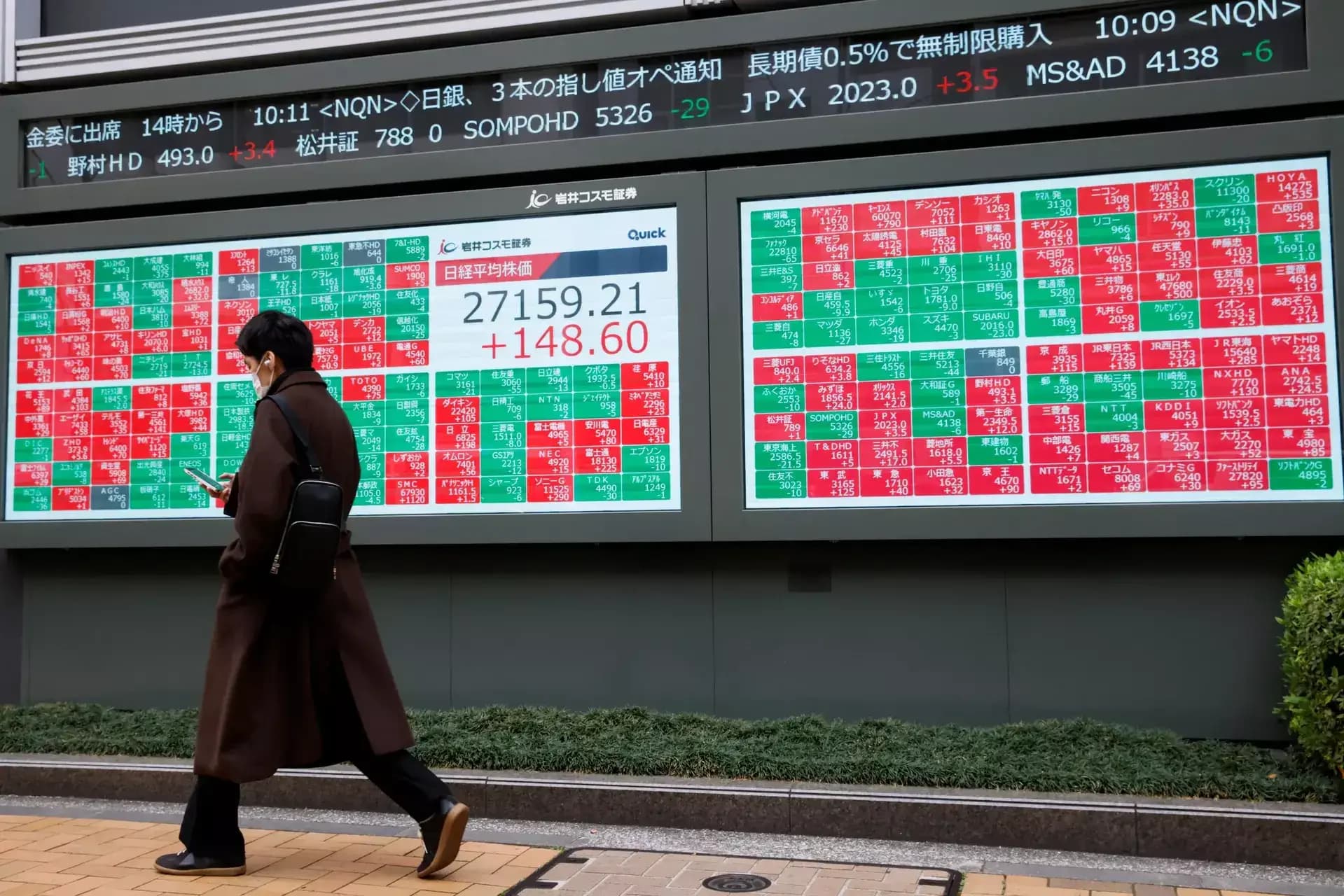
Wall Street futures remained steady following the S&P 500 and Nasdaq's record-breaking performance, according to reports from Investing.com India. The Nasdaq 100 ETF (QQQ) has demonstrated remarkable resilience, with an investment of $10,000 in March 2000 growing to approximately $61,650 today, representing a 516% return or 7.2% annual growth. This performance spans major economic events including the dot-com bubble, 9/11, the 2001-2002 recession, Global Financial Crisis, COVID-19 pandemic, and geopolitical tensions including the Russia-Ukraine war and ongoing Middle East conflicts. Recent market reaction to geopolitical and AI-related events had remained muted until the outbreak of the war in the Middle East, as reported in the ECB's Financial Stability Review, May 2026. Global stocks extended a rally as investors remained optimistic that peace talks between the U.S.-Iran are progressing, despite a fresh exchange of strikes earlier this week, with market moves in response to the Middle East conflict being orderly but reflecting complacency amid increased uncertainty about the economic outlook.

The AI debt wave has transitioned from an equity market narrative to a defining force in fixed income, with hyperscalers shifting from internal cash flows to substantial bond issuance to fund massive data center, GPU, and power infrastructure buildouts. In 2025, the five major hyperscalers issued approximately $121 billion in U.S. corporate bonds, more than four times their 2000-2024 annual average of $28 billion. Early 2026 data show continued momentum, with projections for hyperscaler net supply rising 30-50% to $130-150 billion. Overall U.S. IG gross issuance is forecast to hit record levels between $1.8 trillion and $2.25 trillion, with AI-related deals representing a material share. Wall Street estimates center on $300 billion in AI-related IG supply for 2026, potentially delivering $360 billion in 10-year duration equivalents.
The MSCI Emerging Markets Index has become increasingly concentrated, with Samsung and SK Hynix together comprising roughly 13% of the index, as reported by Global Markets Investors and Bloomberg Opinion. SK Hynix alone now carries a weighting that rivals Tencent and Alibaba combined, after more than doubling in market value this year alone. When combined with TSMC, these three chipmakers represent over 25% of the entire index, having driven more than 70% of its gains in 2026. This concentration mirrors the late 2020 situation when Chinese stocks reached over 40% of the same index, which subsequently crashed in February 2021, dragging the broader emerging markets index into a 15-16 month bear market. Non-bank portfolio valuations remain elevated and concentrated in US equities despite recent price declines and foreign exchange losses in 2025, as noted in the ECB's Financial Stability Review, May 2026.
Turkey offloaded nearly all its U.S. Treasury holdings in March, reducing them from $16 billion to just $1.8 billion, representing a reduction of approximately 89%, according to Hedgeye analysis. The trigger was the Middle East conflict and oil price spike, as Turkey's heavy dependence on imported energy deepened its current-account deficit and pressured the currency. The Turkish central bank hiked overnight rates to 40% as the lira came under severe pressure, with USD/TRY trading in the 44.5-45.6 range. Notably, Turkey reportedly sold both Treasuries and gold reserves simultaneously, indicating acute financial distress rather than routine reserve management.
April data reveals a broad slowdown in Chinese domestic demand, with car retail sales falling 15% year-over-year, marking the sharpest decline since mid-2022, according to China's National Bureau of Statistics. Overall retail sales rose by just 0.2% YoY in April, the weakest reading since December 2022. Fixed-asset investment also fell 1.6% over the first four months of 2026, moving back into contraction territory. This suggests China's GDP growth could slow to around 4.1% YoY in Q2 2026, below Beijing's official 4.5%-5.0% growth target, with both consumer demand and investment under pressure. However, China's industrial firms reported stronger profit growth at the start of the second quarter, supported by rising energy prices and resilient overseas demand for technology products despite the broader economic slowdown.