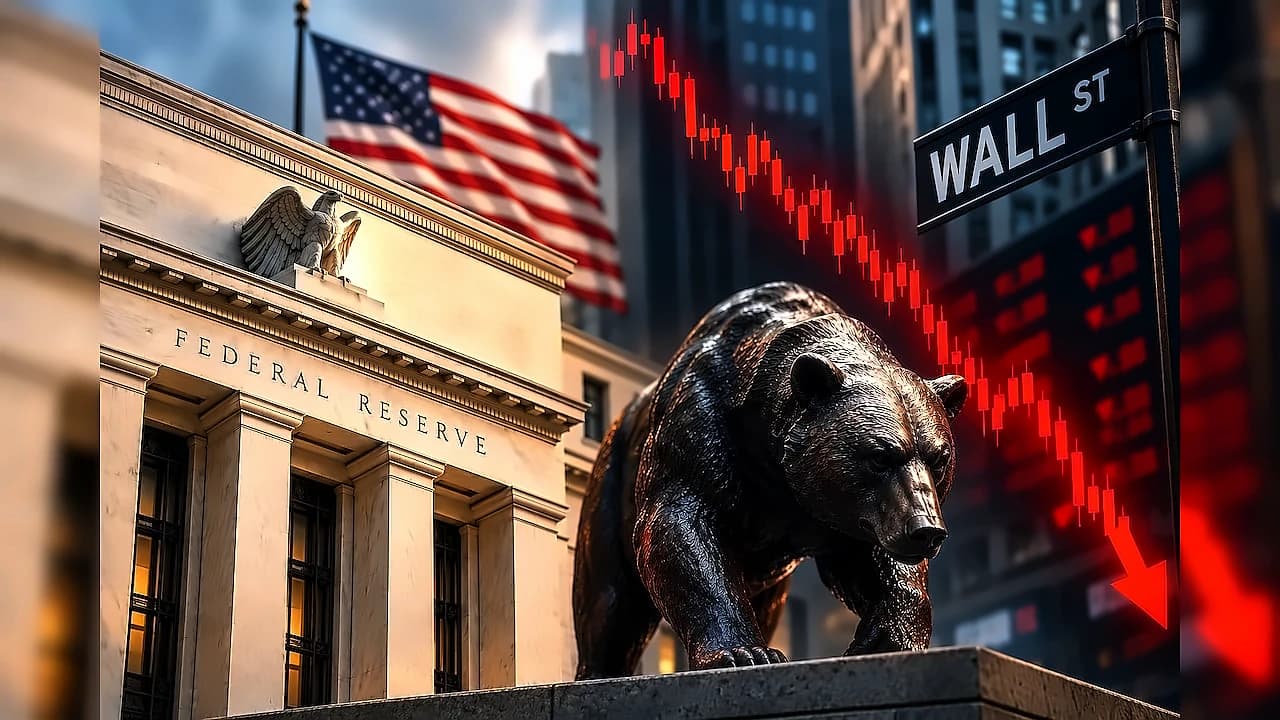
The Federal Reserve delivered its first rate hike in three years on Wednesday, with the 10-year Treasury yield climbing above the psychologically key threshold of 5% and US crude rising above $100 per barrel as markets responded to the decision. According to Reuters, the rate increase was widely expected by investors, though uncertainty remains about the Fed's future hiking trajectory. Fed funds futures suggest roughly even odds that the central bank will raise rates again at its next meeting in October, just before the US midterm elections. The decision was viewed as a credibility test for new Fed Chair Kevin Warsh, who was picked by President Trump, with investors now watching for signs of the central bank's plans for this hiking cycle. As Bloomberg macro strategist Simon White argues, trouble would really start if the US 10-year Treasury yield rose above 5.25%, which he calculates as the "inflection point" where historically stocks and bonds have reinforced losses in one another. John Higgins, chief economic adviser at Capital Economics, notes that while he isn't convinced 5% is the "magic" number, higher Treasury yields would certainly pose risks to the sustainability of US public finances as well as threaten equities.
Historical data reveals concerning patterns for investors following Fed rate hikes, with the 10-year Treasury yield crossing 5% when markets closed on September 16, marking the highest level since July 2007. According to The Motley Fool, examining five Fed rate-hike cycles over the past 30 years shows that the first rate hike in these cycles was followed by significant market declines within three months. In March 1997, the S&P 500 fell as much as 7% within three months, with the Nasdaq dropping 4% and the Dow declining 7%. The June 1999 cycle saw the S&P 500 fall 8% while the Nasdaq and Dow each declined 7%. The March 2022 rate hike cycle saw an even larger decline, with the S&P 500 falling as much as 17%, the Nasdaq dropping 22% and the Dow declining 13% within three months. This historical pattern suggests that higher interest rates can put pressure on stocks as borrowing becomes more expensive across the economy, with consumers and businesses potentially reducing spending and investments.
The US dollar index closed near 100.21 on September 18 after touching a seven-week high around 100.56, gaining over 1% during the week. The dollar is receiving support from strong US growth, Treasury yields near 5%, and demand from safe havens. The U.S. dollar index gained nearly 1% to close last week at 100.20, with the index producing a strong rebound from the 50-week SMA. A confirmed break above 101.80 will open the way for a strong rally toward the 106-107 range, defined by the descending trend line that stretches from September 2022 high. Other central banks are also facing inflation pressure - the ECB raised the deposit rate to 2.50% and the refinancing rate to 2.65%, expecting inflation of 3.0% in 2026 but growth of only 0.9%. The Bank of Japan raised the overnight rate to 1.25% on September 18 as energy prices, wages and yen weakness increased inflation risks. Australia has held the rate at 4.35% after several increases in 2026, while China kept the one-year loan prime rate at 3.00% with consumer inflation only 0.8% in August.
Investors are closely monitoring an anticipated visit by Chinese President Xi Jinping to the US, including a meeting with Trump expected on Thursday. Among issues between the two countries, investors said the AI development race and restrictions involving semiconductors could impact markets, especially technology shares. The tech sector accounts for 38% of the S&P 500 and has gained over 20% in 2026, though it has lost ground since the start of June. One popular measure used by investors to assess whether a market is overvalued – the CAPE ratio – has risen to its highest level since 2000, showing that the US stock market is unusually highly valued compared with its profits. However, there are signs that AI is beginning to power economic growth, with the US economy recording a rise in productivity growth, while AI is also among reasons the UK economy has beaten expectations to grow at the fastest rate in the G7 in the first half of this year. Industry leaders have called for a slowdown in AI development following dire warnings about the dangers of the emerging technology, with slowdown worries modestly weighing on semiconductor companies at the center of the AI boom.
The S&P 500 index is 3% below an all-time high, with a combined value of more than $20tn for the "magnificent seven" tech stocks – Nvidia, Apple, Google, Microsoft, Meta, Amazon and Tesla. According to Société Générale senior analyst Albert Edwards, these are febrile times as the key worry is the extent to which the current oil price shock will ripple through the global economy. South Korea's army of traders have been buying shares in AI-linked chip makers on margin – doubling the value of the blue-chip Kospi index, but once the market started to fall, they were hit by massive margin calls. According to Goldman Sachs, 1.2 million South Korean retail investors were hit by margin calls – which is the equivalent of one in 30 adults getting a nasty call from their broker asking them to hand over more money. The huge spending plans announced by AI companies are causing concerns that they may simply borrow too much to fund datacentres. Markets have a habit of falling, or even crashing, before a recession begins, and often start to recover before the economy does, though the big concern among investors is that the main hope of economic redemption – AI – could also turn out to be a dud.