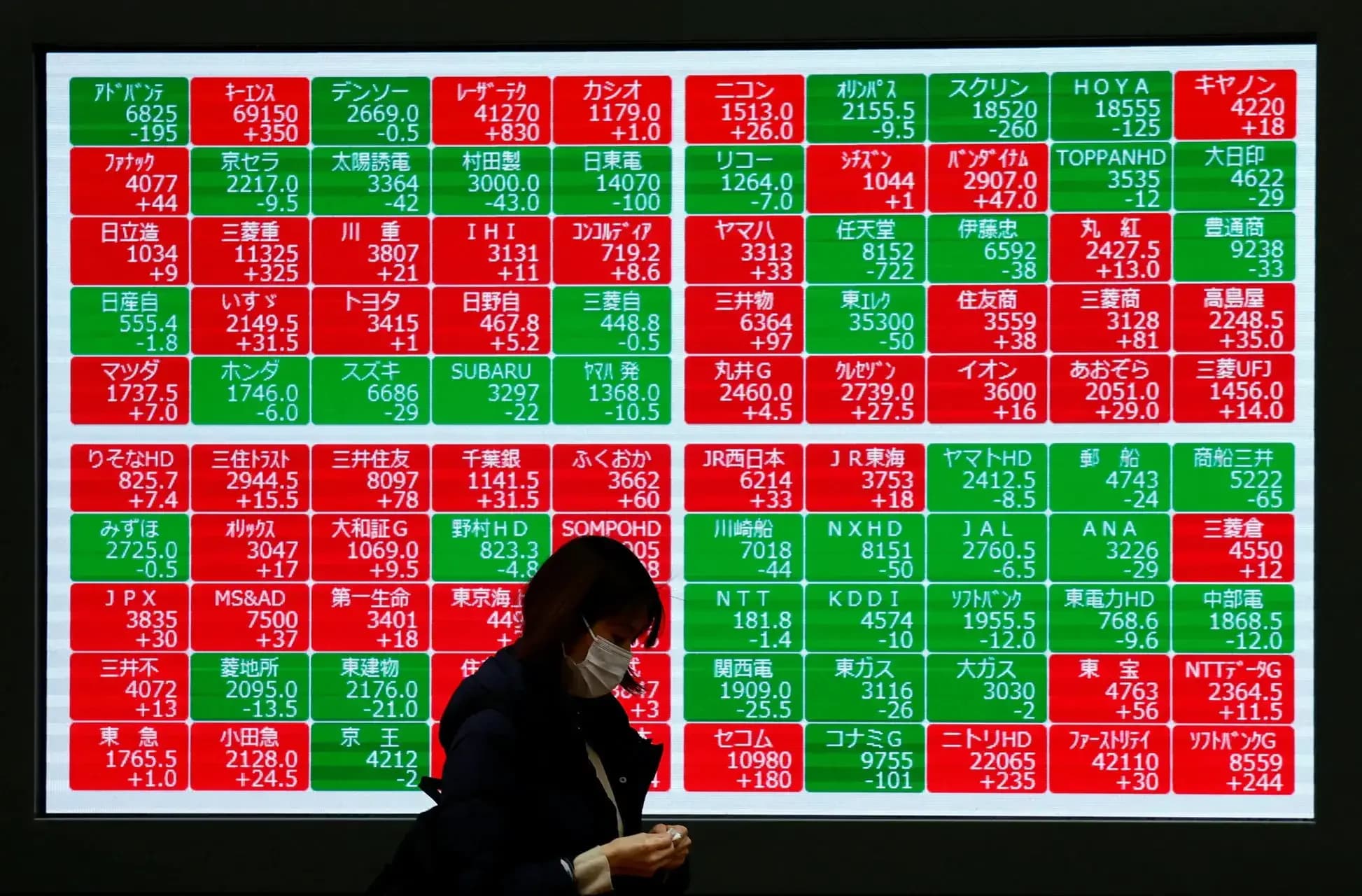
Global markets experienced a devastating $2.2 trillion selloff on November 16, as US stocks, precious metals, and Asian equities collapsed simultaneously. According to market data, the S&P 500 alone shed about $1.06 trillion, while the Nasdaq lost $870 billion, the Dow $270 billion, and the Russell 2000 $55 billion. Gold lost roughly $420 billion, silver $130 billion, and Asian stocks about $600 billion. The rout was driven by five interconnected factors that collectively unsettled investors across multiple asset classes. Technology and AI-linked names led the decline, with the VIX volatility index jumping nearly 24% as investors rushed to reduce risk exposure. Monday marked the third straight day of losses for the S&P 500 and the Nasdaq, with the Dow Jones and Nasdaq 100 both falling 750 points each. On November 17, Nasdaq 100 futures declined 0.53% and S&P 500 futures fell 0.6%, extending the pressure ahead of key earnings announcements. Wall Street dropped on Tuesday as investors remained cautious ahead of Nvidia's quarterly earnings report and the much-awaited initial public offering of AI startup Anthropic this week.
Nvidia shares fell 3.7% in Tuesday's session as the company faces escalating concerns following Jensen Huang's abrupt resignation as CEO. The crisis has intensified with reports that the board is not considering bringing Huang back, with the board instead reportedly weighing a national security investigation following allegations involving a relationship that US authorities linked to Chinese intelligence interests. This represents a significant escalation from earlier session lows when the company's leadership crisis first emerged. A person familiar with the matter told CNBC that Nvidia's board is not considering bringing Huang back, with the board instead focused on its investigation into his conduct. Nvidia has lost about $735 billion in market value since the scandal over former CEO Jensen Huang broke, according to The Associated Press. Huang added to the uncertainty on Tuesday by posting on X that he would return as CEO if "the Board of Directors decides that my return is in the best interest" of the company, creating further market volatility. Nvidia's market capitalisation has fallen dramatically from around $5.8 trillion in early October to $3.9 trillion as of Friday, highlighting the market's concerns about the company's trajectory and the potential ripple effects across the entire AI ecosystem. With Monday's fall, Nvidia's market capitalisation is now well below the $4 trillion mark, as the stock is now down nearly 35% from its peak. Asian markets bore the brunt of fresh US measures aimed at restricting China's access to advanced AI chips and servers, with a regional equity benchmark falling 1.5%, while South Korean and Taiwanese markets led the losses. Investors are also assessing the company's leadership uncertainty following Jensen Huang's sudden exit as CEO, with Ross Mayfield, investment strategist at Baird telling CNBC that Nvidia should report strong results and guidance, but is unlikely to be able to give investors solid answers to the questions heavily weighing on the stock regarding leadership and investigations around export controls.
The technology sector faced severe pressure as the Nasdaq fell 1.57% to 24,124.35, bringing it about 13% below its October 6 peak of 27,722.75, which puts it in correction territory. The S&P 500 dropped 1.4% to 7,312.99, while the Dow Jones Industrial Average lost 1.74% to 50,712.09. Earlier in the session, the S&P 500 fell as low as 7,288.34 and the Dow hit 50,685.51, with the Nasdaq briefly dropping below the 24,000 mark to an intraday low of 23,989.09, a 2.12% fall from Monday's close. Tuesday's losses come on top of a sharp drop on Monday, when the S&P 500 fell 1.9%, the Nasdaq 2.5% and the Dow 739 points. The S&P 500 is about 7% below its own peak, also set on October 6, as the broader market selloff continues. The selling was even heavier across the wider AI supply chain, with AI cloud providers Nebius and CoreWeave slumping 7.06% and 5.89% respectively, as the global AI supply chain faces interconnected pressure from both leadership transitions and regulatory developments. US stock futures remained under pressure on Tuesday, pointing to another cautious session on Wall Street as investors braced for Nvidia's quarterly earnings, with Dow Jones futures down 0.46% at 51,432, S&P 500 E-mini futures falling 0.30% to 7,417, while Nasdaq 100 futures slipped 0.21% to 27,228.25. Investors are also reacting to wider economic and geopolitical concerns, including uncertainty surrounding the war with Iran and rising oil prices, with Brent crude prices rising 1% to $93.36 per barrel.
Federal Reserve Chair Kevin Warsh added to market unease by outlining scenarios where the AI investment boom fails to deliver expected returns. Speaking at an event on Monday, Warsh did not make any remarks pertaining to monetary policy, but warned that in case the AI trade disappoints, it could lead to a steep fall in stock prices and bring about an economic slowdown. After significant capital investment and stock market gains, expected returns could turn down and equity valuations could fall, leading to an economic slowdown and a more notable rise in unemployment. He highlighted two other scenarios, where an ideal case shows AI accelerating economic growth beyond the current range and keeping employment at full capacity, and in a less ideal scenario, AI impacts the jobs market resulting in rising unemployment. The warnings came as investors faced a busy calendar with Nvidia reporting earnings on Tuesday and Anthropic's highly anticipated IPO arriving later this week. Treasury yields sit near multi-year highs, and the dollar keeps strengthening, with traders expecting further Fed rate hikes to fight sticky inflation, which hurt growth stocks and non-yielding assets such as gold and silver.
Late in the session, several large US banks reported online outages, adding to market pressure as financial stocks slid. Downdetector flagged problems at Chase, Bank of America, Wells Fargo, and Capital One, with Chase blaming a "technical issue" that slowed some transactions while assuring customers kept access to their accounts and funds. JPMorgan fell more than 2.4%, while Bank of America dropped over 2.1% and Wells Fargo about 2%. The banking outages compounded the broader market selloff and contributed to the Nasdaq sinking roughly 2.5% as investors hit intraday lows across multiple sectors. The weakness was not limited to technology stocks, with healthcare shares also weighing on market performance, as UnitedHealth and Humana among the notable decliners. The answer depends largely on this week's events, with Nvidia's results and Anthropic's market debut offering clearer signals about the strength of the AI rally, while Asian markets matter given their heavy exposure to chip supply chains.