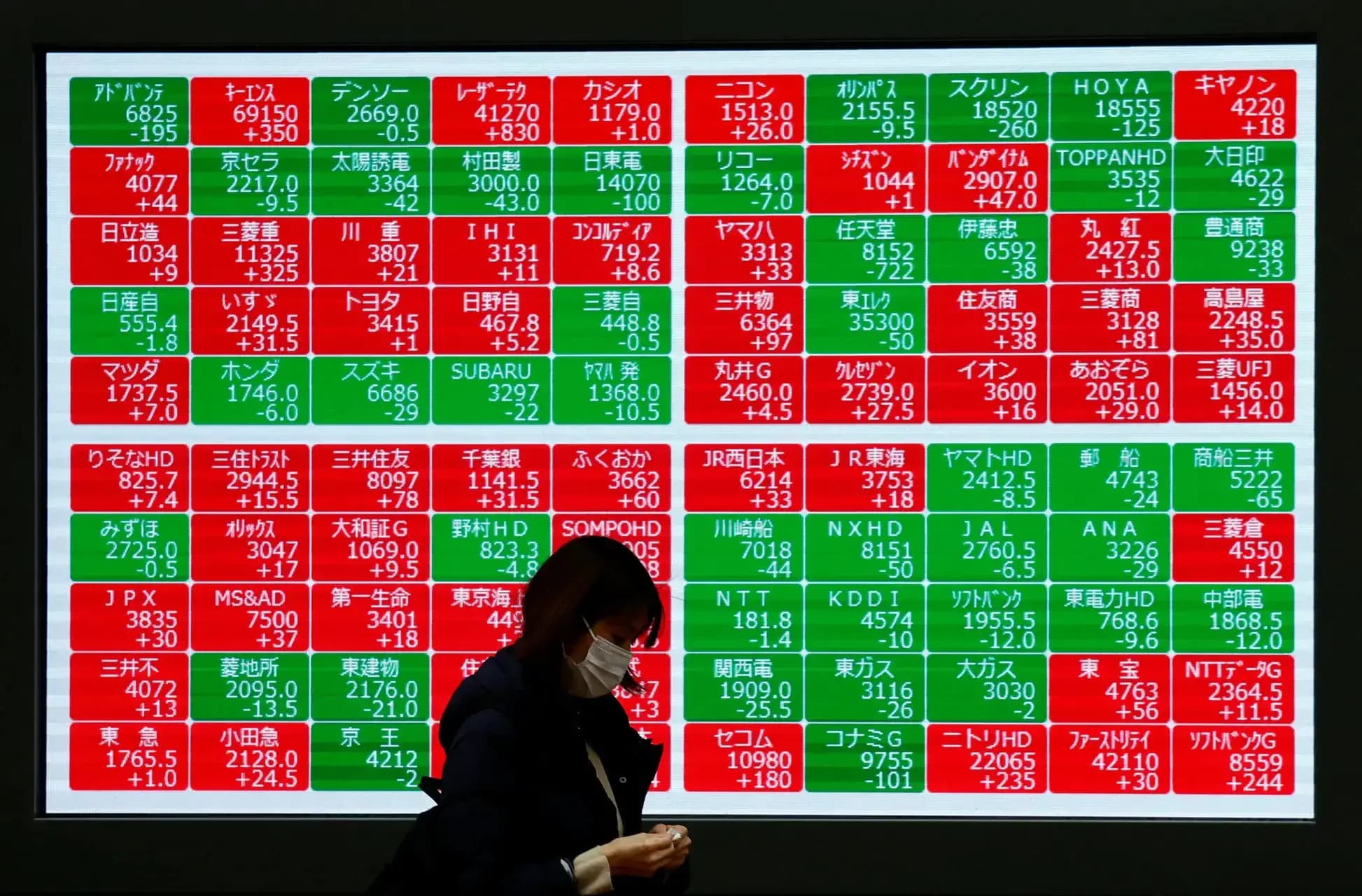
Asian markets extended Wall Street's decline on Tuesday, with MSCI's broadest index of Asia-Pacific shares outside Japan down 0.5% as investors pared holdings in technology stocks ahead of earnings that could indicate concerns over the artificial intelligence rally. According to Business Standard, Japan's Nikkei lost 0.9% and South Korea's Kospi slid 2.7%, with Nasdaq futures off 0.08% while S&P 500 futures were flat. The regional weakness followed a rout in chipmakers that pulled the Nasdaq 100 down almost 1% on Monday, with Nvidia Corp.'s shares falling for a seventh consecutive session — the longest losing streak since 2022. US equity-index futures also edged lower in early Asian trading, with the decline further complicated by trade tensions after President Donald Trump threatened to raise US tariffs on all cars, trucks and automotive parts from Canada to 50% starting January 1, escalating a trade fight after negotiations collapsed last week.
Artificial intelligence-related shares experienced significant declines across the region, with Samsung's decline following investor disappointment with its plans to return as much as 110 trillion won ($80 billion) to shareholders. The broader semiconductor sector remained under pressure ahead of Nvidia's earnings, with SK Hynix falling 3.4% in South Korea. In Japan, Kioxia fell 7.2% and TDK slipped 0.5%, while SoftBank dropped 5% after unveiling plans for a record ¥1 trillion retail bond offering. The technology selloff was particularly pronounced as investors awaited Nvidia's earnings report due Wednesday for insights into whether the AI boom can justify increasingly demanding valuations. Nvidia shares dropped a further 2.9% after the company told customers that it would raise prices on AI systems due to ship early next year, with the company's results becoming an important gauge of the artificial intelligence trade which has come under pressure in recent months as investors question whether massive spending on the technology will translate into commensurate profits.
Nvidia shares were trading 1% lower at $210.92 at 9:34 a.m. EDT on Wednesday ahead of the chipmaker's fiscal second-quarter earnings report. Wall Street expects Nvidia to report a near-100% jump in quarterly revenue, with Bloomberg's analyst consensus projecting revenue at $92.3 billion, up 97% year-on-year from $46.7 billion. Adjusted earnings per share is expected to nearly double to $2.09 from $1.05, while adjusted net income is expected to rise 98% to $52.3 billion from $26.4 billion. Adjusted margins are projected to increase slightly to 55.35%. Data centre revenue is projected at $85.7 billion, more than double the $41 billion reported a year earlier, with around $43.5 billion expected to come from hyperscalers, while $41.9 billion is estimated from AI Clouds, Industrial and Enterprise (ACIE). Options markets are pricing in a 5.4% move in either direction for Thursday, which would translate into a market capitalisation swing of roughly $280 billion at Nvidia's current valuation.
Alibaba's launch of a $10.2 billion share sale at a steep discount to fund its AI ambitions added to the technology sector's decline, as reported by Business Standard. The massive fundraising move came alongside disappointment over Samsung Electronics' shareholder-return plan, creating additional pressure on Asian technology stocks. Analysts are generally looking for quarterly revenue to almost double to around $92 billion for Nvidia, though investors are aware of how hard it will be for the chipmaker to meet sky-high expectations. Full-year earnings guidance is expected in a range of $103 billion to $105 billion, with Fabien Yip from IG noting that those are really high expectations to be met. "Judging from Nvidia's track record, it won't be surprising if they meet the headline numbers, but I think the more piece is people are trying to understand whether there are concerns on the circular deals powering its growth and whether that growth percentage is sustainable in the upcoming quarters," Yip explained.
Market strategists remain cautious about the sustainability of the current AI rally, with Wataru Akiyama from Nomura Securities noting that concerns over semiconductor-related company profitability are likely a pretext for selling following a significant build-up of open positions in margin trading. As reported by The Economic Times, Akiyama stated that "it does not appear that the Japanese stock market is currently in a position to sustain an upward trend" given the combination of rising bond yields and inflation worries. The upcoming Nvidia earnings report on Wednesday is expected to provide crucial insights into the sustainability of AI-related investments and the impact of rising memory costs on the sector's profitability. Investors said that the sell-off reflected growing concerns over whether heavy spending on artificial intelligence would deliver matching profits, with traders watching closely for signals on whether the recent weakness in chip stocks would persist. Analysts are generally looking for quarterly revenue to almost double to around $92 billion for Nvidia, though investors are aware of how hard it will be for the chipmaker to meet sky-high expectations. Traders balanced escalating geopolitical risks against a heavy slate of economic data and corporate earnings due this week, with technology's trajectory viewed as crucial for the broader market sentiment, according to CNBC TV18. Markets awaited clearer guidance from Fed Chair Kevin Warsh on the Federal Reserve's likely path for the remainder of the year, with markets implying around a 40% chance that the Fed will raise interest rates when it meets on September 16 and fully priced for a move by December.
Gold rose 0.5% to $4,675.51 an ounce as the US Treasury's intervention in the bond market revived concerns about fiscal policy and its impact on the dollar. According to The Economic Times, the commodity fell more than 2% on Monday, snapping a six-day rally, with lower energy prices lifting Treasuries on Monday, with the 10-year yield falling four basis points to 4.70%. Brent crude was little changed on Tuesday, down 0.1% to $92.08 a barrel, after US President Donald Trump warned countries to cut their business ties with Iran or face secondary sanctions as part of what he billed as an "economic D-Day," though the Treasury Department stopped short of imposing any penalties. The benchmark had dropped more than 2% on Monday, breaking a six-day winning streak, with West Texas Intermediate rising 0.3% to $85.09 a barrel. The commodity fell more than 2% on Monday, snapping a six-day rally, with oil futures down around 2% ahead of U.S. Treasury Secretary Scott Bessent's press conference to outline sanctions on Iran. In tariff news, the Canadian dollar was little changed after Canadian ministers were set to announce a response to US tariffs on Tuesday, with the outlook for technology shares emerging as a key test for broader risk sentiment as investors weigh mounting geopolitical risks against upcoming economic data and corporate earnings.