Wall Street experienced a dramatic turnaround on Thursday as Jensen Huang's defense of CoreWeave (CRWV) provided the catalyst for a market rebound. According to Investing.com, Huang's explanation of CoreWeave's financial position was enough to pull the NeoCloud complex off the floor and give the broader market something resembling a pulse. The reaction was almost theatrical, as the market moved from pricing the possibility that the AI financing machine had started eating its own tail to listening to the high priest of the boom explain that the patient was getting stronger. However, as Investing.com notes, CoreWeave's bonds have already traded below 80 cents on the dollar, default protection has widened materially, and the broader AI financing story has become much harder to dismiss as a temporary wobble. The market can believe in the structural demand for compute while becoming deeply suspicious of the balance sheets built to satisfy that demand.
The tech sector experienced significant selling pressure on Thursday as AI financing worries intensified alongside rising corporate bond yields. According to AlphaCheck, the Tech (XLK) sector slumped as chip stocks declined, led by major players Nvidia (NVDA) and AMD (AMD). Memory giants Micron (MU) and SK Hynix (SKHY) also declined, along with flash memory maker Sandisk (SNDK). The selling pressure was particularly pronounced in companies with debt-heavy balance sheets, with CoreWeave (CRWV) shares falling on concerns about circular financing arrangements that could be generating artificial demand. Nvidia fell 1.3% in premarket trading, while Micron Technology declined 4% and Advanced Micro Devices lost 1.9%. The selloff erased approximately $80 billion in combined market value across several AI-related companies. However, CoreWeave shares reversed early losses, closing 6% higher after dropping more than 15% Wednesday on debt concerns.
US annual inflation accelerated to 3.7% in September, above the 3.6% forecast, increasing expectations of further Federal Reserve interest rate hikes. As reported by AlphaCheck, this inflation data provided the catalyst for Thursday's market decline, with investors reassessing the financial sustainability of large-scale AI infrastructure spending under higher borrowing costs. The immediate pressure on equities followed September's Consumer Price Index report, released on October 14, which showed annual US inflation accelerating to 3.7% from 3.4% in August. US stock index futures were mixed on October 15, 2026, with Nasdaq 100 futures down 1.26% and S&P 500 futures falling 0.35%, while Dow Jones futures advanced 0.39%. The 10-year Treasury yield was around 5.09% in late-afternoon trading, down nine basis points from Wednesday's close, after soaring to 5.33% following Wednesday's CPI data before reversing course as the tech-driven stock selloff drove investors to safer assets.
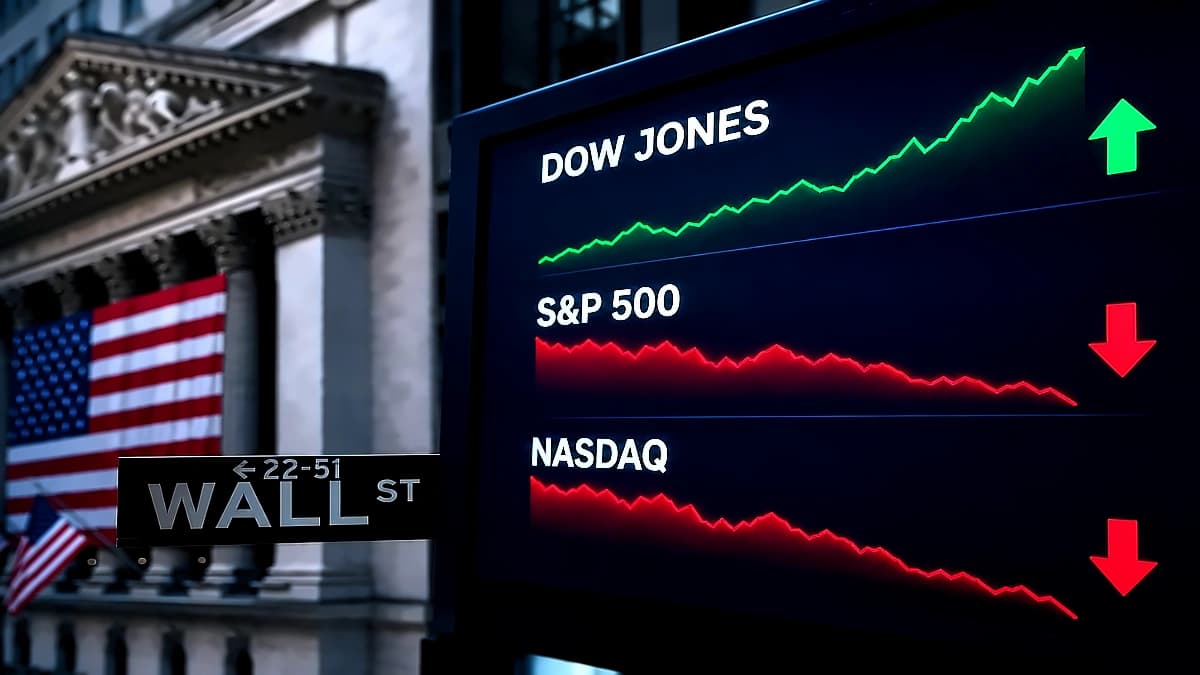
The global tech selloff deepened significantly in Asian markets on Thursday, with South Korea's Kospi tumbling 9.1% as the index heavily skewed toward chip stocks faced severe pressure. According to Bloomberg, Samsung Electronics and SK Hynix each plunged over 10%, while China's Shanghai Composite Index lost 2.2% and Hong Kong's Hang Seng Index was 1.5% lower, with its tech gauge dropping 3.0%. The worst of the selling was concentrated in names that have borrowed heavily to finance data center build-outs and have signaled plans to keep doing so, making lenders uneasy. Capital spending by the top five hyperscalers is set to outpace their operating cash flow in 2026, marking a shift that leaves AI-related investments increasingly dependent on external financing, said Takahide Kiuchi, an economist at Nomura Research Institute. "This would mean that AI-related investments are becoming increasingly susceptible to financial market conditions," he said. Some investors moved into safe haven assets, with Japanese government bond yields falling 7.2 basis points to 2.925%, while Australian and New Zealand bond yields also declined significantly.
Thursday's session revealed a significant market rotation as the Dow and Russell outperformed while the AI complex remained bruised. According to Investing.com, the equal-weight S&P 500 gained around 1.4%, suggesting the market was not merely rescued but redistributed. Money that had spent months crowding into the same handful of technology names suddenly discovered there are other parts of the board that matter. Financials, industrials, small caps and old-economy cyclicals are not required to become the next AI trade to matter; they just need to attract enough capital that the market stops relying on one narrow group to carry the entire index. Since mid-2024, the average rotation out of technology has run for roughly 67 days with a median around 59, while tech drawdowns over those periods have averaged 16.6% with a median near 14.6% (Deutsche Bank). This rotation pattern suggests the current episode may follow similar historical patterns, though it does not guarantee the same outcome.
The most significant development was Treasuries rallying hard despite hot PPI data, firm growth data, and higher oil prices. As reported by Investing.com, this marked the first convincing evidence in weeks that when fear gets specific enough, capital still knows where the old risk-off bunker is. Long-dated Treasuries rallied despite hot PPI, firm growth data and higher oil as safe-haven demand overwhelmed the inflation impulse. This behavior suggests investors are beginning to price tighter financial conditions through markets rather than through the Fed. The dollar weakened while gold and bitcoin moved higher, indicating the session was being driven by positioning and cross-asset hedging as much as by clean macro logic. The dollar's weakness alongside falling yields fits with the idea that investors are beginning to price tighter financial conditions through markets, and if the AI credit wobble deepens, the dollar may not get the same automatic support it normally receives from risk aversion.