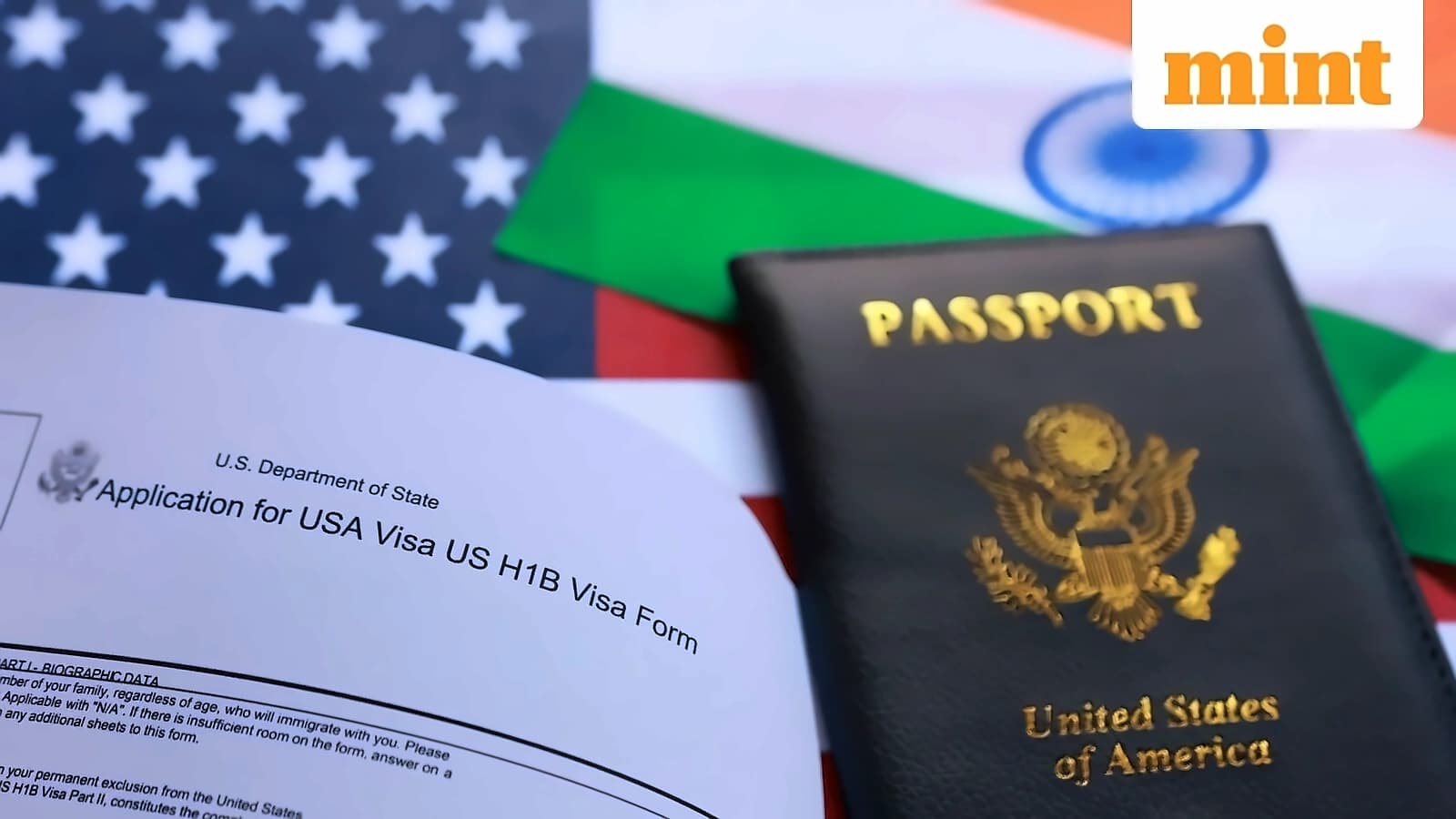
President Trump has lashed out at federal judges after a court struck down his administration's $100,000 fee on new H-1B visa applications, calling the judicial setback 'crazy' and 'hurting our country very badly'. Speaking to reporters while leaving New York after attending an NBA Finals match, Trump criticised the courts, stating 'These federal judges are really giving us a hard time. It's really crazy what's going on with the court system... They're hurting our country very badly.' The ruling found that the steep levy amounted to an unlawful tax that had not been authorised by Congress, dealing a blow to Trump's aggressive immigration measures. The fee, announced through a proclamation in September last year, would have sharply raised costs for employers seeking to hire foreign professionals in speciality occupations.
IT services companies such as Tata Consultancy Services (TCS), Infosys, Wipro, HCLTech, and Tech Mahindra are expected to hog the limelight on Tuesday, June 9, following the major relief from the court decision. According to Upstox, these firms depend significantly on H-1B visas to deploy skilled employees onsite in the US for high-value projects, and a sharp increase in visa costs would have raised operating expenses, pressured margins, and potentially forced a shift toward more offshore delivery from India. The court's decision removes this cost risk and is seen as a positive sentiment, as it preserves the existing US delivery model that supports the industry's global competitiveness. Simply, this means that Indian IT companies can continue their current mix of offshore work from India and onsite work in the US without disruption, which is a key reason they stay cost-competitive in the global market.
Despite the favorable court ruling, Indian IT stocks declined in intraday trade on Tuesday, even after the U.S. court struck down the proposed $100,000 H-1B visa fee. As per ET Now, Infosys fell the most, slipping around 1.47% to hit an intraday low near ₹1,170, while Oracle declined about 1.39% to touch a low of roughly ₹1,482. HCLTech declined about 1.09% to touch a low of roughly ₹1,138, and Tech Mahindra also saw selling pressure, falling around 1.67% to an intraday low of approximately ₹1,478. However, Wipro gained 1.42% to trade near ₹184 at its session low, and heavyweight TCS fell 1.05% to slip to an intraday low near ₹2,144. The mixed market response suggests that while the legal victory removes a significant cost overhang, investor sentiment remains cautious about broader market conditions and potential future policy changes.
The court order has drawn support from lawmakers across party lines, even as the White House prepares to challenge the decision in an appeals court. Several Republicans welcomed the ruling, arguing that the fee would not only hit technology companies but also damage hospitals, universities and schools in rural regions that rely on overseas professionals to fill staffing shortages. Republican Senator Lisa Murkowski of Alaska said the issue went beyond party politics in her state, where academic institutions are finalising faculty appointments for the next school term and communities already struggle to attract skilled workers. The White House defended the measure and vociferously said that it would seek to overturn the ruling, with spokesperson Taylor Rogers stating 'The H-1B programme has been abused for decades, and President Trump finally took action to fix it' and adding that the administration was confident the order would be reversed on appeal, citing a separate Washington ruling that upheld a similar measure.
The US H-1B visa programme is facing its strongest political pushback yet since its launch over three decades ago, with at least a dozen Republican lawmakers backing four bills this year that seek to restrict, suspend or eliminate the visa programme. As per the latest developments, Congressman Chip Roy from Texas proposed the American White-Collar Worker Jobs Act of 2026 on June 4, 2026, bringing seven comprehensive reforms to the use of H-1B visas. The bill proposes to cut the current six-year stay limit to two years and mandate employees to prove they plan to return home, representing the most significant legislative challenge to the programme since its inception. This legislative push has heightened uncertainty for visa holders residing in the US with their families, many of them being Indians, most of whom work at information technology (IT) firms. The H-1B visa program is a cornerstone of employment-based immigration, allowing companies in the US to hire college-educated foreign workers for specialized occupations, with Amazon.com Inc., Tata Consultancy Services Ltd., Microsoft Corp., Meta Platforms Inc. and Apple Inc. among the companies with the greatest number of H-1B visas.
Major Indian IT companies have responded to the legislative challenges by increasing local hiring and reducing visa dependence. Tata Consultancy Services CEO K. Krithivasan stated that the firm had deployed 'fewer people than the number of approvals each year' and emphasized this move was 'part of a consistent reduction in dependency on visa-based talent over time.' Cognizant Technology Solutions CEO Ravi Kumar confirmed in an October analyst call that the company has 'significantly reduced the dependency on visas, while increasing local hiring and nearshore capacity' over recent years. The latest developments come as Cognizant CEO Ravi Kumar S offered an optimistic outlook on the demand opportunity emerging from agentic AI for IT and business process service providers at the recent Cognizant AI Forum. According to Upstox, the CEO highlighted that based on an analysis of Global 2000 enterprises' operating expenditure linked to labour exposed to 'agentification,' the total addressable market for Cognizant—and its peers—could expand from around $1 trillion to $5–$6 trillion. The company reiterated its goal of repositioning itself as an 'AI Builder' through a three-pillar strategy: enabling hyperproductivity, industrialising AI, and agentifying the enterprise.