Companies are using funds received from tariff refunds to offer sale deals, customer discounts, lower prices, and make employee 401(K) contributions, as reported by Bloomberg. The Supreme Court struck down US President Donald Trump's tariffs under the International Emergency Economic Powers Act (IEEPA) in February, resulting in $166 billion being collected by the government. According to Bloomberg, companies getting refunds have become 'creative' with these funds, using them to cover rising costs, supplement employee retirement accounts, and repay debt. Some companies are sharing the bounty with vendors who paid higher import costs during tariff implementation, while a number of consumer companies are beefing up their assortment of lower-priced products and offering deals to attract budget-conscious shoppers. Nintendo exemplifies this trend with its 'Customer Appreciation Sale' offering up to 30% off Switch games, accessories, and merchandise, with the sale limited to the United States.
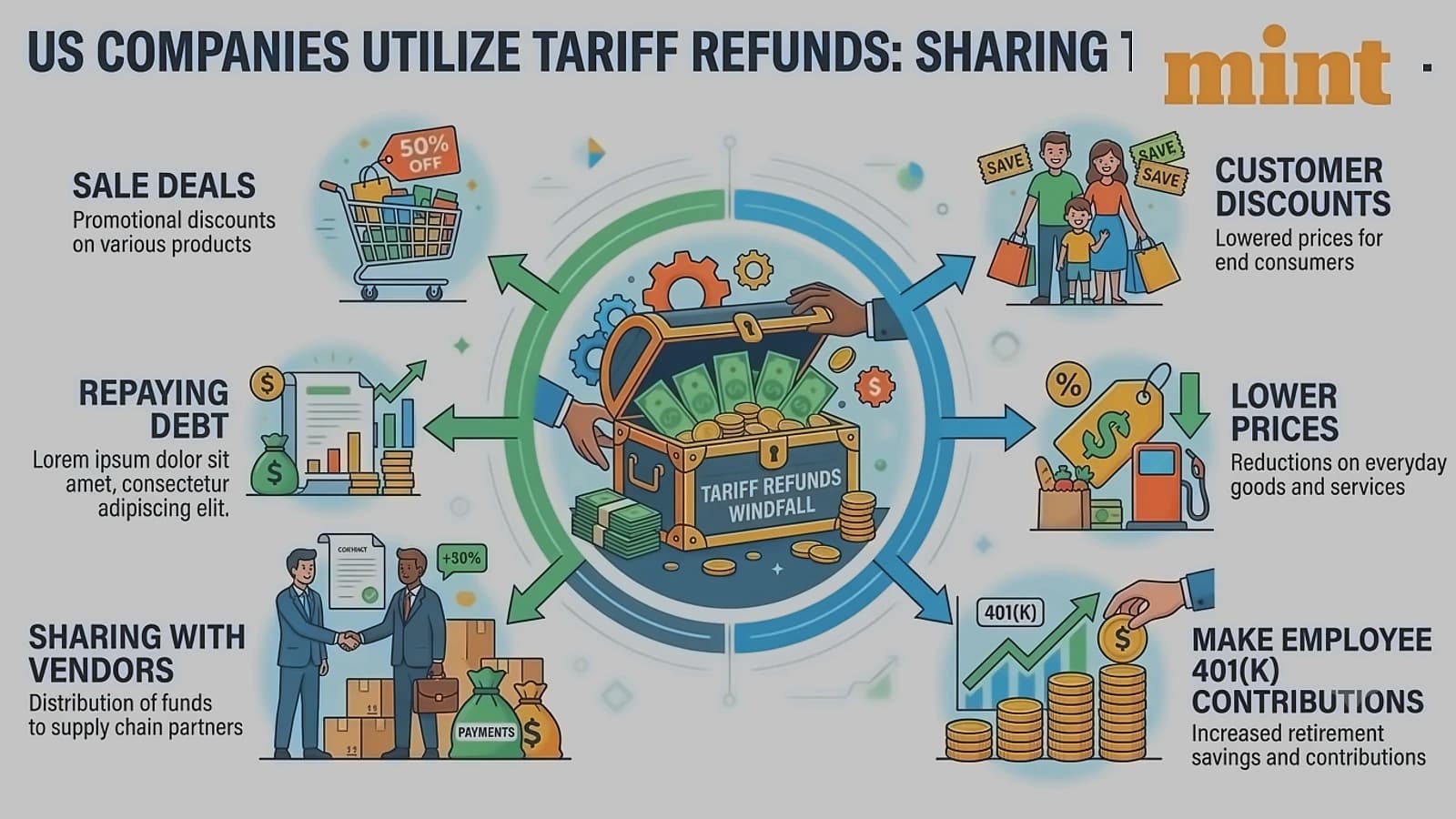
Williams-Sonoma Inc. allocated $10 million of its $200 million refund toward employee 401(K) contributions and paid $47.5 million to vendors who provided inventory purchase discounts to offset tariff costs. As reported by Bloomberg, CEO Laura Alber stated the company was 'so appreciative to have the money back and to be able to reward employees' during a chaotic year moving products globally. Kohl's Corp. shared approximately $150 million in refunds with vendors who paid higher import costs, while reinvesting cash in business expansion including inventory levels for lower-priced brands. Consumer discretionary and staples companies accounted for more than a third of the references, disclosing the receipt of close to $9.8 billion in refunds during July, August and September.
According to Bloomberg analysis, companies in the Russell 3000 Index mentioned 'tariff refunds' nearly 1,000 times in earnings calls and filings during July, August and September, representing a 4x increase compared to previous earnings seasons. These companies revealed receipt of approximately $9.8 billion in refunds during that period. Some companies have opted to monetize their refunds through secondary markets, with Funko, Inc. selling $22 million in tariff refund claims for $19.2 million to a third-party financial institution and using some proceeds to pay down a term loan. Xerox Holdings Corp. recognized $105 million in tariff refunds and sold the receivable to a third party for $80 million in cash to help reduce its debt load. Academy Sports & Outdoors Inc. recorded $83.7 million in refunds and sold $72.2 million of claims to a third party for $10.5 million, using proceeds primarily to lower prices.
The tariff refunds are providing temporary relief amid broader economic pressures, with consumers facing significant cost increases elsewhere. According to GasBuddy petroleum analyst Patrick De Haan, Americans have collectively spent over $100 billion more on gasoline and diesel since March 1 compared to the same period a year ago. As reported by Bloomberg, economist Swonk noted this represents almost as big as the tariff revenues after losing other IEEPA revenues, creating another tax on top of the tariff burden. The economic impact is visible in retail performance, with retailers reporting reduced foot traffic from low- and middle-income households and a pullback in spending. Spending at grocery stores has been hit the hardest, with big box discounters and grocery chains using tariff refunds to offer targeted discounts. However, consumers are seeking price declines rather than temporary discounts, which is eating into their discretionary budgets.
While companies are starting to receive refunds, many executives flag the U.S.-Canada trade dispute as a potential risk going forward. Bath & Body Works Inc. is forecasting $30 million in additional tariff and input costs during the second half of this year, with Canada tariffs remaining at 50% for the remainder of 2026. The company, which makes candles in Canada and operates retail stores there, faces exposure to both U.S. and Canada levies, with CFO Tom Javitch noting they're still evaluating retaliatory tariff risks in real time. Stanley Black & Decker Inc. said the 'temporary tariff tailwind' is being eclipsed by inflationary pressure and higher prices for materials like metals and oil, with the company indicating 'it appears more likely than not a price increase will be necessary' in 2027. Despite the tariff relief, economists report that inflation is suppressing growth, with the overall economy running around 2% growth for 2026, down from 2.5% prior to the tariff implementation.