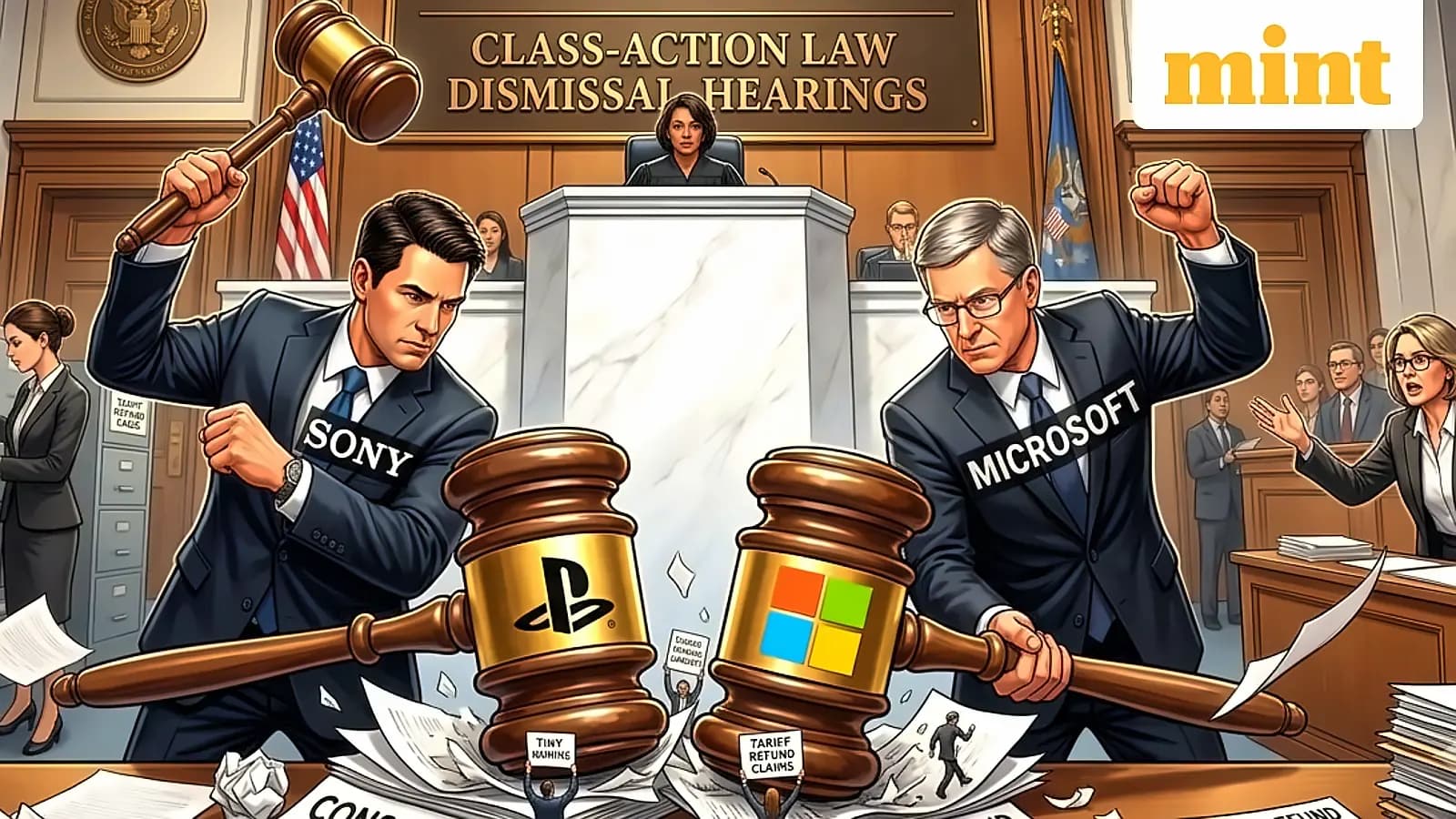
Sony and Microsoft have filed motions to dismiss class-action lawsuits that accuse the companies of failing to pass tariff refunds to consumers after raising prices of PlayStation 5 and Xbox consoles. According to reports from Game File, the lawsuits were filed following 2025 price increases for the consoles, with consumers alleging the increases were linked to tariffs imposed by the US government. The latest developments show that Sony's case remains pending with the court having consolidated related actions and scheduled further proceedings around the company's anticipated motion to dismiss. Microsoft is also seeking arbitration as an alternative to having the case proceed in court, demonstrating the companies' strategic approach to resolving these consumer claims. In Sony's case, brought against it by a group of players in California, the company used a familiar line of argument that essentially said consumers got what they paid for. "Paying fair market price for voluntarily purchased consumer goods is not a legally cognisable injury in fact," Sony argued in a legal motion, seeking to dismiss the suit early before it could turn into a class-action lawsuit.
Sony has asked a federal judge in California's Northern District to dismiss the case, arguing it has no legal obligation to pass tariff refunds to customers. As reported by Game File, Sony's legal team described the claim that tariffs were responsible for console price increases as 'speculative and illogical', stating that factors like inflation, currency fluctuations, component costs, logistics, competitive dynamics, or demand were responsible for pricing decisions. The company pointed to several factors that influence pricing, including inflation, currency fluctuations, component costs, logistics, competition and consumer demand. Sony highlighted that it implemented additional hardware price increases after the tariffs were declared illegal, arguing this would not have been necessary if tariffs were the primary reason for earlier price increases. In its dismissal request, Sony's lawyers flatly rejected the plaintiffs' claims, stating that paying a fair market price for voluntarily purchased consumer goods does not constitute a legally recognizable injury. The company noted that retail prices are shaped by a complex, dynamic web of global supply chain inputs, not a simple, dollar-for-dollar tariff equation. When Sony raised PlayStation 5 prices in August 2025, the company cited "a challenging economic environment" as the reason, rather than directly naming tariffs as the cause. Sony Interactive Entertainment lawyers have now explicitly stated that the company does not consider itself obligated to share with PlayStation 5 buyers the funds that the company expects to receive from the US government as a refund of previously paid import duties.
The dispute comes after Sony told investors in July that it expected to receive $508 million in tariff refunds from the US government. According to Game File, the refund helped lift Sony's first-quarter operating income by 37%. However, Sony argues that receiving a government tariff refund does not mean the company must return the money to consumers who purchased consoles at previously advertised prices. The company maintains that if tariffs had been the primary reason for earlier price increases, it would have been expected to cut prices after the tariffs were removed rather than raise them again. Sony's lawyers noted that if the original price increase were attributable to tariffs, the company would have had no reason to raise prices again after the Supreme Court invalidated the IEEPA tariffs. The legal battle escalated after Sony disclosed to investors that it projected receiving a $508 million refund on U.S. tariffs, with the majority flowing directly into its gaming division. In July, Sony told investors it's expecting $508m (£375m) in tariff refunds from the US government, with most of that going to PlayStation. Indeed, none of the three companies have lowered prices in response to the tariffs getting struck down, meaning they will continue to benefit from the elevated prices. The reason for the legal dispute was import tariffs introduced in the US in 2025, after which companies began seeking refunds when the US Supreme Court declared the relevant duties illegal in February 2026.
Microsoft has taken a similar position in a separate class-action lawsuit filed in federal court in Washington state and has also asked for the case to be dismissed. As reported by Game File, Microsoft's legal team argued that customers received exactly what they paid for at the advertised price and therefore had no basis for claiming the company owes them a refund. The company said the plaintiff had not provided specific evidence showing that any portion of the Xbox price increase was directly attributable to tariffs. Microsoft also argued that it would be impossible to recreate a dollar-for-dollar calculation of tariff-related pricing because console prices are affected by numerous market factors. The company stated that the plaintiff provides no specific allegations that would establish any pricing differential attributable to tariffs or suggest any possibility that Microsoft applied then or could recreate now any dollar-for-dollar calculation of tariff-related pricing. Microsoft challenged plaintiffs to prove any specific, mathematically traceable pricing differential directly tied to tariffs, arguing that calculating retrospective assessments would be virtually impossible given the array of broader market factors impacting retail MSRP. When Microsoft raised Xbox prices in May 2025, the company cited "market conditions and the rising cost of development" as the reason, rather than directly naming tariffs as the cause.
Sony and Microsoft's arguments follow a class action dismissal request that Nintendo submitted in July. According to Game File, lawyers for the platform holder argued that 'if a consumer did not want to pay the advertised price, they were free to abstain from purchasing the product or seek out competing products'. Nintendo clarified that it 'did not simply increase each product's price by the amount of tariffs it paid on that product or impose an across-the-board tariff surcharge'. Instead, Nintendo imposed modest and selective price adjustments, and it chose to bear the costs of tariffs on some of its most popular products of 2025, including its flagship console, the Nintendo Switch 2. However, there is an important counterexample - Panic, the company behind the Playdate handheld, chose to return tariff-related refunds to customers after receiving its own reimbursement from the government. That decision demonstrates that passing the money back to consumers is possible as a business policy, even though Sony, Microsoft, and Nintendo argue that it is not a legal obligation. While there have been companies like PC cooling makers Arctic and Playdate maker Panic that chose to return tariff surcharges directly to their consumers, the giant console manufacturers have chosen to stand united in court. In all cases, consumers are frustrated that companies get paid twice, once by those who buy the price-hiked consoles and another when tariffs are refunded.