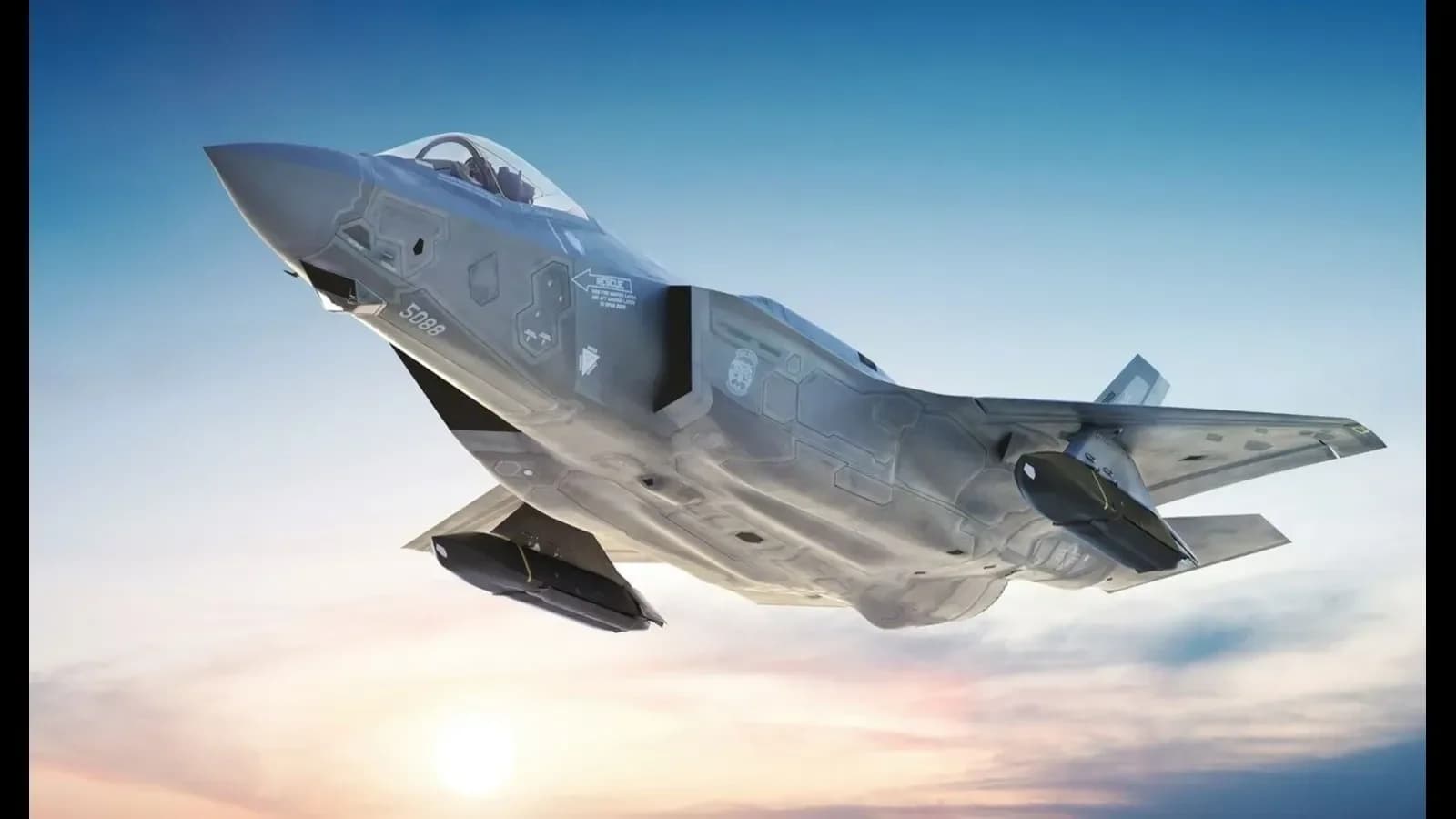
The Trump administration has officially approved a $24.3 billion sale of 48 F-35 fighter jets and related equipment to Saudi Arabia, marking a significant defense contract win for the kingdom amid escalating tensions with Yemen's Houthis. As reported by The New York Times, the State Department issued a notification to Congress dated September 17, approving the Foreign Military Sale of 48 F-35 Lightning II Joint Strike Fighter aircraft and 49 Pratt & Whitney F135-PW-100 engines, including one spare. The announcement comes after the Houthis claimed on Wednesday they shot down a Saudi F-15 fighter jet over Marib, a key city in their battle against Saudi-backed Yemeni government forces. The group released video of fighters standing before burning wreckage of what appeared to be a US-made F-15 fighter jet with Saudi Arabian markings, with the Houthis claiming the aircraft was shot down with a 'locally made' surface-to-air missile, which would mark a dramatic change in the group's ability to wage war in the area. The F-35 is a stealth multirole fighter developed by Lockheed Martin that uses advanced stealth technology to evade enemy detection systems, and the proposed sale would make Saudi Arabia the second operator of the F-35 in the Middle East after Israel. The State Department emphasized that the proposed sale would support US foreign policy and national security objectives by strengthening Saudi Arabia's security capabilities and improving its ability to deter current and future threats.
Turkey's Foreign Minister Hakan Fidan has signaled technical military support for Saudi Arabia against attacks by Iran-backed Houthi militants, aligning with the Mecca Defense Alliance established last month. As reported by Business Standard, Fidan stated in an NTV interview that "there may be military needs, particularly in certain technical areas, and we would have no problem meeting them." Pakistan, the third member of the alliance, has also pledged military support to the kingdom. The activation comes as Saudi Arabia faces intensifying attacks from Iran-backed Houthis targeting western cities and energy infrastructure. On Saturday, Riyadh intercepted a ballistic missile headed for the capital and thwarted separate Houthi attacks on civilian sites, including in Yanbu, a key Red Sea oil port. Fidan emphasized that "we see very serious attacks against Saudi Arabia's territorial integrity and sovereignty," adding that "under our alliance, 'we stand by our word.'"
The proposed package includes secure communications, precision navigation and cryptographic equipment, electronic warfare database support, spare parts, training equipment and simulators, software, technical documentation and logistics support, as reported by Business News. The State Department emphasized that the sale would support US foreign policy and national security objectives by strengthening Saudi Arabia's security capabilities and improving its ability to deter current and future threats. The deal would augment Saudi Arabia's operational aircraft and enhance its air-to-air and air-to-ground self-defence capabilities, particularly as the kingdom faces renewed fighting with the Houthis in Yemen. The package was sent to two congressional committees in June for informal approval as the administration moved the sale into a more advanced stage. The F-35 sale is the latest in a series of major arms purchases by Saudi Arabia, with Washington also signing off on a $1.96 billion deal in July for the kingdom to buy guidance sections that can convert rockets into precision weapons.
US intelligence officials have raised significant concerns about Chinese military access to Saudi Arabia through espionage or the kingdom's military and security partnership with Beijing, according to The New York Times. A Pentagon Defense Intelligence Agency report circulated among government agencies and congressional offices reportedly questioned whether secure facilities could be maintained for the F-35 technology and whether Saudi Arabia would agree to restrict access by Chinese military and intelligence personnel. The report also raised questions about the presence of equipment from Chinese technology companies Huawei and ZTE in telecommunications, router infrastructure and defence installations. The Pentagon is particularly concerned about protecting the F-35's advanced radar and surveillance technology. US intelligence analysts have questioned whether secure facilities could be maintained for the F-35 technology and whether Saudi Arabia would agree to restrict access by Chinese military and intelligence personnel. US Representative Raja Krishnamoorthi, a Democratic member of the House Intelligence Committee, expressed opposition to the sale on those grounds, stating it should not proceed "when our own intelligence community is warning that it could put the crown jewels of American military technology within reach of the Chinese Communist Party."
The proposed sale will now face a 30-day congressional review period during which lawmakers can scrutinize the proposed sale and seek to block it, according to Business News. Some US lawmakers and defense officials have raised concerns about the potential transfer of sensitive F-35 technology to China, citing Saudi Arabia's security partnership with Beijing. The proposed F-35 sale could also draw scrutiny over Israel's military advantage in the Middle East, as Israel is currently the only country in the region operating F-35 fighter jets. The deal would augment Saudi Arabia's operational aircraft and enhance its air-to-air and air-to-ground self-defence capabilities, particularly as the kingdom faces renewed fighting with the Houthis in Yemen. The principal contractors for the proposed sale are Lockheed Martin Aeronautics Company of Fort Worth, Texas, and Pratt & Whitney Military Engines of East Hartford, Connecticut. The United States has so far only allowed F-35 sales to its closest allies, including European NATO allies and Israel, with Washington previously kicking NATO member Turkey out of the F-35 program in 2019 over concerns about Russian air defense system purchases. The administration's decision comes as Saudi Arabia has signed a mutual defense agreement, dubbed the Mecca Agreement, with Pakistan and Turkiye last month, a sign the countries are seeking ways to provide mutual defence that relies less on Washington.