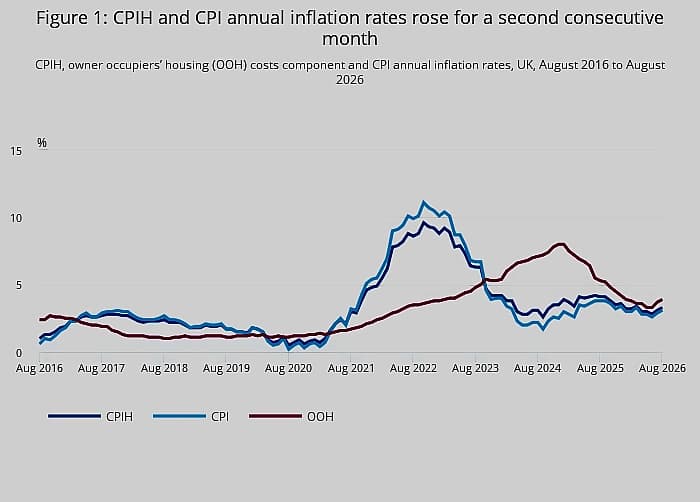
UK consumer prices are set to grab headlines this week with inflation accelerating for the first time in four months, with the median economist estimate in a Bloomberg survey predicting a 2.9% jump in July. The Iran war is making plane travel more expensive and feeding through to household energy bills, while a crunch in artificial intelligence-related components drives up electronics prices. As reported by Business Standard, this marks the start of a lift-off expected to continue through the second half, cutting short a spell of positive news on price pressures. The figures may leave BOE rate-setters increasingly uneasy as the Iran war starts to show up more clearly in prices — especially with a resilient economy.
The Bank of England has warned that the rapid expansion of AI capacity is driving up the cost of memory chips used in phones, laptops and games consoles, while the British Retail Consortium's July data suggest rising chip costs are feeding through to electronics prices. Apple laptops and tablets as well as Xbox gaming consoles are already set to get more expensive, a sign that AI pressures could become a feature of core goods inflation in the coming months. One of three dissenters at the BOE's last meeting, Chief Economist Huw Pill doubled down on his call for tighter rates after the UK economy unexpectedly grew in June, helped by a heat wave and the World Cup.
US market expectations regarding potential Federal Reserve interest rate hikes have diminished following poor jobs numbers and benign inflation prints. According to ING analysis, a 25bp rate hike on 16 September was fully expected three weeks ago, but that has since dropped to less than a 50% chance. The data calendar is light for the coming week, with industrial production expected to rise perhaps 0.3% month-on-month based on the strength of the ISM index. The release of July FOMC minutes will be closely followed given the muddled messaging from new Fed Chair Kevin Warsh at the press conference. However, as reported by Reuters, many investors are increasingly looking to corporate earnings to validate bullish assumptions and offset macroeconomic risks, with the primary focus continuing to be the Federal Reserve.

US stocks fell on Friday after the S&P 500 notched a record high amid deteriorating consumer sentiment. The S&P 500 declined by about 0.2% but capped its third consecutive weekly gain, while the Dow Jones Industrial Average dropped 0.2% and the Nasdaq Composite fell about 0.3%. Investors turned cautious in afternoon trading after a preliminary reading of August consumer sentiment from the University of Michigan showed that Americans grew more dour on the economy as inflation remained top of mind. Oil prices also rose, adding pressure amid low-volume summer trading. Despite the Friday decline, stocks have been fueled by strong earnings, with about 85% of S&P 500 companies reporting earnings beats and profits up 32.7% excluding mark-to-market gains at Alphabet and Amazon.
With no major reports on the calendar for Friday, attention is turning to a series of retail earnings next week, including Target (TGT) and Walmart (WMT), before Nvidia's (NVDA) highly anticipated report on August 26. On the economic data front, US retail sales fell the most in more than a year last month, according to new data released Friday by the Census Bureau. The robust earnings season continues to support stock markets, with earnings strength especially notable among companies tied to AI-related infrastructure spending. Earnings results from Walmart and chipmaker Analog Devices will offer fresh clues into the health of the U.S. consumer and broader economy.