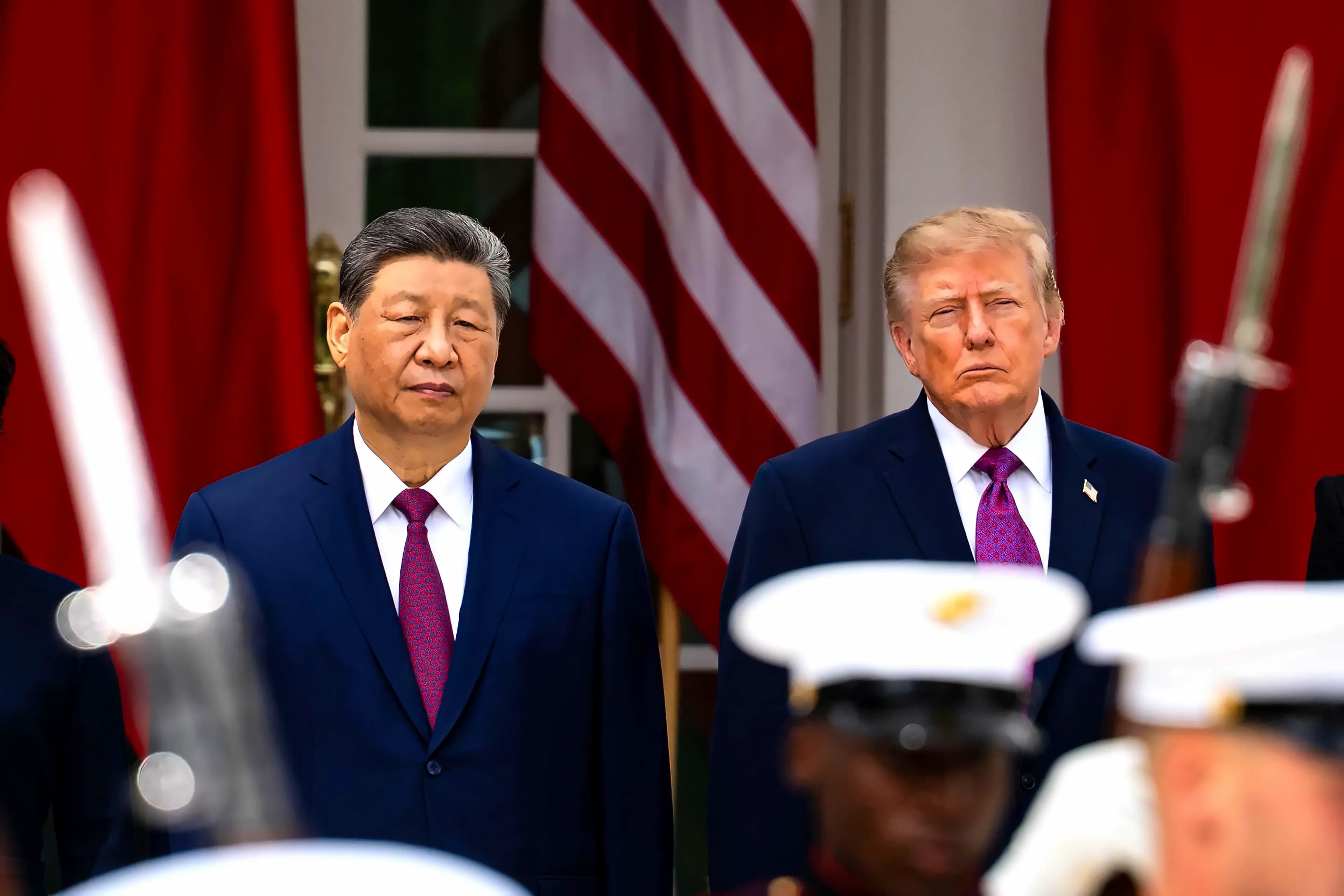
US President Donald Trump and Chinese President Xi Jinping concluded their first summit since October 2025 and Trump's first trip to China since 2017, with the meeting held mid-May 2026 in Beijing. According to Associated Press, the leaders took a short walk through the grounds at Zhongnanhai featuring ancient trees and Chinese roses, and strolled through a covered passageway with green columns and archways painted with birds and traditional Chinese mountain scenes before their final engagement. Over tea and lunch, Trump and Xi huddled for nearly three hours of talks before the U.S. leader completed his three-day visit to China. Trump told reporters that it's been really a great couple of days, while Xi called it a 'milestone' visit, stating 'We have established a new bilateral relationship, or rather a constructive, strategic, stable relationship'. China's Xinhua news agency reported that President Xi issued a warning on Taiwan, stating that if the US did not handle relations with Taiwan properly then the US and China would clash and their entire relationship would be in great jeopardy. The White House readout stated that both sides agreed that the Strait of Hormuz must remain open and that 'Iran can never have a nuclear weapon', though Chinese state media only reported that the Middle East was discussed without specifically mentioning Iran's nuclear program or the Strait of Hormuz. A Chinese Foreign Ministry spokesperson said Trump's meetings with Xi during his visit have promoted mutual understanding, deepened trust, advanced cooperation and injected 'stability' into the world, adding that the two heads of state also reached important consensus on properly handling each other's concerns and agreed to strengthen communication and coordination on international and regional issues.
A major breakthrough emerged regarding the Strait of Hormuz, which has been effectively closed since the start of the US and Israel war against Iran. As reported by Business Standard, Xi agreed with Trump that the Strait of Hormuz must be open for the free flow of energy, with the Chinese leader opposing any implementation of tolls on vessels crossing the strait. This development comes as Iran has allowed some Chinese vessels to transit through the Hormuz Strait, according to reports from Fars. The leaders agreed that the Strait of Hormuz — effectively closed since the start of the Iran conflict on February 28 — needs to be reopened to support global energy demands, with about 20% of the world's oil flowed through the strait before the war started. Trump appeared impressed by the bucolic grounds, remarking the roses were the most beautiful he had ever seen, while Xi promised to send him some rose seeds. China's Ministry of Foreign Affairs said on Friday that 'shipping routes should be reopened as soon as possible,' adding that 'now that the door for dialogue has been opened, then it shouldn't be shut again'. China reiterated a call to reopen the Strait of Hormuz in a bilateral meeting with the U.S. and called for a diplomatic solution to the Iran war, with the ministry stating that the solution should 'take into account the concerns of all parties on the Iran nuclear issue'. Trump suggested there could be a deal for China to buy oil from the United States after talks in Beijing, saying 'I think it will happen' and 'They've agreed they want to buy oil from the United States. They're going to go to Texas and to Louisiana and to Alaska'. Beijing limited U.S. energy imports to a 'bare minimum' after Trump imposed significant trade tariffs in 2025 and U.S. crude exports to China effectively halted more than a year ago, according to trade data and analytics platform Kpler. Despite the global energy shock from the Iran war, China's ample oil stockpile has so far been able to cushion it from bigger economic impacts, with Russia having been a major source for crude imports for China.
The summit highlights the 'win-win' nature of US-China economic ties, with Xi emphasizing that facts have shown time and again there are no winners in trade wars. According to Business Standard, the Chinese president called on both sides to jointly sustain the good momentum they have worked hard to build. This positive economic outlook comes as the US agricultural industry has borne the brunt of the recent US-China trade conflict, with farmers closely watching as Presidents Trump and Xi seek a potential agreement. Trump told Fox News about soybeans, airplanes and oil in an interview that followed his two-hour sit-down with Xi on Thursday, saying 'We feel very similar about (how) we want it to end' regarding the US-Israel war in Iran. Trump praised the visit as 'incredible' and said 'a lot of good has come of it,' including 'some fantastic trade deals' that are 'great for both countries'. Trump also focused on trade and deals for China to buy more agricultural products and passenger planes, setting up a board to address their differences and avoid a repeat of the trade war ignited last year after Trump's tariff hikes. Longtime US diplomat Richard Haass noted that for this president, first and foremost, is trade and reducing the imbalance of trade that exists between us, while acknowledging that no negotiations or compromises, especially on big issues, will be made during the summit. Ahead of the summit, CSIS experts offer analysis on a range of issues likely to be on their agenda, including the structural challenges that make a quick fix unlikely despite recent progress. U.S. Trade Representative Jamieson Greer said he expects to 'see an agreement for double-digit billion purchases' of U.S. agricultural products after Trump's visit to China concludes, speaking on Bloomberg TV and confirming that China has complied with prior trade agreements on farm products.
Despite recent progress, Taiwan remains the most important issue for China, with Xi's sharp language on Taiwan looming large over the visit, as Chinese government officials amplified that differences on the self-ruled island pose the biggest risk to U.S.-Chinese relations. Secretary of State Marco Rubio warned later on Thursday it would be 'a terrible mistake' for China to take Taiwan by force, telling NBC News that U.S. policy toward Taiwan was 'unchanged'. Xi's sharp language on Taiwan loomed large over the visit, as Chinese government officials amplified that differences on the self-ruled island pose the biggest risk to U.S.-Chinese relations. Trump at moments has shown ambivalence toward Taiwan, raising speculation that he could be open to loosening ties with Taipei, though Trump has demanded Taiwan increase defense spending and in December, the White House announced an $11 billion weapons package for Taiwan, the largest ever to the island democracy, with the U.S. yet to begin fulfilling the arms sales. Despite recent progress, the US military would face serious challenges fighting a protracted war with China due to a lack of long-range munitions, air defense systems, and unmanned systems, along with vulnerable bases and critical infrastructure in the Indo-Pacific. Trump suggested Xi assured him that China wouldn't provide Iran with military equipment, with Trump telling Fox News that 'I think it will happen' when asked about China buying oil from the United States. Trump said Xi told him 'he likes the idea' of buying oil from the U.S. 'I think it'll happen,' Trump said. 'Look, they're doing it right now. They're sending Chinese ships up to buy it.'
The summit also addresses broader regional issues, with Ukrainian Foreign Minister Andrii Sybiha linking Kyiv attacks to the Xi-Trump summit, seeking pressure on Russia. As reported by Business Standard, Iranian Foreign Minister Abbas Araghchi urged Brics to condemn US-Israel for international law violation during the Delhi meeting. The Brics meeting saw heated exchanges between Iranian and UAE officials over West Asia conflict issues, highlighting the complex regional dynamics affecting global diplomatic relations. Araghchi said Iran views Brics as a symbol of an emerging global order led increasingly by countries of the Global South. Beijing has shown little public interest in U.S. entreaties to get more involved in solving the conflict in Iran, even though Trump said in an interview with Fox News' Sean Hannity that Xi had in their conversations offered to help. The Chinese government also bid farewell to Trump with great pomp, with Chinese Foreign Minister Wang Yi seeing a smiling Trump off at the airport and schoolchildren dressed in Air Force One's light blue and white colors waving American and Chinese flags. Trump turned at the top of the stairs and pumped his fist and waved before entering the aircraft, with the children chanting 'Farewell, farewell' and 'Warm farewell!'. Trump's relative silence even extended to posting on his social media site, where he was not as active as usual during his three-day Beijing swing, with the White House so far hasn't released details of any deals struck during Trump's summit with Xi in Beijing. Trump has repeatedly complimented Xi's leadership during his visit to Beijing, calling him 'a tremendous leader' and noting that 'there's no games, there's no talking about how nice the weather is. Let's look at the stars, let's look at the sun. No, he's all, he's all business,' as he predicted the summit 'will go down as a very important moment in history' and 'maybe more than anything else, a great moment of respect'.