President Donald Trump has abandoned his plans to renovate the John F. Kennedy Center for the Performing Arts after a federal judge blocked his closure and renaming efforts. According to the latest reports, Trump announced he would 'have no interest' in pursuing the renovation project following the court setback. The president had previously claimed that large-scale renovations set to begin next month would be impossible without a closure and that Cooper's order to keep the center open would be dangerous. 'I cannot be involved with a situation where danger to the Public is allowed to flourish in plain and open sight,' Trump said in his Friday post on Truth Social. Cooper explained that the board relied 'on an insufficient, one-sided presentation of information' when it decided to close the center for two years for renovations.
President Donald Trump announced on Friday that he would transfer control of the John F. Kennedy Center for the Performing Arts to Congress after a federal judge blocked his plans to close and renovate the venue. According to reports from Reuters, Trump said on social media that he instructed the U.S. Commerce Department to 'make all necessary arrangements with Congress to allow a full and complete transfer of this Institution' and give lawmakers responsibility over its operation, maintenance and management. The center was previously governed by a bipartisan board of trustees, which Trump last year purged and filled with allies who installed him as the chair. As reported by Reuters, it was not immediately clear how Trump's directive could be carried out, as the Kennedy Center was created by Congress in 1958 and is run by a board of trustees that the president has packed with allies in his second term.
U.S. District Judge Christopher 'Casey' Cooper of the US District Court for the District of Columbia ruled that the Kennedy Center board's March 16 vote to close the facility was 'ill-informed and seemingly preordained' with no regard for its legal obligations. According to Reuters, Cooper's ruling effectively blocked Trump's plans to close the center for two years for renovations, though the judge said 'sorely needed' repairs to the aging building could move forward. Cooper concluded that the board 'overstepped its statutory bounds' by unilaterally adding Trump's name to the center, stating that 'Congress gave the Kennedy Center its name, and only Congress can change it.' The judge ordered defendants to remove Trump's name from the institution's façade and any 'official materials,' such as digital or physical signs, within 14 days. Cooper wrote that 'May the John F. Kennedy Center for the Performing Arts be renamed absent Congressional authorization? The answer, plain from the face of the statute, is no. Nor can any other individual be memorialized on the front portico of the building.' Cooper's order also stopped the Trump administration's planned two-year closure of the Kennedy Center for major renovations, though the judge said 'sorely needed' repairs to the aging building could move forward.
As reported by Associated Press, Trump's takeover of the Kennedy Center and its renaming led to a steep decline in sales at the institution, which puts on a range of arts events from musicals to opera to symphony concerts. The center was built to be a living memorial to Kennedy, who was assassinated in 1963. Kennedy Center officials denied speculation that the planned shutdown came due to declining ticket sales, pointing to multiple areas within the structure that needed repair. Matt Floca, who recently took over as the center's executive director from Richard Grenell, told reporters last month that the 2-year closure was needed to complete maintenance projects. Trump, a former New York businessman, has a history of putting his name on buildings and goods, making the renaming particularly significant for him. Roma Daravi, the Kennedy Center's vice president of public relations, said Friday the institution is 'confident that on appeal the court will uphold the Board's will to recognize President Trump's historic contributions to our nation's cultural center.' She said the decision would be reviewed 'carefully' and noted that 'with $257 million secured by President Trump and approved by Congress, the resources are in place' for restoration.
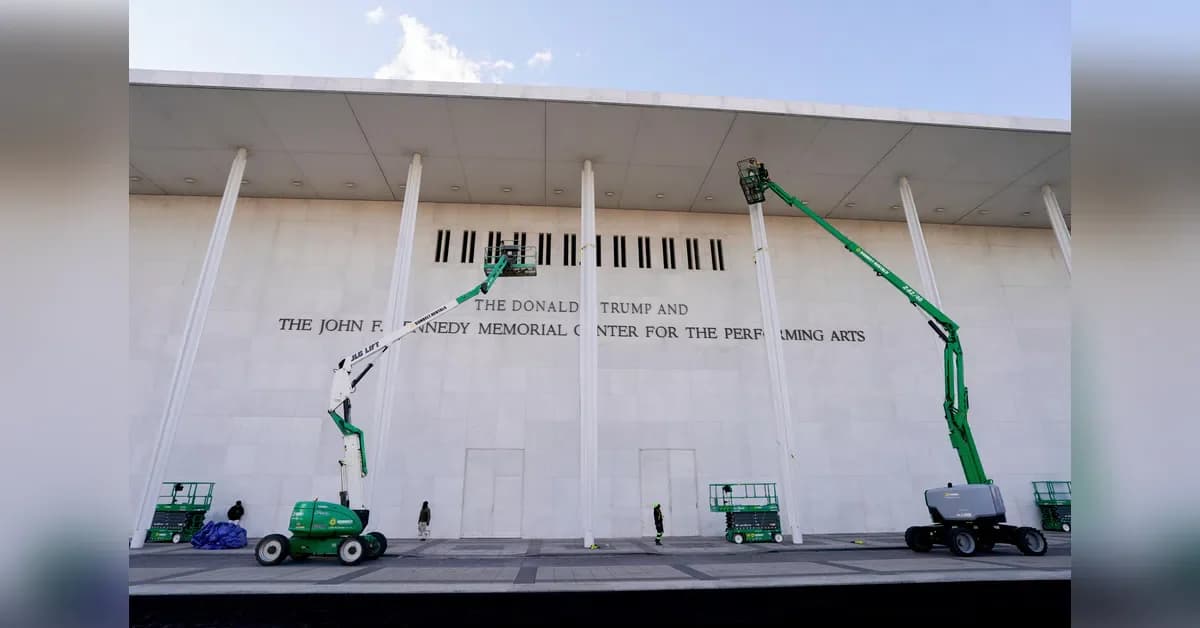
According to Reuters, the developments mark a setback to Trump's efforts to leave his personal stamp on Washington's historic sites. The judge stated his decision doesn't prevent the center from continuing with needed repairs or prevent the board from deciding later to close it 'should it come to this decision anew after independently balancing its multiple obligations to the Center in a prudent fashion.' Trump has appeared consumed with his renovation projects, even as he grapples with the ongoing war in Iran and the ensuing spike in fuel prices, frequently speaking about them at length in public appearances and in social media posts. The administration is expected to appeal some of the decisions. Trump has made reshaping Washington's historic institutions a major focus of his second term, with his administration overseeing projects that include demolishing the White House East Wing for a new ballroom and adding Trump's name or image to several federal buildings, including the US Institute of Peace and the Justice Department headquarters. He has also backed plans for a triumphal arch overlooking the Potomac River. Several of those projects have faced legal challenges, with opponents securing favourable rulings in lower courts.