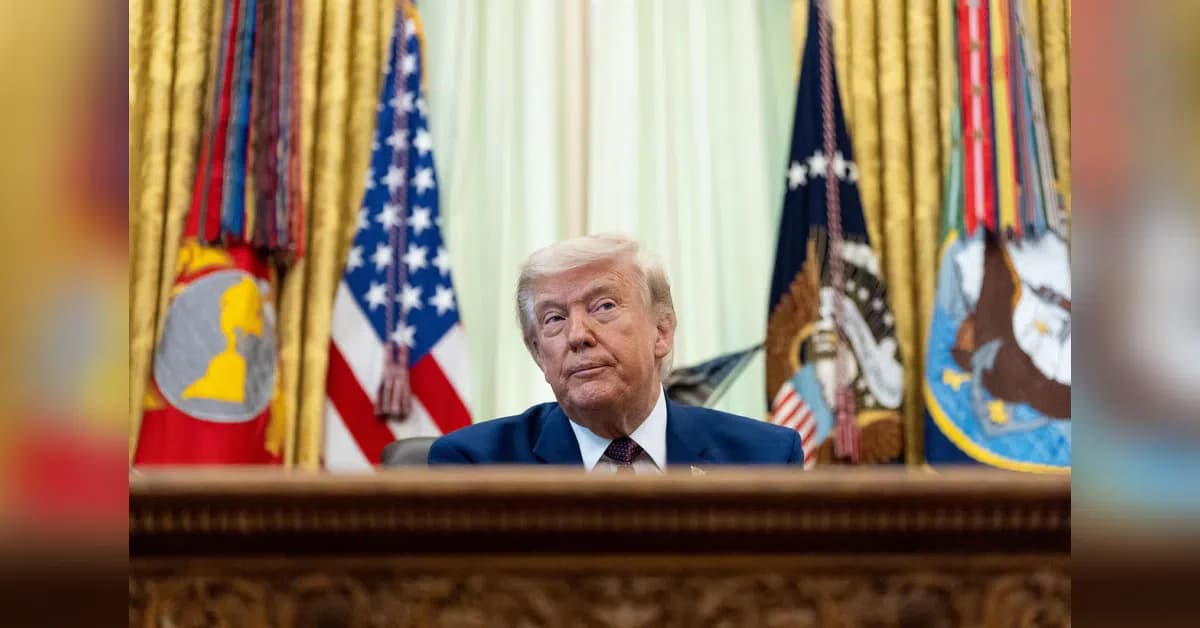
President Donald Trump confirmed that his administration is actively exploring the idea of the US government holding equity stakes in leading artificial intelligence developers, stating he planned to host a meeting with AI executives as soon as next week. Speaking at the White House Oval Office, Trump said he would soon meet top 12-15 executives to discuss the proposal, telling reporters that "I'm going to have meetings with the top 12 or 15 executives very shortly, and we're talking about giving back something to the public, and if we do that, the public will become very rich." According to Reuters, Trump told reporters aboard Air Force One that "There are concepts where pieces could be given to the American public, where the American public essentially becomes a partner with the companies." The President added that such a programme could potentially distribute dividends generated by AI companies to American citizens, emphasizing that "There's something very interesting about it, where it almost becomes a partnership with the American public." The White House did not immediately respond to requests for comment on details of the planned meeting, while AI giants Anthropic, OpenAI, Google, Facebook and SpaceX did not immediately respond to requests for comment.
OpenAI Chief Executive Officer Sam Altman had floated the idea of government stakes in major AI firms with the Trump administration in early 2025, according to a person familiar with the matter as reported by Business Standard. His proposal resembled later recommendations from the company, including the idea of donating equity to seed a fund together with other AI companies. According to CNBC, background discussions around government participation in AI-linked gains have been ongoing for some time, with OpenAI CEO Sam Altman and the White House having been in talks for more than a year over a possible structure that could allow the US government to take or receive equity-linked benefits in artificial intelligence companies. The idea includes the creation of a "Public Wealth Fund" model, under which returns from AI investments could potentially be distributed to citizens, according to the proposal referenced by CNBC. OpenAI has previously floated the idea of a public wealth fund that could invest in AI-related assets and distribute returns to citizens, though no formal agreement has been finalised. In response to reported discussions about the US government taking a stake in AI companies, OpenAI pointed to its public proposal in April calling for a wealth fund. The proposal gained additional significance as fears about AI capabilities have mounted, particularly following Anthropic's release of its powerful Mythos tool, which experts warn could dramatically accelerate sophisticated cyberattacks, particularly in sectors such as banking that rely on complex, interconnected technology systems.
Senator Bernie Sanders, a Vermont independent aligned with Democrats, accelerated discussions earlier this week with a proposal for the top AI companies to hand 50 per cent of their stock to the government. According to Business Standard, those shares would be kept in what he called a sovereign wealth fund that would be used to redistribute economic gains from the technology to the public. Sanders met with Altman on Capitol Hill, where the two discussed AI oversight and the growing role of tech money in politics this election cycle. Sanders has advocated a far more expansive approach, arguing that the public should receive a significantly larger share of AI-generated wealth, bringing renewed attention to the debate over AI ownership and wealth distribution. The comments come amid growing political and public scrutiny of the AI sector, particularly around job losses and the concentration of wealth in large technology companies.
The Trump administration has been struggling to decide how tightly to regulate AI, with the White House abruptly cancelling a signing ceremony for an AI executive order that had been slated for May 21. Other media outlets reported the cancellation came after the tech industry pushed back against elements of the directive. At the time, Trump said he did not like certain aspects of the executive order and did not want to take any steps that might undermine the U.S. in its AI competition with China. However, earlier this week, Trump signed a revamped version of the order that asked leading AI developers to voluntarily submit their most capable models for government cybersecurity tests before releasing them to the public. The Trump administration has also signed directives aimed at accelerating AI adoption across federal agencies and encouraging access to advanced models for national security use.
Since Trump's return to office, the government has invested in nearly a dozen companies, including several involved in the critical minerals industry, and pledged to take a stake of as much as 10 per cent in chipmaker Intel Corp. As reported by Business Standard, it remains unclear how the government would acquire equity in the AI ventures and how much stock might be handed over. According to a Reuters/Ipsos poll, around half of Americans fear AI could put them or someone in their household out of work, reflecting rising anxiety about automation's economic impact. The Trump administration has taken an unusually large role in the U.S. corporate sector, taking stakes in U.S. chipmaker Intel and a handful of rare earth and quantum companies. The discussions come amid growing scrutiny of AI's economic impact, with governments worldwide exploring ways to balance innovation, competition and public benefit as investment in the technology accelerates. While the structure remains unclear, the discussion reflects increasing political interest in how the benefits of AI growth could be shared more broadly, even as the sector continues to expand rapidly in valuation and influence.