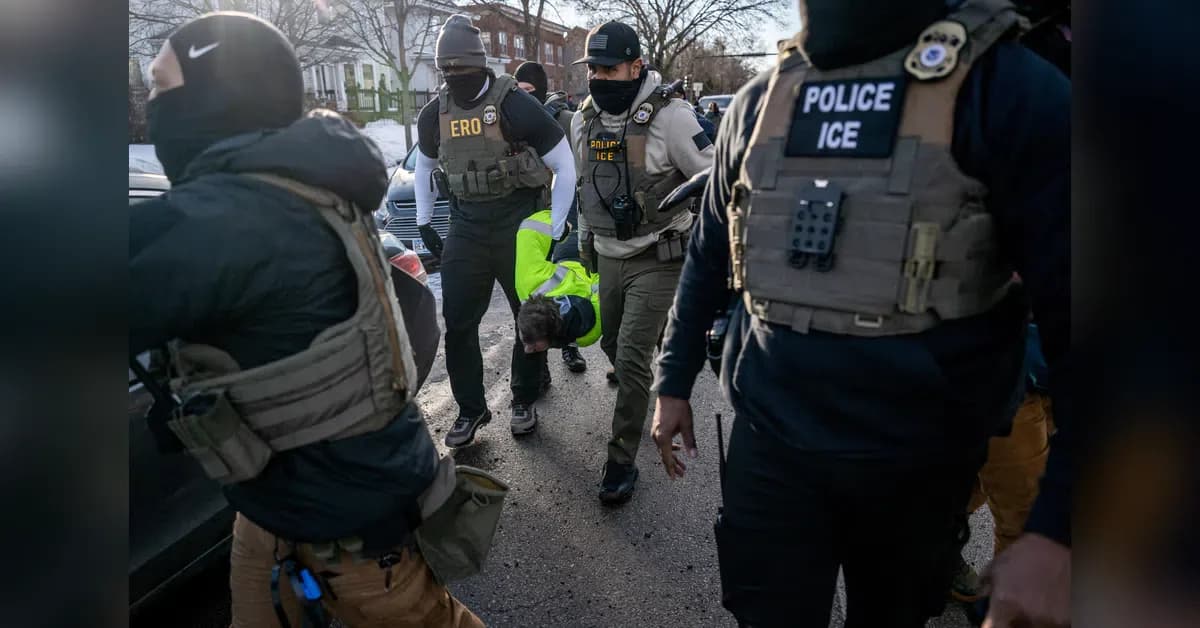
The Trump administration's immigration enforcement surge resulted in 668,000 job losses across 86 US cities that experienced the sharpest increases in ICE arrests, according to a new report from the Brookings Institution. The study found that in these cities, roughly 13 jobs were lost for each excess arrest during the enforcement campaign. The report, released Friday, analyzed the impact of the Immigration and Customs Enforcement campaign that adopted what the authors described as 'shock and awe' tactics that were broader and more visible than previous enforcement efforts under former Presidents George W. Bush and Barack Obama. The current administration's 2025 interior immigration enforcement campaign has been promoted, in large part, as a labor market policy: remove unauthorized workers and create jobs for Americans. However, this research evaluates that claim and finds the reverse: enforcement surges cost jobs, including jobs held by American-born workers.
Between 51,000 and 297,000 of the estimated 668,000 job losses would have been held by American-born workers, as reported by the Brookings Institution. The study found that businesses that rely partly on immigrant workers suddenly found themselves short of labor and scaled back operations for everyone, including US-born employees. Industries that traditionally employ large shares of undocumented migrants, such as construction, saw the biggest impact, but employment in sectors like arts and entertainment also fell sharply as businesses cut staff when people stopped going out during ICE raids. The analysis shows that employment fell below what one would have expected absent the enforcement shock, with losses spreading far beyond the workers directly arrested. The reason is twofold: local economies do not operate on a one-for-one logic in which removing one worker simply frees up one job for someone else. When firms suddenly lose workers they rely on, they often cannot replace them quickly enough to keep production on track. At the same time, highly visible enforcement triggered broader fear and withdrawal from economic life, reducing both labor supply and local demand.
The study, conducted by Brookings researchers Marcela Escobari, Ian Seyal and Paul Beach, examined 86 cities that experienced an enforcement surge in the first half of 2025 and compared them with others that didn't to isolate the impact from other factors. The authors used arrest data from the Deportation Data Project and employment estimates from labor market research firm Lightcast and federal payroll records. The analysis shows that employment trajectories in surge and non-surge cities were closely aligned before enforcement began, they diverged precisely when ICE arrests intensified. The gap widened over time, and the knock-on effects extended far beyond those directly targeted. Consumer spending fell significantly in immigrant-heavy communities, with a study cited suggesting spending in Los Angeles neighborhoods with high foreign-born resident levels slipped as much as 25% in the two months following the announcement of a local ICE campaign. The study uses cell phone and credit card data to show that ICE enforcement caused an estimated 2.9% decline in foot traffic and 6.9% decline in spending, equivalent to 8.1 billion fewer visits and at $3.1-$14 billion in foregone spending.
Construction experiences excess job losses even greater than what one might predict based on the large share of likely undocumented individuals it employs. The sector employs roughly 27% likely undocumented workers in the sample of cities, but construction losses averaged 2.2% across all 86 surge cities, equivalent to 102,000 jobs across all cities. This suggests that enforcement did not just remove workers in proportion to their presence, but disrupted operations in ways that cost additional jobs beyond what simple removal would explain. Crews are specialized, and projects are interdependent, meaning a framing crew cannot hand off to a roofing crew if the framing crew is suddenly missing half its workers. Firms cannot quickly replace missing workers without delaying or canceling work altogether. A recent industry-led survey found that 45% of construction firms reported project delays attributable to ICE-related labor shortages, and one in five reported that subcontractors had lost staff directly due to fear of enforcement. Such delays are likely to be felt by homebuyers and renters, with the same mechanism operating today as it did during Secure Communities enforcement.
The report concludes that 'enforcement at this scale and speed — visible, shocking, designed to produce fear beyond the directly targeted population — destroys jobs, disrupts businesses that Americans own and run, and depresses the local economies in which Americans live and work,' as stated by the authors. They emphasized that if the objective is to protect American workers and support resilient local economies, a wide-scale 'shock and awe' enforcement approach in American cities is a costly and counterproductive tool. The analysis shows that the 2025 enforcement surge broke from prior practice, supported across Democratic and Republican administrations, of a measured and proportional combination of enforcement with an expansion of lawful pathways. The pairing of interior enforcement with lawful work authorization has had bipartisan support from the Reagan administration's sweeping 1986 reforms through the Bush and Obama administrations. Businesses in sectors like construction need predictability and stable workforces to take on projects, commit to timelines, and hire. Capricious enforcement that removes employees without notice is a source of economic volatility, the kind of uncertainty that causes businesses to pull back, delay investment, and reduce employment. Any policy that aims to improve labor market outcomes for American workers must reckon with this evidence.