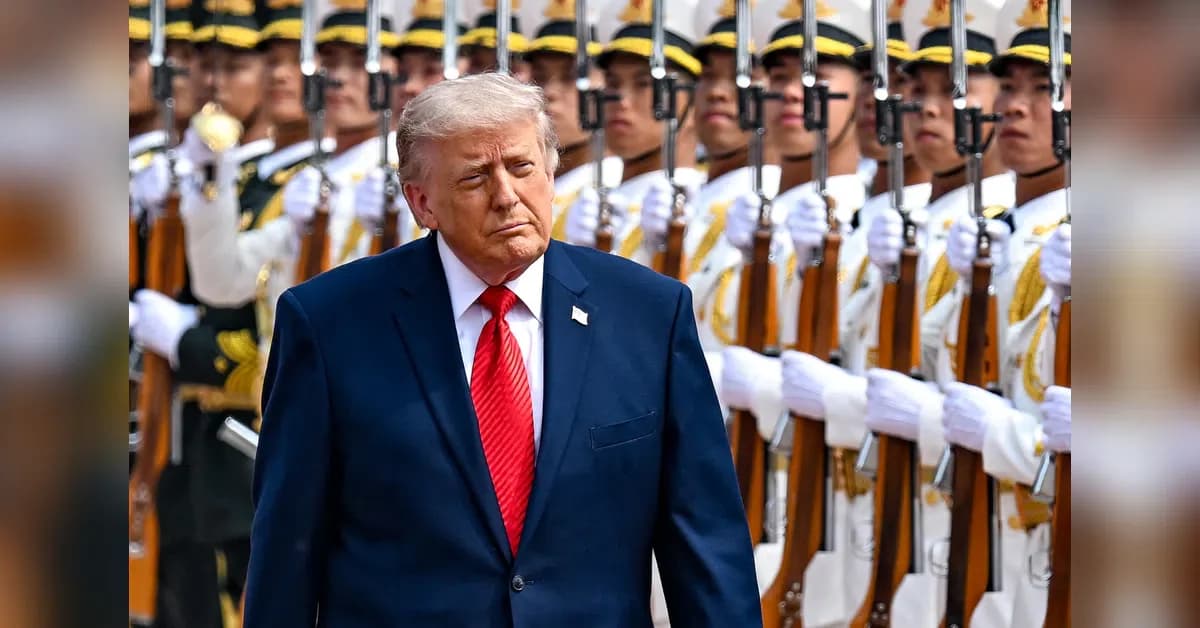
President Donald Trump postponed his planned Wednesday Cabinet meeting at Camp David due to 'possible bad weather conditions', as he announced on Truth Social Tuesday. The meeting was originally scheduled to take place at the woodsy Maryland retreat, with all Cabinet members expected to attend, including the outgoing head of national intelligence Tulsi Gabbard. The cancellation comes after no deal emerged over the weekend, with Trump later appearing to qualify his language, writing on Monday that an eventual agreement with Iran 'will either be a great and meaningful one, or there will be no deal.'
Oil prices jumped 2% following Trump's announcement of the delayed Iran deal negotiations, with Brent crude climbing above $93 per barrel as global markets remain on edge. The surge reflects investor concerns about potential supply disruptions from the ongoing geopolitical tensions. According to Moneycontrol, the oil price movement comes as markets await further developments in the Iran nuclear negotiations, with the Strait of Hormuz, the vital trade route whose de facto closure has caused a historic global energy supply shock, remaining a key focus for investors and traders.
Despite the US bombing that killed four Iranian soldiers, Tehran has not pulled out of peace talks that were continuing under the joint mediation of Pakistan and Qatar. The Iranian foreign ministry denounced the US attack as 'an act of bad faith' and 'a definitive violation of the ceasefire', but did not withdraw from negotiations. The Iranian military announced no specific reprisals, suggesting it did not want the attack to disrupt the delicate last steps towards an agreement. According to Reuters, the Iranian military announced it would 'not leave aggression unanswered' but did not specify any retaliatory measures.
Under the potential deal, Tehran would agree to give up its stockpile of highly enriched uranium - a key Trump demand - in return for sanctions relief. As reported by CBS News, citing a senior Trump administration official, Iran has 440.9 kilograms (972 pounds) of uranium that is enriched up to 60 per cent purity, a short technical step from weapons-grade levels of 90 per cent, according to the International Atomic Energy Agency. One regional official with direct knowledge of the negotiations said how Iran would give up the uranium would be subject to further talks during a 60-day period, with some likely being diluted while the rest would be transferred to a third country. Trump on Monday said the uranium would either be turned over to the US or 'destroyed in place or, at another acceptable location, with the Atomic Energy Commission, or its equivalent, being witness to this process'. The comment signals a softening of Trump's previous insistence that the US take control of Iran's uranium stockpile, as reported by CBS News.
Trump threw a curveball into the negotiations when he said he was 'mandatorily requesting' that a slew of Middle Eastern nations 'immediately sign the Abraham Accords' to normalize relations with Israel as part of a deal with Iran. As reported by Reuters, Pakistan already rejected the proposal, while Trump on Monday said any agreement to end the Iran war should include a requirement for several additional countries, including Saudi Arabia, Qatar and Pakistan, to join the Abraham Accords. According to Reuters, Trump's optimism that the other Middle Eastern and majority Muslim countries could soon sign on to the accords might be overly ambitious, with Saudi Arabia insisting that establishing a guaranteed path to a Palestinian state remains a precondition. According to CNN, retired US ambassador Barbara Leaf said officials from Gulf countries who were on the call told her that Trump's pitch was greeted by 'stunned silence', though a person familiar with the call disputed that characterization. Leaf, a distinguished diplomatic fellow at the Middle East Institute, said Middle Eastern allies recognize that Iran will likely use any money from sanctions relief to bolster its military capabilities, but they have been supportive of Trump pursuing an end to the conflict because 'they see no other way out because of many of these early mistakes that the president and the administration made in conducting the war.'