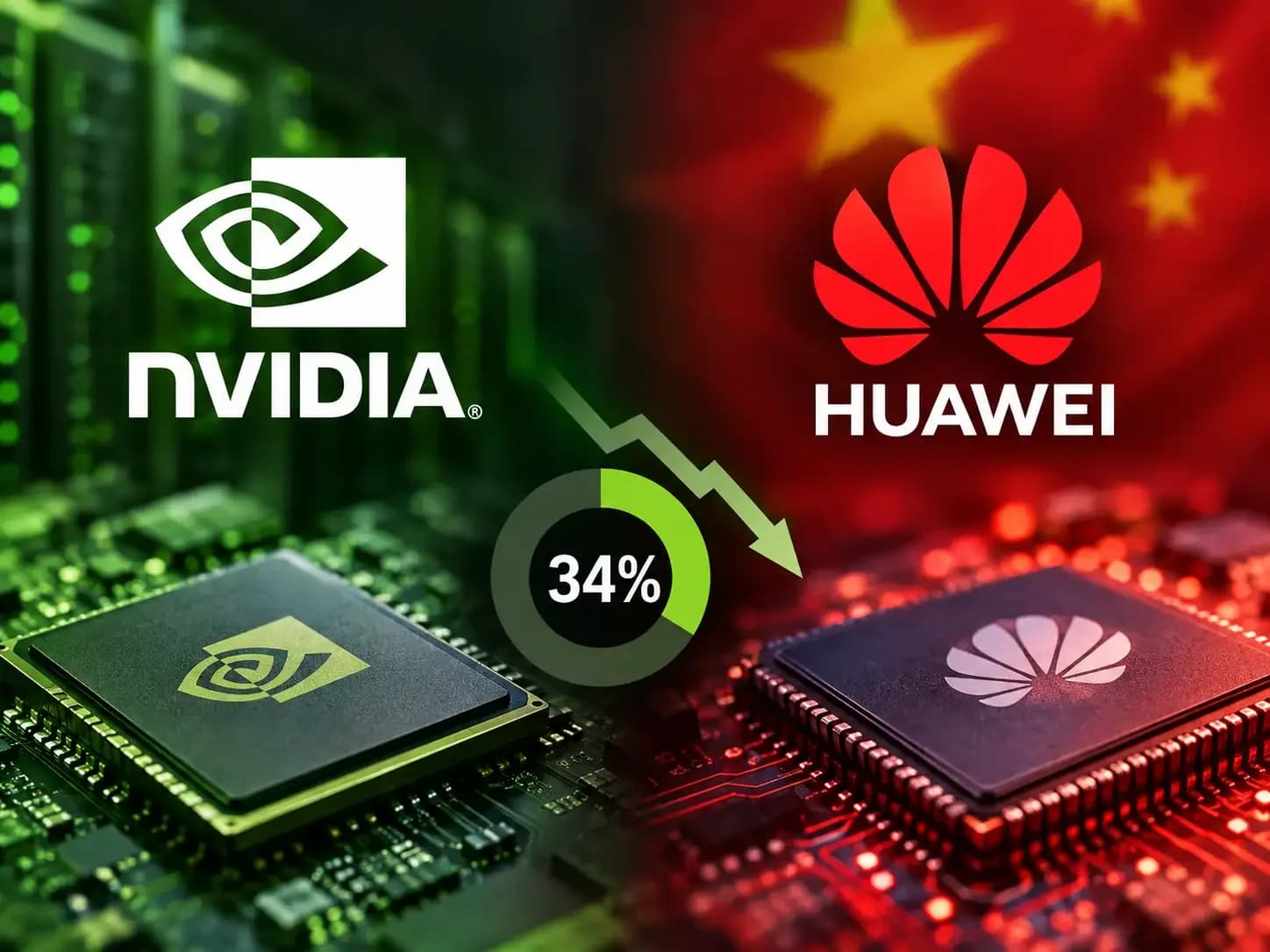
Former State Department official Keith Krach warns that while the U.S. remains ahead of China in the global artificial intelligence race, Beijing is rapidly narrowing the gap through Huawei's global expansion. Speaking to FOX Business, Krach stated that 'America is still ahead, but we are not comfortably ahead' in the AI competition. The competition extends beyond AI models to encompass energy, infrastructure, semiconductors, talent, exports and technical standards that other nations will rely on for years. According to Krach, China has gained ground in patents, industrial deployment, research, robotics and lower-cost open models, while the U.S. leads in private investment, advanced chips, cloud infrastructure, universities and entrepreneurial talent. As reported by FOX Business, Krach emphasized that 'the race will be won by the ecosystem the world chooses to build on'.
Huawei serves as 'a vertically integrated delivery system' for technological and geopolitical influence, according to Krach's analysis. The Chinese technology giant offers governments wireless networks, data centers, cloud services, AI chips, software, cybersecurity tools and financing in a single package. Krach warned that once these systems are installed, they become costly, disruptive and 'politically difficult' to replace. 'The real strategic asset is not the hardware,' Krach explained, 'It is long-term access to data, standards, software updates, technical dependencies and government relationships.' China's advantage lies in integration, financing, speed and state support, while Krach argues that 'America must counter it with a trusted full-stack alternative that performs better and strengthens, rather than compromises, a partner country's independence.'

The Trump administration is drafting a ban on U.S. imports of new models of Chinese data center components, according to reports from Reuters. The Federal Communications Commission (FCC) is working on measures to bar imports of new Chinese optical transceivers, which allow data to travel over fiber-optic cables at the speed of light within data centers. Officials hope to publish the measure this year when it would take effect, as the FCC seeks to protect AI infrastructure from potential data theft and malware. The move aims to prevent Chinese firms from stealing data, installing malware, or disrupting service at U.S. data centers that house chips to train and run AI models. However, the FCC could still modify or shelve the restriction, with sources speaking on condition of anonymity to discuss sensitive matters.
Shares of U.S.-based transceiver makers saw significant gains following the ban announcement, with Lumentum jumping 7%, Coherent rising 11%, and Applied Optoelectronics surging 18%. The ban would likely impact China's Zhongji Innolight, one of the biggest global sellers of transceivers, which was added to the Pentagon's list of alleged Chinese military-backed companies in June. The FCC would ban all imports of new transceiver models and then exempt many non-Chinese suppliers from the restrictions, similar to its approach with Chinese drones, routers, robots and inverters. However, China hawks in the administration are keen to avoid another situation like Huawei, where telecom equipment was so deeply embedded in U.S. infrastructure that removal efforts were slow, expensive and incomplete.
The FCC's decision reflects a broader policy shift where humanoid robotics and data center components are increasingly being viewed as strategic AI capabilities deserving of protection afforded to other critical technologies. According to MIT Technology Review, the White House is also considering restrictions on open-source Chinese AI models that compete with US companies such as OpenAI and Anthropic at fractional costs. This expansion represents a shift from focusing solely on semiconductors and frontier AI models to treating robotics and data center infrastructure as the next frontier of artificial intelligence. The move comes as China hawks in the administration are keen to avoid another situation like Huawei, where telecom equipment made by the heavily sanctioned Chinese firm was so deeply embedded in U.S. infrastructure. Krach emphasized that 'America's advantage is freedom, innovation, capital, entrepreneurship and allies' and called for faster permitting, support for proprietary and open American AI models and export packages that allies can easily purchase and deploy.