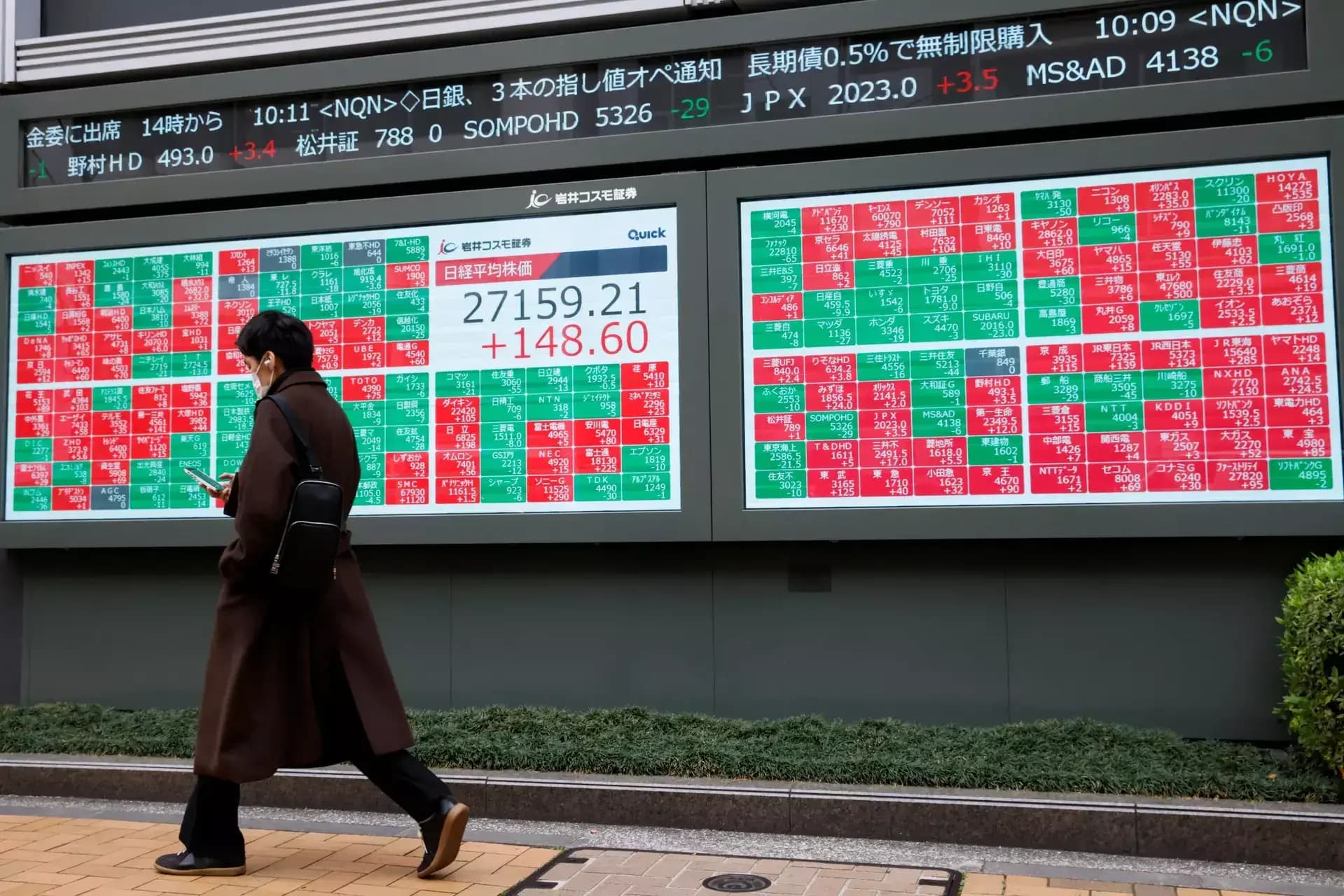
Japan's Nikkei 225 surged past 68,000 for the first time, climbing 2.9% to 68,634.74 by midafternoon on Wednesday, extending its record-setting rally as strong gains in artificial intelligence and semiconductor-related stocks outweighed investor concerns over escalating Middle East tensions. The broader Topix index also gained 1.5% to 3,982.89, with both indices continuing their remarkable performance as buying of technology shares linked to the boom in artificial intelligence has been driving rallies worldwide. According to Business Standard, investor sentiment was boosted by continued strength in technology shares following positive cues from Wall Street and optimism surrounding demand for AI-related products and services. Among the Tokyo Stock Exchange's 33 industry sectors, 25 posted gains, with nonferrous metals leading the advance with a 6.3% jump.
Memory chip maker Kioxia Holdings surged as much as 7.2%, crossing the 80,000-yen threshold for the first time after announcing plans to begin dividend payments from fiscal 2027, supported by strong earnings performance. The rally briefly propelled Kioxia ahead of Toyota Motor as Japan's second-most valuable listed company. Semiconductor-related stocks were among the biggest contributors to the market's gains, with Tokyo Electron jumping 13.4% and semiconductor testing equipment manufacturer Advantest rising 5.1%. Together, the two companies added nearly 840 points to the Nikkei index. Other notable performers included Fujikura, which gained 9.3%, and Furukawa Electric, which rose 4.3%. As per Business Standard, Japanese firms are playing a key role in building global AI infrastructure, positioning them to benefit from the sectors rapid expansion.
SoftBank Group Corp. has officially overtaken Toyota Motor Corp. as Japan's most valuable company, marking a milestone that hasn't been achieved in over two decades. According to Business Standard, SoftBank's shares climbed 14% in Tokyo trading, pushing its market capitalisation past Toyota's for the first time since the peak of Japan's internet bubble in 2000. The company's market value has surged more than 90% this year, reaching above 48 trillion yen, while Toyota's has fallen more than 10% this year. SoftBank's Vision Fund reported gains of approximately $43.9 billion in the fiscal year ending March 2026, with its total investment in OpenAI now exceeding $64.6 billion, following a $30 billion funding commitment in February 2026. The dramatic reshuffling of Japan's corporate hierarchy reflects how rapidly investor tastes have shifted toward companies benefiting from the AI buildout.
The Nikkei's record-breaking performance came amid broader global technology stock weakness, with US technology stocks experiencing significant overnight declines that triggered profit-booking across Asian markets. Nvidia declined 3.6%, Amazon.com fell 2.5%, and Alphabet lost nearly 0.8% in US trading. The sell-off spread across Asian technology names, with Taiwan Semiconductor Manufacturing (TSMC) falling about 1.7%, while Taiwan's Foxconn dropped more than 4%. In South Korea, Samsung Electronics and SK Hynix declined 1.3% and 2.8%, respectively. According to CNBC TV18, SoftBank shares tumbled more than 11% on Thursday, tracking the broad sell-off in global technology stocks after overnight weakness on Wall Street. The decline came despite SoftBank's strong rally this year, with the stock having gained roughly 70% year-to-date and recently surpassing Toyota Motor Corp. to become Japan's most valuable listed company.
Japan's economic position has shifted significantly in the global landscape, with the country's economy now estimated at about $4.2 trillion to $4.4 trillion in nominal terms, down from its peak of $5.5 trillion in 1995 when it accounted for around 18% of global output. By contrast, China's rapid industrialisation and export-led expansion have transformed the regional balance of power, with China's wealthiest coastal province, Guangdong, generating output of approximately CNY14 trillion ($1.9 trillion) in 2025. Combined, China's three richest coastal provinces - Guangdong, Jiangsu, and Shandong - generated more than $5 trillion of economic output, surpassing Japan's entire economy. This regional economic shift underscores how Japan's traditional dominance in Asia has been challenged by China's accelerated growth and the rise of Southeast Asian economies including Indonesia and Vietnam. According to Jefferies strategists, "Despite concentration risks and rising volatility, the AI theme continues to be underpinned by strong earnings," with the rally being fundamentally driven by earnings momentum. Barclays has also suggested that investors chasing Asia's AI rally may want to consider Japan instead, potentially highlighting undervalued opportunities in the region.