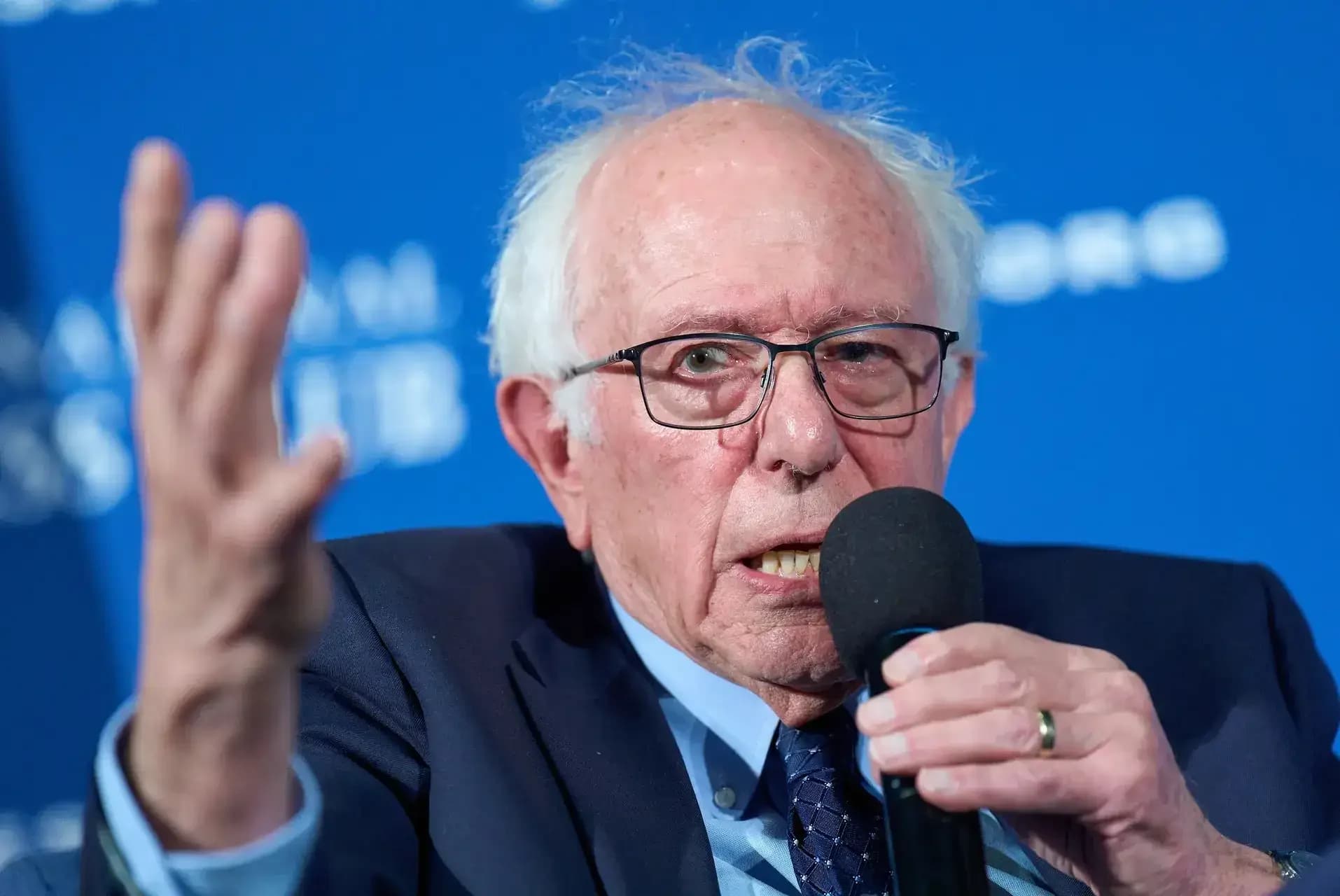
US Senator Bernie Sanders has introduced the American AI Sovereign Wealth Fund Act, proposing a 50% public ownership stake in major US artificial intelligence companies. According to reports from The Associated Press, the legislation would levy a one-time tax paid in stock rather than cash, equal to half the equity of firms with at least $200 million in annual AI revenue. The shares would be held in a government-run fund estimated to be worth $7 trillion, with a 5% annual dividend that would deliver direct payments of more than $1,000 to every American. As Fortune reports, Sanders emphasized that "AI and robotics will impact every man, woman, and child in this country," pointing to predictions of massive job loss, privacy concerns, and mental health impacts on children. The senator has been teasing interest in his plan for weeks, finally unveiling the detailed legislation on Thursday. As reported by Sen. Sanders, the act would give the American public a 50% direct ownership stake in the largest AI companies in the U.S., achieved through a one-time 50% tax on these companies' stock.
As reported by The Associated Press, Sanders stated that "We can no longer sit back and allow a handful of Big Tech oligarchs to determine the future of this revolutionary technology with no democratic input." The Vermont independent emphasized that the proposal aims to redistribute the industry's soaring wealth amid growing concerns about AI's impact on jobs and inequality. According to Fortune, Sanders argued that "AI is built on the foundation of human knowledge, of the work of millions and millions of people. Every tweet that you send out, every email that you send out, every article that you write, that's part of AI. The American people should be able to stop what's bad and benefit from the financial gains of AI." As reported by Sen. Sanders, he noted that "there has not been one significant piece of legislation to protect the American people from AI and robotics," and described the current movement as "a grassroots movement, which is taking place: opposition to data centers, deep concern about the growth of AI." The bill has virtually no chance of passing Congress, but Sanders is likely to use it to shape the growing debate over AI, jobs and inequality in the country.
According to The Associated Press, US President Donald Trump recently weighed the idea of the government buying shares in AI firms, calling it a possible "partnership with the American public." In a surprise development, his administration has separately taken equity-style stakes in several companies, including mineral and semiconductor firms to quantum computing players. White House officials are reportedly split on how to structure any stakes in AI firms, with Treasury Secretary Scott Bessent favoring using equity to seed "Trump accounts" for American children, while Commerce Secretary Howard Lutnick prefers a sovereign wealth fund structure. The proposal comes as Americans grow increasingly disillusioned by AI and Big Tech companies' plans for the future. Semafor reports that Commerce Secretary Howard Lutnick also supports a sovereign wealth fund approach, while Sanders said he has not spoken to the White House about his plan. Sanders has discussed the bill with other senators, but there are no other official cosponsors, and he did not name specific allies.
As reported by The Associated Press, most industry groups and Big Tech companies are expected to fiercely resist a plan that would dilute founder and investor control of the sector's most valuable firms. Critics note that Norway's sovereign wealth fund, which Sanders cites approvingly, caps its holdings at 10% of any public company -- far below the 50% he proposes. The proposal faces a significant challenge as many of the most valuable AI companies, like OpenAI and Anthropic, are not profitable. According to Fortune, Sanders acknowledged this hiccup, stating "I'm not a Luddite. I think that AI can do some very good things." The goal, he emphasized, is "to make AI work for ordinary people, not just for Mr. Musk and other multibillionaires." At OpenAI CEO Sam Altman's request, he and Sanders met for nearly an hour earlier this month, soon after the senator announced his plan. Altman told Sanders he agrees that the public should have equity in AI companies but said that he couldn't support a 50% stake. As reported by The Associated Press, in their meeting, Altman and Sanders remained far apart on how large of a stake the public would get, with Altman suggesting "5% of our profits back into the government," while Sanders emphasized "What we're talking about are two very different things."
If passed, the bill would create a seven-person Independent Commission for Democratic AI, nominated by the president and confirmed by the Senate, to manage the sovereign wealth fund "in public interest." As reported by The Associated Press, the commission would use its voting shares "to block decisions that hurt the American people and to push for policies that help them." According to Fortune, the plan draws inspiration from 67 countries that have sovereign wealth funds, including Norway, China, and the United Arab Emirates. According to The Associated Press, the bill notes that several states, including Texas and New Mexico, have had sovereign wealth funds for decades and have used them primarily to fund education. The bill would also force AI companies with non-AI businesses to separate them, so the public's ownership stake would solely be in the AI business. Sanders estimates that at current valuations, the fund would be worth $7 trillion, with plans to pay out yearly $1,000 checks to every American from the expected 5% dividend from the AI companies. As reported by Sen. Sanders, if major AI companies grow, the fund would also increase accordingly, though if AI companies fall in value, so would the fund, with the companies absorbing the fallout instead of the federal government. The proposal lands the same week as the California Billionaire Tax Act gathered enough signatures to qualify for the November ballot, with the Billionaire Tax Now Coalition signaling willingness to negotiate a reduced 2% wealth tax rather than the originally proposed 5% rate.