Amazon founder Jeff Bezos has called for the elimination of federal income taxes on the bottom 50% of US earners, arguing that most revenue already comes from high earners. Speaking on CNBC's "Squawk Box" from Florida, Bezos made this pitch during a Wednesday interview, then amplified the message across social media where the clip drew millions of views. The proposal targets what Bezos describes as the 'Nurse in Queens' scenario, highlighting a New York City nurse earning $75,000 annually who pays more than $12,000 in taxes - representing over $1,000 per month that could cover rent or groceries. "I don't want to reduce it, I want to eliminate it," Bezos told anchor Andrew Ross Sorkin, explaining that "Zero is a better number than $1." As per CNBC, Bezos slammed the "absurd" tax system that sees the top 1% of taxpayers pay about 40% of all tax revenue while the bottom half pay only 3%. "We shouldn't be asking this nurse in Queens to send money to Washington. They should be sending her an apology. It really makes no sense," Bezos emphasized, noting that "the income tax paid by lower earners is a small amount of money for the government."
IRS data supports Bezos's framing, as reported by The Tax Foundation. The top 1% of US filers paid 40.4% of all federal income taxes in 2022, while the bottom 50% paid only 3.3% the following year. According to CNBC, the bottom 40% of households already pay no net federal income tax on average when accounting for refundable tax credits. The average income tax rate in 2023 was 14.1%, while the bottom half of taxpayers paid an average rate of just 3.7%. This figure is small in fiscal terms but meaningful per household, as reported by CNBC. The bottom 50% of earners account for only 3% of all tax revenue, with the bottom half—who earned about $24,500 on average in gross income—paid an average rate of 3.7%, according to the latest IRS data analysis. In Australia, the top 1% of earners paid 19.6% of all net income tax in 2021-22, while the 41% of workers who earned less than $45,000 paid only 2.3%, as per analysis by The Australian Financial Review.
Bezos framed his comments around what he described as a bifurcated economic reality – what economists have labeled a K-shaped economy. Higher-income Americans continue to benefit from surging asset values and strong wage growth, while lower- and middle-income households grapple with the lingering effects of inflation, elevated gas prices, and the end of pandemic-era relief programs. Federal Reserve Bank research has documented how the expiration of pandemic-era subsidies created a measurable economic split beginning in 2023, a trend that researchers say is being aggravated by elevated fuel costs. Sharply higher gasoline prices amid the Iran war are exacerbating the K-shape, as lower earners spend a greater share of their incomes on gasoline relative to higher earners, according to CNBC reports. Bezos repeated his familiar critique that Washington overspends rather than under-taxes, claiming that New York City public schools spend $44,000 per student - a figure that tops outlays in Chicago, Boston, Los Angeles, Miami, and Houston, while producing weaker results. He used the example of an Amazon worker in New York earning $50,000 annually to illustrate the absurdity of taxing lower earners, asking "Why are you taxing them so much?"
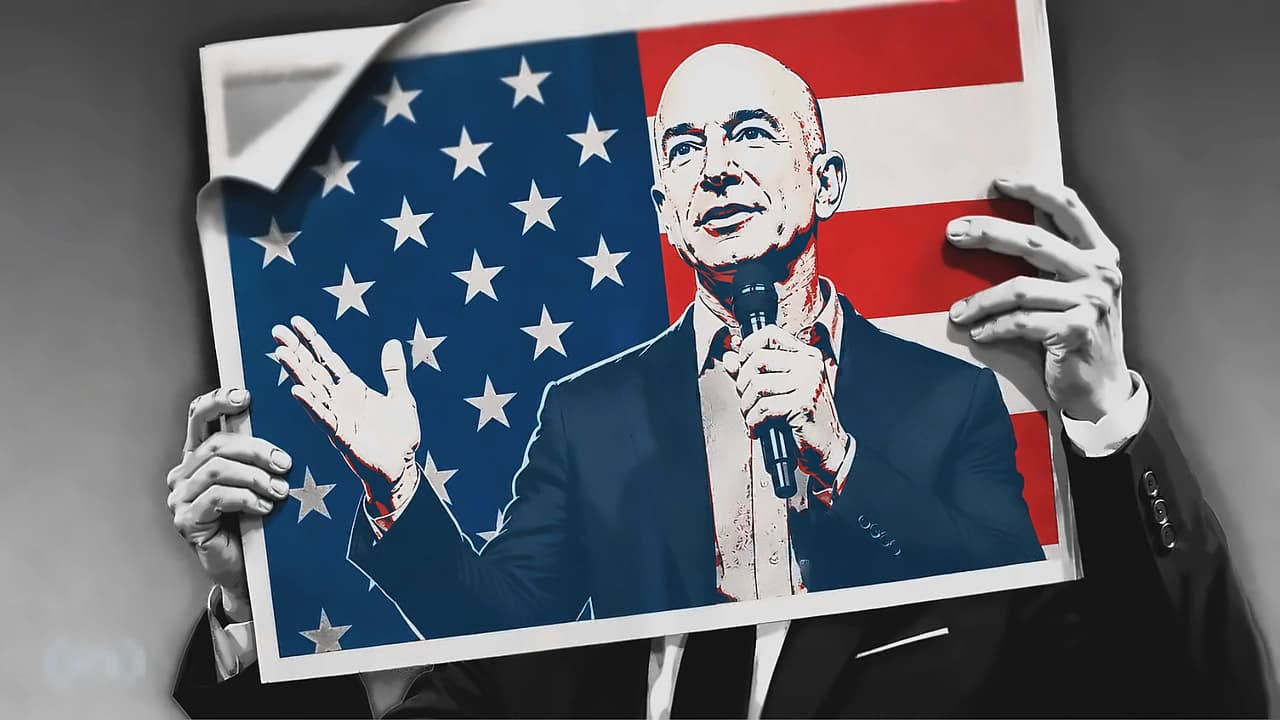
Bezos pushed back against what he called a political reflex to target billionaires to solve income inequality, arguing the approach is more about electoral positioning than economic remedy. "What's happening here is politicians are using the kind of age-old technique – picking a villain and pointing fingers," he said. "But the problem is that doesn't solve anything." That drew immediate pushback from New York City Mayor Zohran Mamdani, who wrote on social media: "I know a few teachers in Queens who would beg to differ." However, the proposal has garnered support from prominent figures in the business world. US venture capitalist and entrepreneur Chamath Palihapitiya praised Bezos's proposal as a "simple, elegant and very effective idea," while entrepreneur Anthony Pompliano called it a "Great idea that would help millions of families who need it." Venture capitalist and founder of Lux Capital, Josh Wolfe, said it was "smart and simple approach worth doing."
Several US lawmakers are pushing for alternative tax relief measures aimed at lower-income Americans. Among them, Senator Cory Booker has introduced the "Keep Your Pay Act," which proposes making the first $75,000 of income tax-free for couples filing jointly, with proportional tax relief for single filers and heads of households. "No income tax on the first $75,000 families earn would be a game changer for working people," Booker said in a statement earlier this year. "This tax cut would immediately put more money in your pocket every month to deal with the high price of everyday expenses, an unexpected emergency, or to plan for the future." Bezos's comments come as a number of Democratic states explore higher taxes on the wealthy, with his proposal representing a significant shift toward eliminating taxes for lower earners entirely. As per Mint, Bezos, the world's fourth-richest person with a net worth around $269 billion according to Forbes, has positioned himself as a leading voice for tax reform without detailing specific implementation strategies.