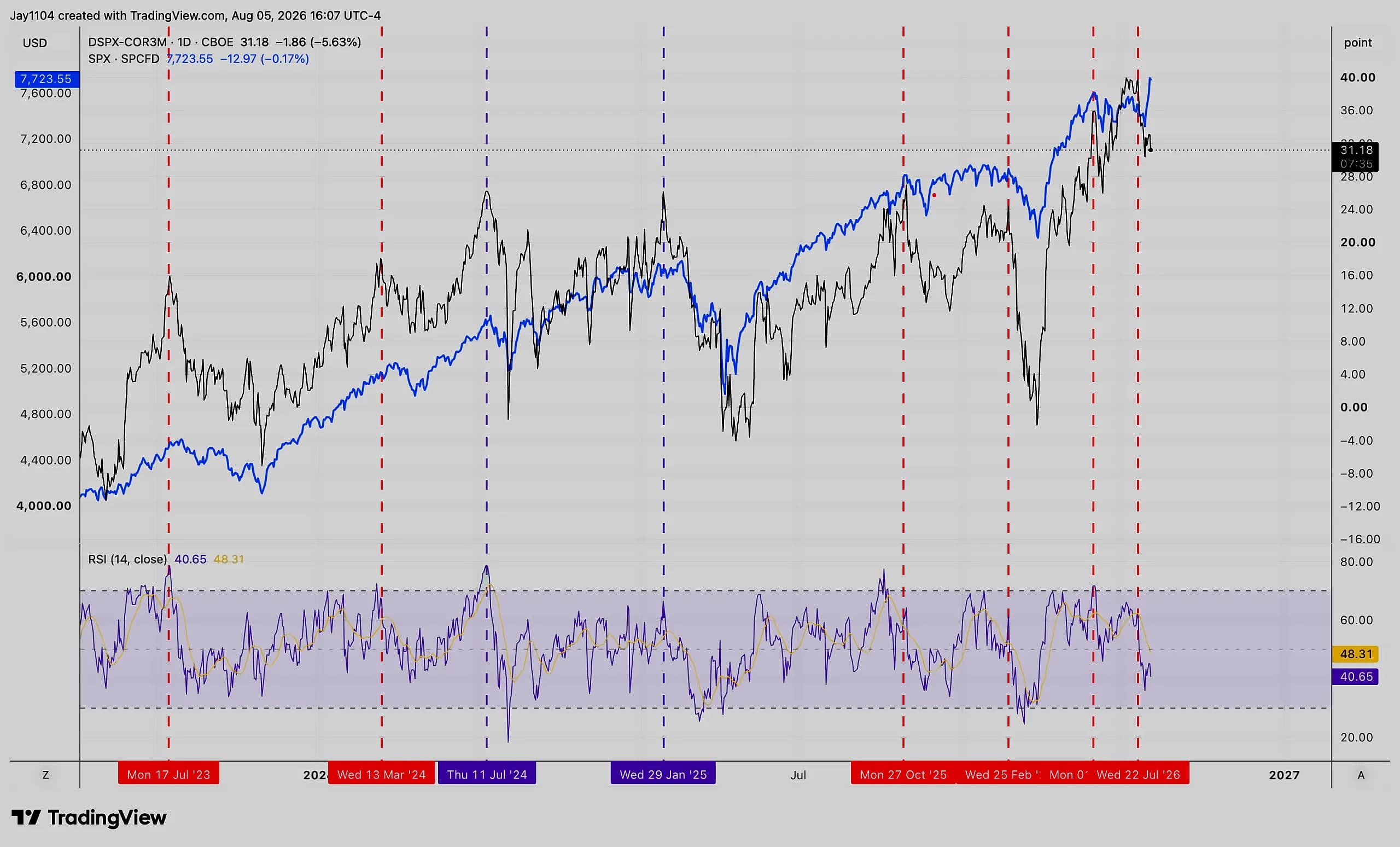
The Nasdaq Composite emerged as the outperforming index on Monday, closing 2.26% higher at 27,122.090 points as Wall Street began the new trading week on a strong note. According to The Times of India, the market looked like a giant gamma squeeze, with the epicenter of the squeeze centered around Meta (NASDAQ:META). Meta shares ended 11.4% higher on Monday, their best single-day gain since April 2025, following the success of Muse AI. The S&P 500 gained 1.49% to close at 7,764.70 points, while the Dow Jones Industrial Average increased 0.71% to 52,048.83. The rally was primarily driven by AI-linked chip stocks and falling bond yields, with Meta Platforms spurring a rally among chipmakers as early signs of success for the company's new AI agent sparked enthusiasm regarding demand for the chips needed to power such agents. Meta's CDS widened to 90, highlighting the extreme volatility in the stock as the market experienced what analysts describe as an unusual gamma squeeze. The gains came despite safety warnings from leaders of major AI companies a week earlier, which had triggered a global technology selloff. Investors instead pointed to signs that spending on AI continues to expand.
Advanced Micro Devices became the latest chip company after Nvidia, Micron, Broadcom, and TSMC to command a market capitalization of $1 trillion, with shares gaining 10% on Monday. Intel shares gained 12.2% as the rally was powered by AI gains as Treasury yields eased and crude prices tumbled more than 3%. Meta shares ended 11.4% higher on Monday, their best single-day gain since April 2025, following the success of Muse AI. According to Wedbush Securities, Agentic AI relies on compute-driven applications and there are only two compute vendors in the market - Intel and AMD. Meta is AMD's second-biggest customer, contributing to 5.5% of the overall topline, highlighting the significant impact of AI adoption on semiconductor demand. Arm Holdings surged 17%, sending the PHLX semiconductor index 4.3% higher. The Nasdaq 100 rose 2.8% as the technology sector led the market surge. Overnight, the Philadelphia Stock Exchange Semiconductor Index closed up 4.3%, the biggest one-day rally since Aug. 4, while South Korean chipmakers Samsung Electronics and SK Hynix were up about 3.5% early in the session. As noted by Investing.com, personal agents broaden the compute trade beyond GPUs into inference, memory, custom silicon, networking and cloud capacity, creating recurring demand for compute every time users shop, book, pay, organize or act through the agent.
Bond yields pulled back significantly from recent highs, with the 10-year Treasury yield falling to 4.95% and holding under the critical 5% threshold amid lack of major economic cues. According to The Times of India, the decline in oil prices and Treasury yields added to the positive mood. As reported by Bloomberg, yields across maturities fell by at least five basis points, with the two- and five-year retreating from multiyear highs reached Wednesday after the rate hike. Markets see a 50% chance of another hike next month according to CME's FedWatch, with commentary from at least 10 central bank policymakers due this week. The yield decline demonstrates the market's ability to absorb hawkish Fed policy while maintaining confidence in economic fundamentals, with stronger corporate earnings providing counterweight to yield increases. The S&P 500 traded at just under 19 times expected earnings last Friday, its lowest valuation since 2023, according to LSEG data, with AI-related heavyweights responsible for much of the recent rise in earnings expectations.
Oil prices continued their decline with Brent crude futures falling below $100 a barrel and touching their lowest level since September 9 before settling at $100.34 per barrel, providing additional support to the broader market rally. According to The Times of India, the decline in oil prices came amid speculation about a possible breakthrough in Middle East talks at a UN meeting this week. West Texas Intermediate crude fell 4.9% to $95.43 a barrel, easing pressure on equities as the 10-year US bond yield slipped below the critical 5% mark. US President Donald Trump said he would be open to meeting Iranian President Masoud Pezeshkian, who is expected to attend the UN General Assembly in New York this week. However, Trump also threatened to eliminate Iran's leadership if they do not strike a deal. The fall in oil prices further added to risk appetite, with investors looking ahead to a meeting between President Donald Trump and Chinese leader Xi Jinping later this week that could help ease geopolitical tensions and support sentiment. As reported by Investing.com, lower oil prices are taking some heat out of the inflation trade, while the upcoming Trump-Xi meeting offers another possible pressure valve around trade, technology and critical minerals.
Taiwan's Taiex advanced 1.8% to a record as Asian markets responded positively to the AI rally, with MediaTek gaining 9.4% to a record and Unimicron Technology and Nan Ya Printed Circuit Board each jumping by their daily limit. According to The Times of India, the rally reflects growing confidence that hyperscalers will continue scaling their proprietary chips as AI adoption accelerates. Tencent Holdings rose as investors bet the social media giant could unlock similar AI-driven opportunities on its WeChat platform. Memory names also rallied in onshore China, helping lift the Star 50 Index by more than 2%. Gary Tan, a portfolio manager at Allspring Global Investments, noted that the rally in Taiwan's market "reflects growing confidence that hyperscalers will continue scaling their proprietary chips as AI adoption accelerates." He added that if products like Muse gain traction, hyperscalers will need more compute capacity, further accelerating demand for custom AI chips and supporting Taiwan's ASIC ecosystem. As reported by Investing.com, the market is not treating Muse as a Meta-specific product success but as another reason to push the structural demand curve for compute higher, broadening the trade beyond the original GPU-focused approach.