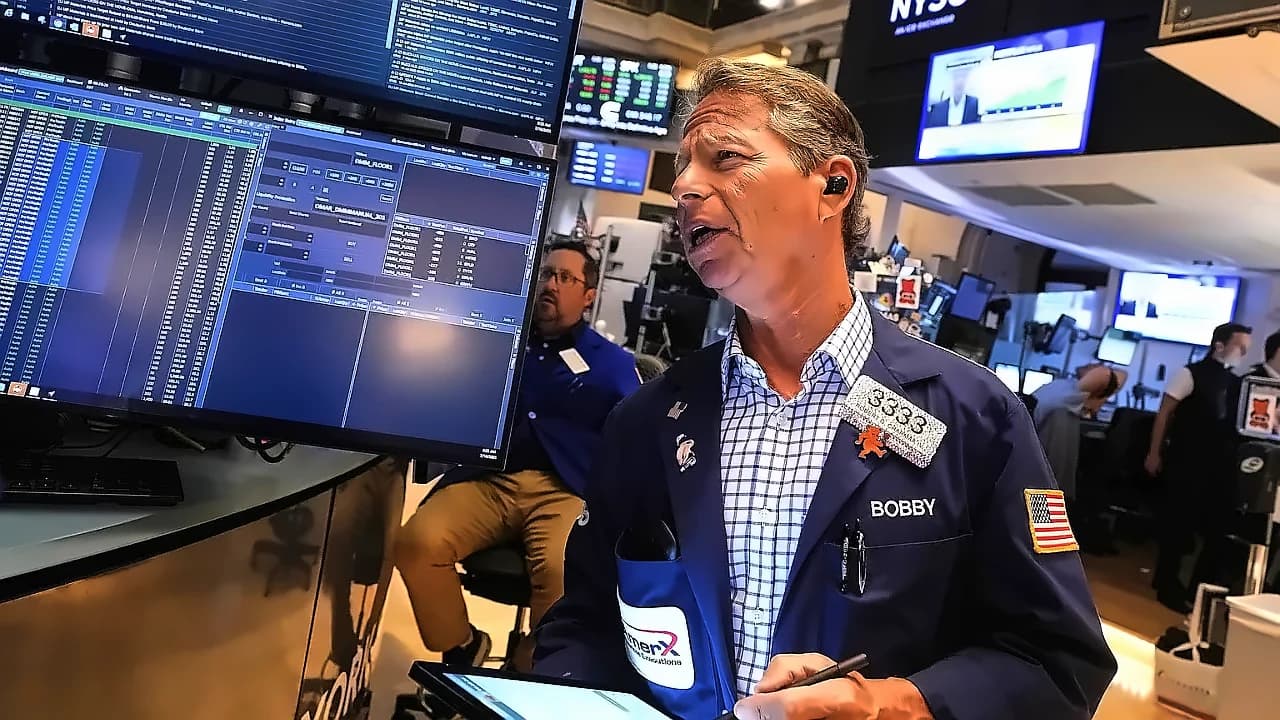
US stocks closed higher on Thursday as semiconductor shares extended Wednesday's rally, with Nvidia Corp. topping S&P 500 Index gainers on a points basis. According to TradingKey, the Nasdaq Composite Index gained 1.91% to 26,517.93 points while the tech-heavy S&P 500 Index rose 1.08% to 7,500.58 points. The Dow Jones Industrial Average rose 0.14% to 51,564.70 points, with all three major indices closing in positive territory. The Philadelphia Semiconductor Index hit another all-time high, closing up 6.42% at 14,341.78 points, with all 30 of its components advancing. Chip companies Micron Technology Inc. and Broadcom Inc. were among the top S&P 500 gainers, while Intel Corp. closed up 10.64% at $133.99, hitting an intraday high of $135.48 to reach an all-time high. Latest data shows US stock index futures have shown promising gains with Dow futures rising 0.2%, S&P 500 futures increasing 0.4%, and Nasdaq 100 futures gaining 0.7%, all linked to the persistent strength in chip equities.
The semiconductor sector is being led by giants like Nvidia, AMD, and Broadcom, with AMD particularly standing out due to its volatility, gaining more than 6% on some days and dropping over 7% on others. Since the start of 2026, AMD's stock has surged roughly 130%, while the iShares Semiconductor ETF (SOXX) has experienced a notable rise, increasing by over 8% on rebound days in June. The Philadelphia Semiconductor Index has enjoyed impressive year-to-date gains of 60-80% by early June, demonstrating the sector's exceptional performance. Among memory concept stocks, SanDisk (SNDK) rose 11.54%, Micron Technology (MU) up 8.70%, Western Digital (WDC) up 4.79%, and Seagate Technology (STX) up 0.39%, leading the gains in the semiconductor sector. The continuation and acceleration of AI spending is a significant driver behind this ongoing rally, with major cloud providers ramping up their capital expenditure plans focused on AI infrastructure, presenting direct benefits to semiconductor manufacturers.
Apple edged higher after CEO Tim Cook told The Wall Street Journal the company plans to raise prices to offset higher memory and storage chips costs. As reported by NDTV, this development comes as the company faces increased pressure from rising semiconductor costs. The announcement reflects Apple's strategy to maintain profitability amid inflationary pressures in the memory chip market. U.S. President Donald Trump revealed that Apple has formally agreed to partner with Intel to locate the entire chip design and manufacturing chain within the United States. Trump stated that while the U.S. has always possessed world-class chip design capabilities, the manufacturing segment has long been lost overseas, which is the core reason why the current administration made rebuilding the domestic semiconductor supply chain a key priority upon taking office. The partnership represents a significant step toward domestic semiconductor manufacturing independence.
SpaceX shares surged in late trading to claw back most of its losses for the day, closing down 3.57% at $184.977, with a market capitalization of $2.43 trillion, making it the sixth-largest company by market value in the United States. According to TradingKey, the market anticipates that SpaceX will merge with Tesla to build a tech behemoth spanning rockets, artificial intelligence, satellites, electric vehicles, robotics, energy, and social media. If the merger officially materializes, the combined entity's valuation would reach approximately $4 trillion. The president of SpaceX recently stated that there are synergies between the two companies, noting that the merger "could simplify Musk's management responsibilities," and pointing out clear business intersections in their futures: "There is undoubtedly room for synergy between the futures of Tesla and SpaceX." SpaceX's partner investment banking team will hold investor conference calls as early as next week to discuss launching a bond offering plan following the company's record-breaking IPO.
Amazon.com Inc. climbed 2.90% as it officially joined the ranks of selling its self-developed AI chips to external customers. Following in Google's footsteps, Amazon has officially joined the ranks of selling its Trainium AI accelerator chips to third-party enterprise data centers, further penetrating the global AI computing power market dominated by Nvidia. This represents a key milestone in Amazon's comprehensive shift toward its AI strategy. Trainium is the core self-developed AI hardware of Amazon Web Services (AWS), since its launch in 2020, it has secured top-tier clients such as OpenAI and Anthropic through a cloud services model, locking in over $225 billion in cumulative revenue commitments. Currently, the third-generation product is essentially sold out, and the fourth-generation chip, expected to hit the market next year, has already garnered significant market attention. Meanwhile, EU regulators signaled looming antitrust oversight for major cloud providers, adding another layer of regulatory scrutiny to the tech sector's growth trajectory.