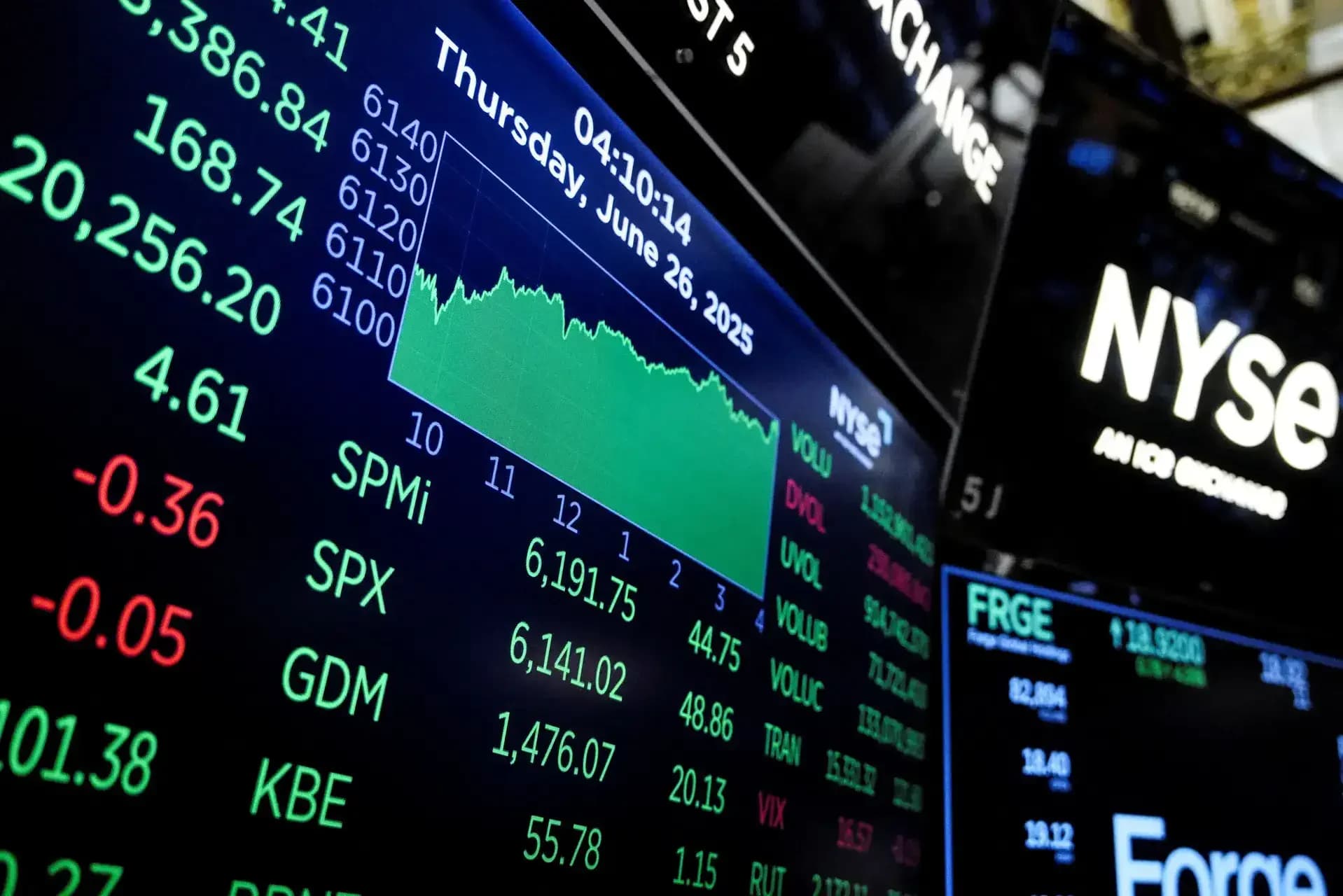
US stocks advanced with the S&P 500 rising 0.6% to close at a new all-time high and the Nasdaq Composite gaining 1.2% to finish at a record high, even as wholesale inflation data came in much higher than expected. According to multiple reports, the S&P 500 gained 17.15 points, or 0.23%, to 7,418.11 points, while the Nasdaq Composite advanced 188.52 points, or 0.72%, to 26,276.72. The Dow Jones Industrial Average fell 216.84 points, or 0.44%, to 49,543.72. As reported by The Economic Times, six of the Magnificent Seven group of AI-related megacaps posted solid gains, with chip stocks rebounding from Tuesday's decline. Technology shares led the rebound, with Tesla (TSLA) and Nvidia (NVDA) rising more than 2% apiece as AI-linked optimism returned after the prior session's weakness. Google parent Alphabet (GOOGL) led gainers at 4%, while Micron Technology (MU) and Qualcomm (QCOM) resumed their recent surges, rising 4.8% and 1.4% respectively after pulling back sharply yesterday. The tech sector lifted the market, led by semiconductors and the "Magnificent Seven" stocks, with Apple (AAPL) crossing $300 for the first time, also hitting a record high.
A report from the Labor Department showed producer prices jumped by 1.4% month-over-month in April, nearly triple the 0.5% expected by economists. According to The Economic Times, while the surge was largely driven by crude supply disruption due to the closure of the Strait of Hormuz, the report showed soaring oil prices are beginning to seep into other segments of the economy. US Treasury yields climbed on Wednesday, with the benchmark 10-year yield touching its highest level since July, reaching around 4.49% after producer prices surged at the fastest pace since 2022. The data prompted traders to ramp up bets on future Federal Reserve tightening, with markets increasingly pricing in a potential rate hike by mid-2027. "Core" PPI, which strips out volatile energy and food prices, rose 1% when a 0.3% rise was expected, while excluding volatile prices for food, energy, and trade services, wholesale inflation rose 0.6% over the month, double the expected increase. On a year-over-year basis, headline prices rose by 6% in April, above estimates of 4.8% and outstripping March's 4.3% print. Core inflation came in at 5.2%, hotter than estimates of 4.3% and previous month's 4% revised gain. Minneapolis Federal Reserve President Neel Kashkari said the Iran war has worsened inflation that already was running too high, underscoring his preference for leaving the Fed's door open to possible rate hikes.
Trump arrived in Beijing with an entourage that included Nvidia Chief Executive Officer Jensen Huang and Elon Musk ahead of a two-day summit with Chinese counterpart Xi Jinping. As reported by The Economic Times, topics on the agenda include urging Xi to "open up" to U.S. businesses and maintaining a fragile trade truce. Tesla CEO Elon Musk and Nvidia CEO Jensen Huang joined President Donald Trump for the Beijing summit, with the CEOs of Micron and Qualcomm also accompanying Trump in China. The meeting occurs amid China's warnings regarding U.S. arms sales to Taiwan and criticism over proposed legislation that would make it harder for Chinese chipmakers to produce AI semiconductors. Oil prices declined after a three-session rally, offering temporary relief to markets worried about sustained energy-driven inflation pressures, despite tight supply signals and concerns over the Strait of Hormuz. West Texas Intermediate futures declined 0.9% to $101.30 a barrel, while Brent crude settled down 2% at $105.63.
In a 54-45 vote, the US Senate confirmed Kevin Warsh as the new chairman of the Federal Reserve, taking over Jerome Powell whose term ends on Friday. The vote largely followed party lines, with Pennsylvania Democratic Sen. John Fetterman the only member of his party to support Warsh. First quarter profits for companies in the S&P 500 have grown 27% throughout the season, far above the 12% analysts had expected, according to Bloomberg. Roughly 83% of the 440 S&P 500 companies that reported earnings up to May 8 have beaten analyst estimates. Morgan Stanley analysts led by Mike Wilson said their bullish index view is an earnings story, not a multiple expansion one, with the bank projecting growth to 8,000 would represent 8% upside and growth to the bank's updated 12-month outlook target of 8,300 would represent 12% growth for the index. The six winners have added roughly $516 billion in market value today, versus a $26 billion decline for the broader market. The 10-year Treasury yield edged up toward the 4.5% level, currently at 4.47%, sitting at its highest level since July of last year, with the longer-dated 30-year yield remaining above 5% key psychological level.