The Quad partners have announced a $20 billion critical minerals framework to counter China's tight grip on global supplies of critical minerals. According to reports from The Hindu BusinessLine and Business Standard, the grouping comprises India, the US, Australia, and Japan, who announced this initiative during a joint statement issued on Tuesday in New Delhi. The framework will mobilise funding through public and private sector mechanisms, including export credit agencies, development finance institutions, loans, guarantees, and subsidies. The funding will specifically target strategic critical mineral projects with a 'Quad nexus' — projects located within partner countries or supplying Quad markets to address supply chain gaps. As per Business Standard, the Quad foreign ministers voiced 'grave concerns' over China's export control regime, noting that China controls around 70% of global rare earth mining.
In a significant development, India and the US signed a framework agreement on 'Securing Supply in the Mining and Processing of Critical Minerals and Rare Earths' in New Delhi. As reported by Business Standard, the agreement was signed by External Affairs Minister S Jaishankar and US Secretary of State Marco Rubio. The India-US framework covers cooperation across mining, processing, recycling, and investments related to critical minerals and rare earths, while also aiming to strengthen resilient and diversified supply chains. US Secretary of State Marco Rubio termed the framework 'a tangible example' of the US-India strategic partnership, adding to Washington's Pax Silica initiative which India joined in February. The US is currently mobilising $30 billion to secure critical minerals supply chains, demonstrating the scale of commitment to this partnership. This bilateral agreement builds upon existing strategic synergy between the two nations, as India had earlier joined the US-led Pax Silica initiative and is also partnering with the US under the Forum on Resource Geostrategic Engagement (FORGE) initiative.
The framework additionally envisages comprehensive cooperation on critical minerals supply chains, including recovery and recycling of critical minerals from e-waste and scrap materials. According to Business Standard, this includes investments in recycling technologies, collection networks, and streamlining export-import procedures for waste and scrap. The initiative also proposes supporting strategic critical minerals projects through export credit agencies, development finance institutions, guarantees, loans, equity participation, insurance, subsidies, and mobilisation of private capital. The framework additionally covers cooperation on permitting and regulatory processes, geological mapping and resource assessment, and coordinated measures to address 'non-market policies and unfair trade practices' in critical minerals markets. Emphasising sustainability and resource efficiency, the Quad countries also proposed collaboration in the recovery and recycling of critical minerals from e-waste and scrap materials, including investments in recycling technologies, collection networks, and streamlining export-import procedures for waste and scrap.
The Quad foreign ministers announced significant initiatives to strengthen maritime security in the Indo-Pacific region, with 60% of global maritime trade passing through the region. As reported by Business Standard, the grouping will augment technology for maritime surveillance, ensure safety of undersea cables, and advance port infrastructure for key Indo-Pacific corridors, starting with building a port in Fiji. The ministers expressed serious concerns over 'dangerous and coercive actions' in the East China Sea and South China Sea, including the militarisation of disputes, and condemned attacks on commercial shipping vessels. They also slammed Iran over shipping tolls in the Strait of Hormuz and Red Sea, opposing any future measures inconsistent with UNCLOS, including imposition of tolls. In another development, the Quad countries issued a joint statement on Indo-Pacific energy security, highlighting concerns over disruptions in global oil, gas, and petrochemical markets and their impact on the region. To mitigate these systemic threats, the four countries announced plans to convene a Quad Fuel Security Forum to coordinate cooperation on strategic petroleum systems, emergency response exercises, and regional energy resilience, while also stressing uninterrupted trade flows through critical maritime routes, including the Strait of Hormuz.
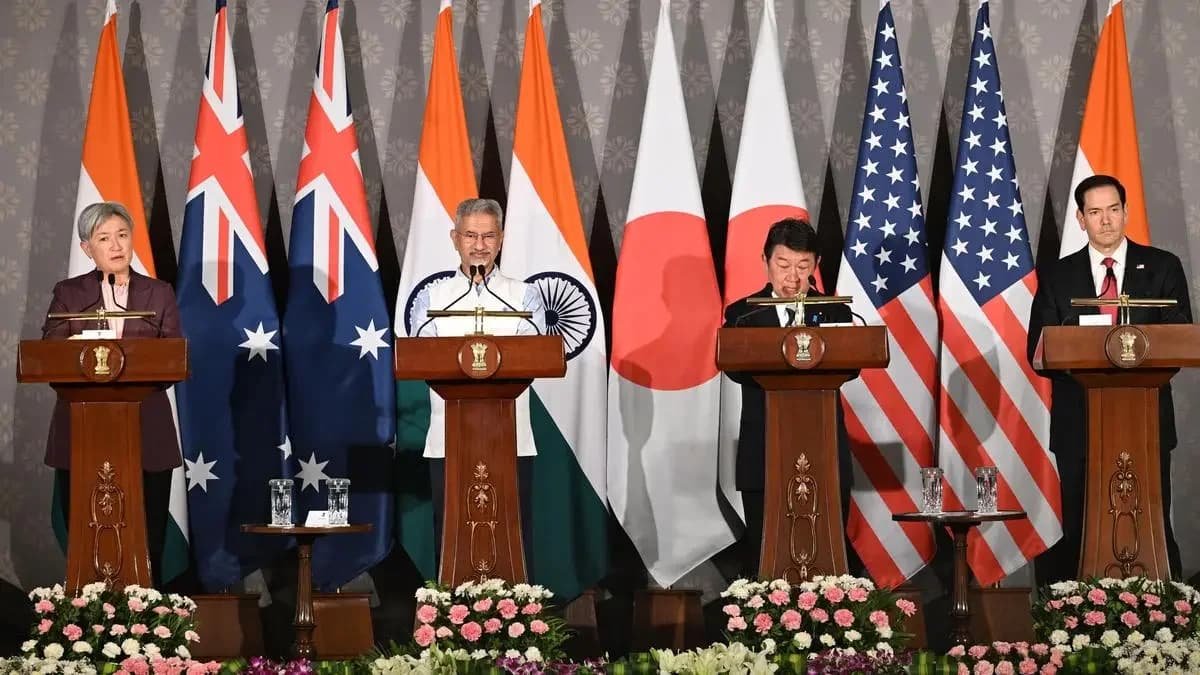
The Quad countries issued a joint statement on Indo-Pacific energy security, highlighting concerns over disruptions in global oil, gas, and petrochemical markets and their impact on the region. According to Business Standard, the four countries announced plans to convene a Quad Fuel Security Forum to coordinate cooperation on strategic petroleum systems, emergency response exercises, and regional energy resilience. Despite uncertainty over whether India will host the Quad Summit this year, Indian officials emphasised that the Quad is 'here to stay and going strong' with new layers being added to its developmental agenda. The alliance plans to target ventures tied directly to the bloc's strategic orbit, with the Quad partners planning to identify projects with a 'Quad nexus' — projects located in Quad countries, operated by companies headquartered in Quad countries, or supplying Quad markets.