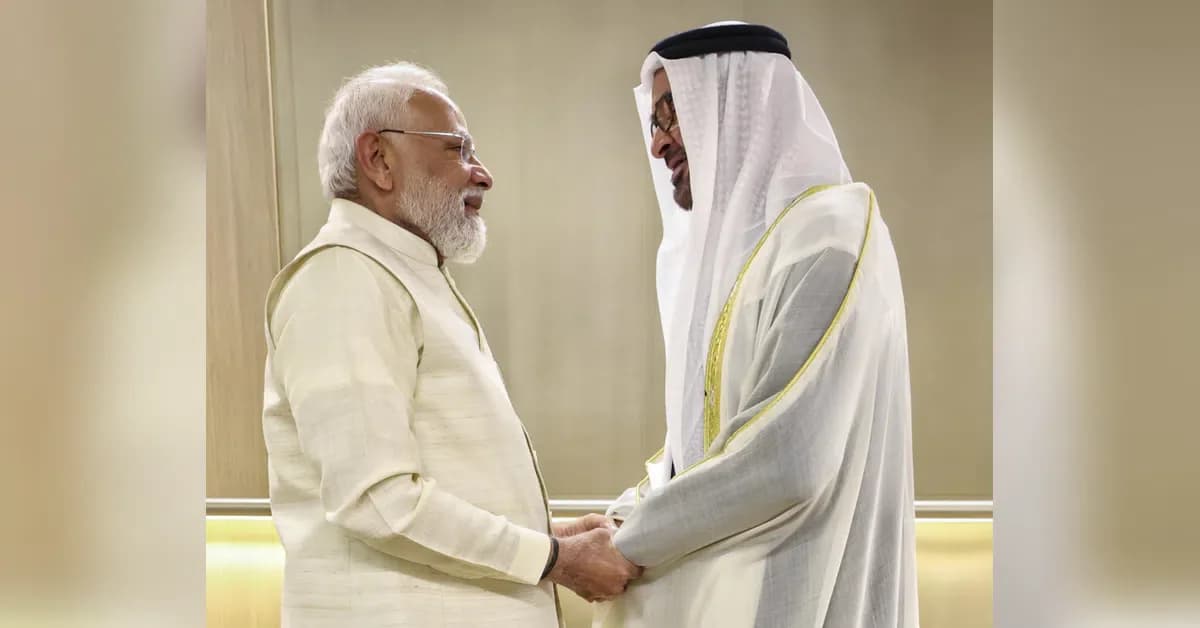
Prime Minister Narendra Modi sharply condemned the Iran-linked attacks on the UAE during his delegation-level talks with UAE President Sheikh Mohammed bin Zayed Al Nahyan on Friday. As reported by ANI, Modi stated 'We strongly condemn the attacks launched on the UAE. The manner in which the UAE has been targeted is not acceptable in any form. We welcome the steps taken by you to uphold national unity, security and regional integrity.' Modi also praised the UAE's response to the crisis, expressing 'For the care provided to the Indian diaspora residing in the UAE in these difficult times, the manner in which they were considered as members of one's own family, UAE Govt, you and Royal Family, I express my heartfelt gratitude.' These remarks came in the backdrop of a significant escalation on May 4, 2026, when Iran attacked the UAE with four drones, three cruise missiles, and twelve ballistic missiles, with three Indian nationals working at the Fujairah Petroleum Industries Zone injured in the strike.
Prime Minister Narendra Modi announced India's readiness to extend all possible support for bringing peace to West Asia during his meeting with UAE President Sheikh Mohammed bin Zayed Al Nahyan on Friday. According to reports from Press Trust of India, Modi made this commitment during the first leg of his five-nation tour that includes four European countries. The prime minister reaffirmed India's solidarity with the UAE and said New Delhi would continue to stand by the country in difficult times. 'India is ready to extend all possible support for the restoration of peace and stability at the earliest,' Modi stated, while highlighting that 'India supports dialogue and diplomacy as the preferred path for resolving disputes.' Modi also conveyed India's clear position in favour of ensuring safe transit passage and unimpeded navigation through the Strait of Hormuz, which is vital for enduring regional peace and stability, as well as energy and food security. The prime minister emphasized that maintaining the Strait of Hormuz as free, open and secure remained a top priority and stressed the importance of adhering to international law.
India and the UAE concluded a framework defence cooperation agreement during the visit, marking a significant milestone in bilateral defence relations. As reported by Press Trust of India, Foreign Secretary Vikram Misri confirmed that the Strategic Defence Cooperation Framework had been proposed during MbZ's brief visit to Delhi in January 2026. The agreement will strengthen collaboration in defence manufacturing, defence technology, defence equipment, industrial collaboration and cooperation across various areas. According to the MEA release, the framework covers training, military exercises, special operations and interoperability, indicating much closer armed forces engagement including maritime security, cyberdefence, secure communications and information exchanges. This agreement is particularly significant as traditionally UAE Armed forces have been trained by Pakistani military officers, with the first five Chiefs of Air Staff being Pakistani officers on deputation in the 1970s-1980s.
The conflict in West Asia has raised significant concerns in India over possible disruptions to crude oil and gas supplies, particularly through the Strait of Hormuz, a key route for India's energy imports. Iran blocked the strategic shipping route linking the Persian Gulf and the Gulf of Oman after the US and Israel launched military strikes on February 28. The UAE, which hosts a prominent US military base, has been targeted during the ongoing US-Israeli war on Iran. Last week, three Indian nationals were injured after a fire broke out on the Fujairah Petroleum Industries Zone (FOIZ) in the UAE following a drone strike, with the UAE's Ministry of Defence blaming Iran for the attack. Global energy markets have also been rattled by Tehran's blockade of the strait, which normally handles around one-fifth of the world's petroleum shipments. Modi acknowledged that 'energy security is a central theme, given rising instability in the Gulf region and concerns over oil supplies,' while praising the UAE's response by stating that 'the way UAE has handled the current situation with restraint is praiseworthy.'
The UAE's Abu Dhabi National Oil Company (ADNOC) signed two MoUs for crude oil storage in India up to 30 million barrels with the Indian Strategic Petroleum Reserves Limited (ISPRL) in Andhra Pradesh and Odisha, as reported by the MEA. ADNOC also committed to potential crude oil storage facilities in Fujairah, UAE and plans to collaborate on LNG and LPG storage facilities in India. The company committed to a potential long-term contract for gas supplies with the Indian Oil Corporation Ltd (IOCL). Sultan Al Jaber, ADNOC Managing Director and Group CEO, stated that the agreements would reinforce supply security and deepen strategic ties, noting that 'as demand accelerates alongside a rapidly expanding population, the strength of the UAE–India energy partnership becomes ever more critical.' This expansion builds upon the 2019 MoU between Aramco and ISPRL for storing about 4.6 million barrels of oil in Karnataka's Padur reserve. The visit also saw the signing of a Memorandum of Understanding on strategic petroleum reserves and a deal for the supply of Liquified Petroleum Gas (LPG), aimed at easing the impact of the ongoing conflict on energy supplies.
Friday's discussions covered energy, trade and investment, blue economy, technology including fintech, defence and people-to-people ties, as reported by the MEA. The two leaders also signed agreements on ship-building cooperation and building supercomputer hubs in India during Modi's visit. Modi also expects to hold detailed discussions on the India-UAE Comprehensive Strategic Partnership during his stay in Abu Dhabi. Following the UAE leg of the tour, Modi will travel to the Netherlands, Sweden, Norway, and Italy for meetings aimed at strengthening cooperation in areas including trade, technology, investment and green transition initiatives. The visit comes against the backdrop of widening differences among Gulf powers over oil production policies, the Strait of Hormuz blockade and regional alignments involving Israel and Iran. Modi thanked the UAE president for the reception in a social media post, stating that 'I look forward to our discussions aimed at strengthening the ties between India and the UAE across key sectors, such as energy, investment, supply chains, and more.'