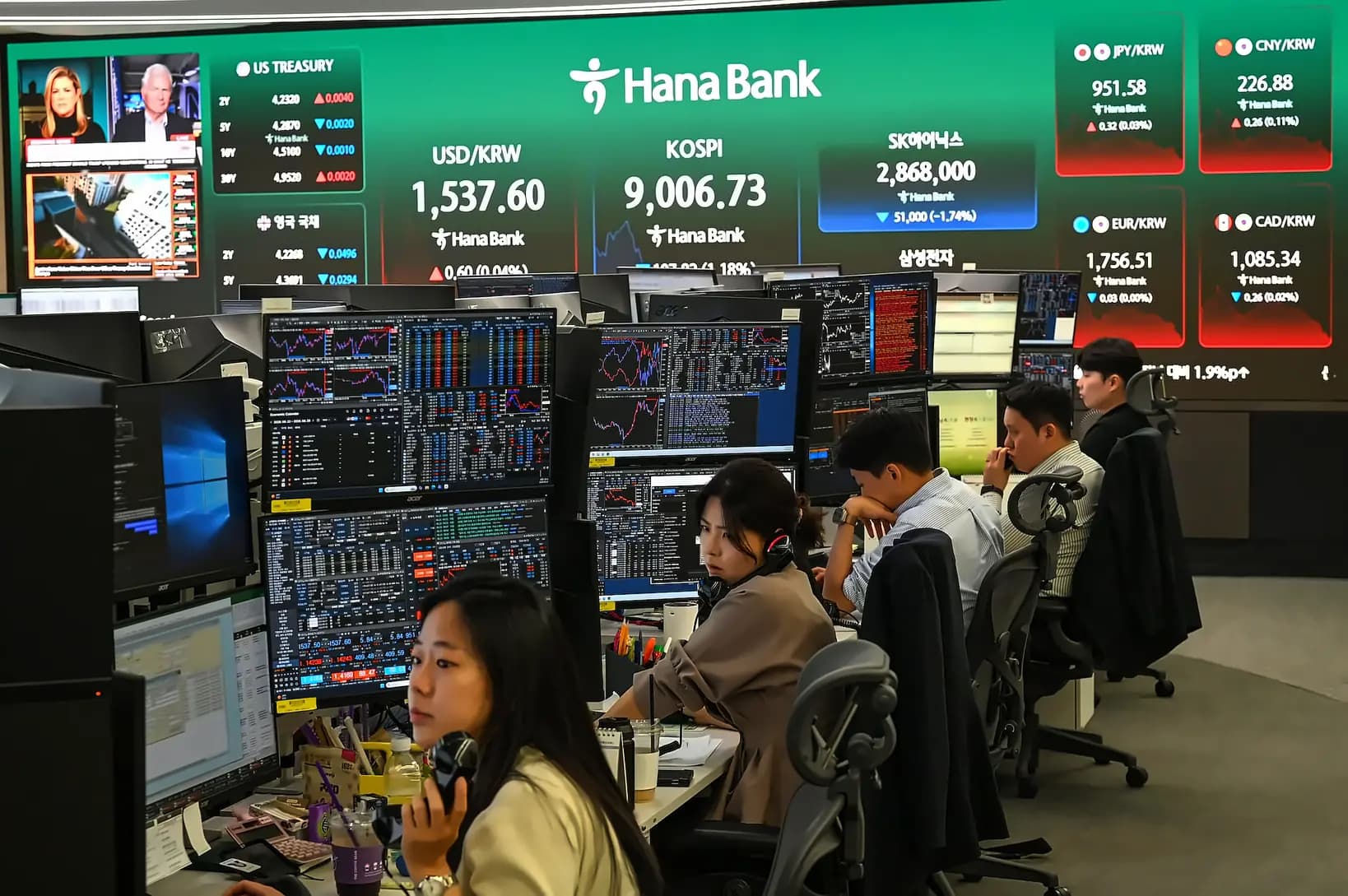
Wall Street extended its tech-driven decline on Friday, with benchmark indices closing lower as artificial intelligence stocks led the selloff. The S&P 500 ended marginally down 0.05% at 7,353.95 points, while the tech-heavy Nasdaq Composite declined 0.24% to 25,297.62 points, putting the index on course for only its second weekly decline in the last 13 weeks. The Dow Jones Industrial Average fell 0.09% to 51,876.11 points. For the week, the S&P 500 fell 2.05% and the Nasdaq lost 4.7%, marking a significant reversal from the previous week's strong performance. The weakness followed a broad selloff across Asian markets, where Japan's Nikkei 225 tumbled 4.2%, while South Korea's benchmark index fell 5.8%. The latest correction reflects growing investor concerns that earnings growth may struggle to justify the massive gains AI stocks have delivered over the past year, with declines in AI stocks having an outsized impact on broader markets given their large weight in global indices.
The semiconductor selloff deepened significantly on Friday, with the PHLX chip index tumbling 5.3%, marking its worst week since early April with a 7.9% decline for the week. Micron Technology shares fell 6% to $1,144.84, erasing gains from its previous session when the stock had surged nearly 16%. Other semiconductor names, including Qualcomm, Intel, AMD and Nvidia, dropped between 4% and 8%, underlining the breadth of selling across the chip sector. Among major chipmakers, Intel fell around 7%, while Advanced Micro Devices (AMD) and Qualcomm declined between 6% and 7% as investors reduced exposure to AI-linked semiconductor stocks. The Philadelphia Semiconductor Index fell nearly 8%, with all 30 constituents closing lower as the index tracks several companies central to the AI hardware supply chain. Memory chipmakers Micron Technology and SanDisk, among the best performers on the S&P 500 this year, fell as concerns over debt-funded AI spending weighed on sentiment. Broadcom also fell about 3.7% during Friday's session, while VanEck Semiconductor ETF lost 6% as investors locked in profits ahead of key earnings and amid weakness across global technology markets.
The pressure intensified following Apple's announcement that it was raising prices on many of its products to offset rising memory costs, raising concerns that higher prices could eventually hurt consumer demand. Apple (NASDAQ:AAPL) rallied 3.1% and partly rebounded from a selloff on Thursday, when it raised iPad and MacBook prices, citing higher component costs, including semiconductors. The stock had previously fallen 6%, overshadowing stronger-than-expected earnings from Micron (NASDAQ:MU). The market reaction suggests investors are becoming increasingly concerned that higher semiconductor costs could begin to erode margins across the technology sector. Companies have been willing to absorb rising expenditure in pursuit of AI leadership, but there are growing signs that those costs are becoming more difficult to ignore. Several US chipmakers were among the key premarket movers, while European semiconductor stocks also opened lower. In Asia, SoftBank Group tumbled by double digits, leading a broader decline across the region's technology sector as investors questioned whether current levels of AI investment remain sustainable.
Another factor dampening sentiment was a report by The New York Times stating that OpenAI is considering delaying its planned mega initial public offering until 2027. The report added to the headwinds facing AI-linked stocks at a time when investor enthusiasm for the sector has already begun to cool. Eight of the 11 S&P 500 sector indexes declined, led lower by industrials, down 3.41%, followed by a 2.45% loss in materials. U.S. inflation rose above 4% in May, data showed on Thursday, as the Iran war drove up energy prices, keeping alive the possibility of a Fed rate hike. According to The Economic Times, interest rate concerns persisted, with traders pricing in one 25 basis-point rate hike and a near 27% chance of another by year-end. Meanwhile, oil prices continued to retreat after easing geopolitical tensions in West Asia, with Brent crude falling 3% to $73.23 a barrel, while US benchmark crude declined 3.2% to $69.65. The latest weakness has significantly altered the picture for US technology stocks, with the Nasdaq having fallen more than 4% this week, wiping out the previous week's gains and pushing the index into negative territory for June, following two exceptionally strong months in April and May.
Traders are now pricing in nearly a 90% chance of at least one rate hike by the end of the year, up from 57% a week earlier, according to CME Group data. This represents a significant shift from earlier expectations, with traders expecting the U.S. Federal Reserve to hike borrowing costs by a total of 50 basis points by December, up from one 25-basis-point hike two weeks ago. The yield on the short-term 2-year Treasury note slipped about 4 basis points to 4.19%, after touching its highest point since February 2025 in the previous session. Traders now see an 88% probability of a rate hike in December, up from 61% before the Fed meeting last week. In the bond market, the yield on the benchmark 10-year US Treasury eased marginally to 4.39% from 4.40% on Thursday. Higher bond yields, driven by inflation concerns, have increased borrowing costs globally and continue to pressure richly valued technology stocks, particularly AI companies. While oil prices have retreated sharply as the Middle East tensions eased, Apple's newly announced price hikes suggest inflation remains a concern, said Art Hogan, chief market strategist at B. Riley Wealth. "We saw a similar dynamic during the pandemic, when supply chain disruptions limited access to semiconductors. Now, we're witnessing a comparable supply shock, this time driven by memory, which is creating renewed inflationary pressure," Hogan noted.