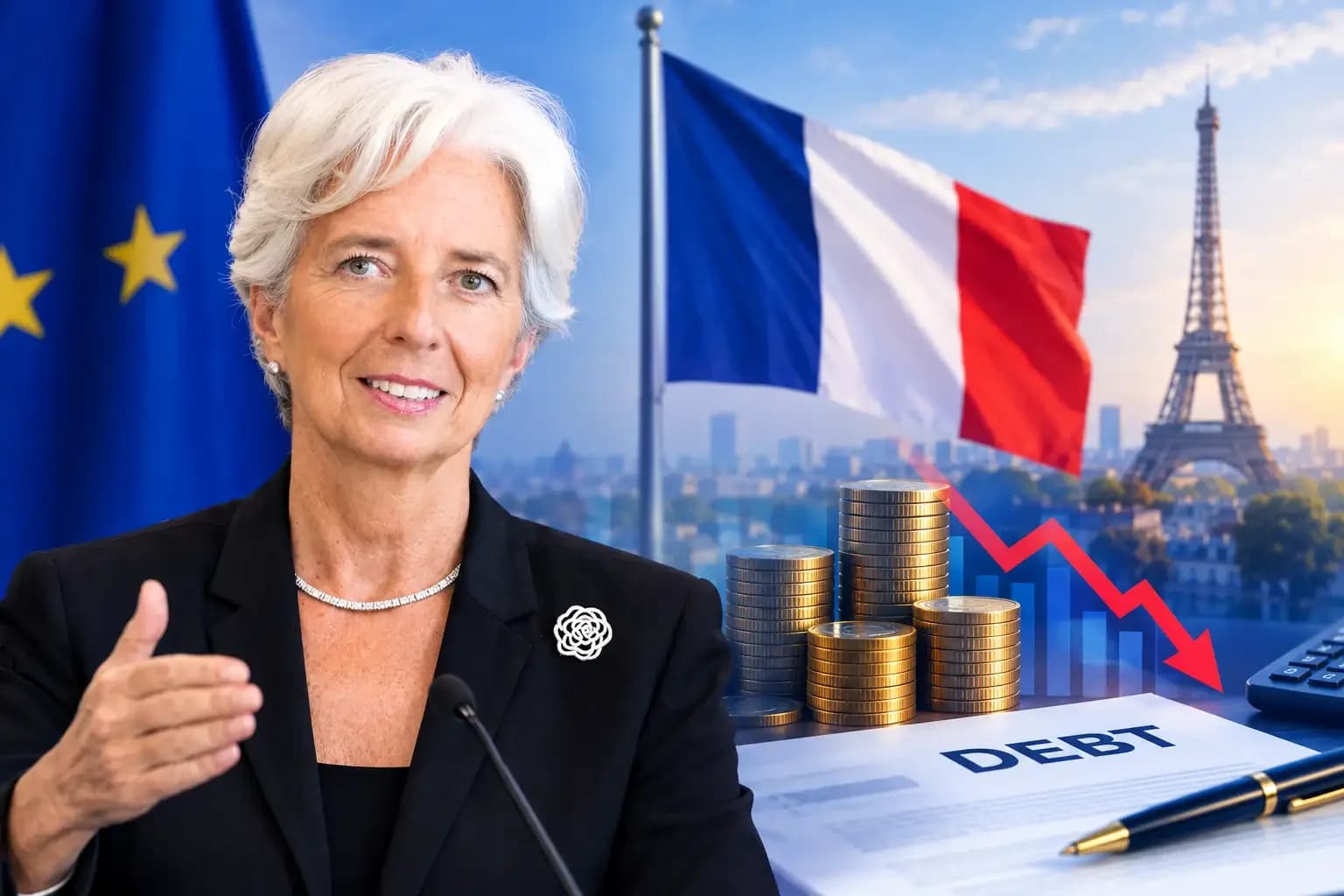
ECB President Christine Lagarde stated on Wednesday that France must tackle its ballooning debt and deficit through domestic fiscal consolidation rather than relying on central bank bond intervention. Speaking at a CNN event in Bangkok, Lagarde emphasized that France faced specific market pressures but that the primary solution lay with the country's own fiscal policies. According to reports from Reuters, investors and analysts have been speculating about whether the ECB could deploy its Transmission Protection Instrument (TPI) to support French bonds, but Lagarde's remarks indicated that France should first take steps to restore investor confidence through fiscal consolidation rather than rely on potential ECB support. When specifically asked about ECB intervention, Lagarde made clear that it was up to Paris to soothe investors' nerves, stating "There are particular circumstances that lead to some countries being more affected, France being a case in point, and for that one, the primary and first solution lies at home in France. And it has to do with fiscal policies."
French government bonds have been among the hardest hit in a global bond selloff, as investors worry that political manoeuvring ahead of next year's presidential election could undermine efforts to rein in the country's high budget deficit. As reported by Reuters, the crisis-fighting mechanism allows the central bank to purchase government debt when it determines that market pressures are unwarranted and disorderly and threaten the effective transmission of monetary policy across the euro zone. The immediate challenge for France remains convincing investors that its public finances are on a sustainable path, with political uncertainty adding to market concerns. Analysts have been speculating for weeks about whether the ECB might start buying French bonds via a crisis-fighting tool known as the Transmission Protection Instrument, which can be activated if a country is under market pressure that the ECB deems "unwarranted," "disorderly" and threatening the transmission of the central bank's interest rates to all corners of the euro zone.
The ECB has yet to see clear evidence of second-round effects, in which higher energy costs feed into other prices and wages. However, the central bank is closely monitoring early indicators, including trade union demands during wage negotiations, to assess whether inflationary pressures could become more persistent. According to Reuters, the ECB has raised interest rates twice over the past four months, with markets expecting another increase in December as policymakers assess the inflation outlook and the economic consequences of higher energy prices. Asked about monetary policy, Lagarde said the current, high rate of inflation in the euro zone had been driven "predominantly, but not exclusively" by a surge in energy prices caused by the Iran war. She noted that policymakers needed to anticipate the emergence of such effects rather than wait until they became fully visible, while emphasizing that there was no sign yet of "second-round effects" on other prices.
Lagarde highlighted continued support from German government spending on infrastructure and military investment, which could help underpin economic activity amid persistent uncertainty over energy costs and the broader global outlook. As reported by Reuters, she noted that while elevated Eurozone inflation persists due to energy costs, growth projections remain modestly resilient. The remarks came on the sidelines of the annual meetings of the IMF and the World Bank in Bangkok, where policymakers are assessing the impact of geopolitical tensions, inflation and rising borrowing costs on the global economy.