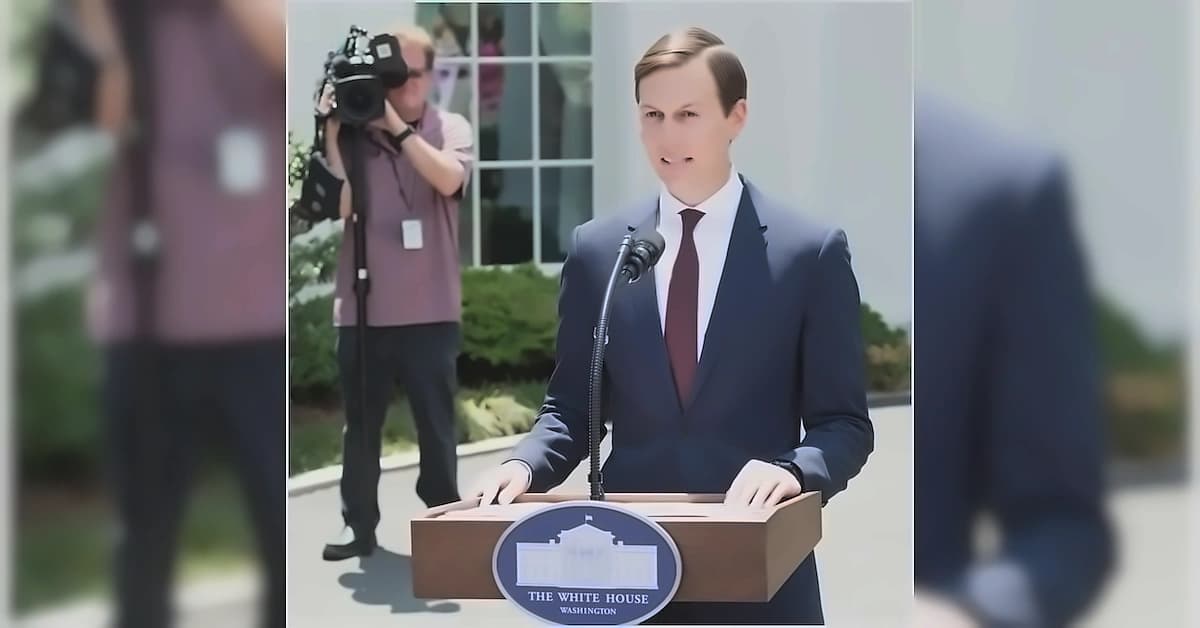
US negotiator and President Donald Trump's son-in-law Jared Kushner held a rare meeting with Hamas chief Khalil al-Hayya on Sunday in Egypt as part of a fresh diplomatic push to advance the stalled Gaza ceasefire. According to reports from NPR, the meeting was confirmed by a regional official and a Hamas official, both speaking on condition of anonymity because they were not authorized to talk to reporters. The Egypt meeting was the first between Kushner and senior Hamas officials since the October 2025 ceasefire agreement. The meeting included Kushner as one of a trio of envoys meeting with al-Hayya, with officials from mediating countries Egypt, Qatar and Turkey also present. The meeting aims to ensure the militant group's commitment to the road map, particularly disarmament, before Kushner's meeting with Netanyahu. Participants included Hamas political bureau chief Khalil al-Hayya, Egyptian intelligence chief Gen. Hassan Rashad, Qatari minister Ali al-Thawadi and a senior Turkish official. Hamas's al-Hayya also met separately with Egypt's Rashad on Sunday, according to the Reuters news agency, while Kushner met with Egyptian President Abdel Fattah el-Sisi after meeting with Hamas. The Egyptian president's office said that aside from Gaza, the two discussed Egypt-US relations, with El-Sisi highlighting the strategic partnership between the two countries and praising their ongoing cooperation across shared interests.
In a statement issued on Sunday, Hamas said it emphasised its 'acceptance' of the roadmap for the second phase of Trump's plan during the meeting with 'delegations from the mediators and guarantors of the ceasefire agreement in Gaza''. 'Hamas and the resistance fully adhered to the first phase of the ceasefire agreement,' it said. However, Israel, however, 'failed to implement this phase, escalating its military operations on the ground and deepening the humanitarian catastrophe, and has explicitly rejected the roadmap', Hamas added. Hamas called upon the mediating parties and the Board of Peace to fulfil their responsibilities and compel the [Israeli] occupation to implement all its obligations in the first phase, end all violations, halt the killings and incursions, agree to the roadmap for the second phase of President Trump's plan and begin developing a timetable for its implementation'. According to Al Jazeera, a Palestinian source told that Hamas's leadership briefed Kushner on Israel's ceasefire violations in Gaza, while another official familiar with the matter stated that Hamas and Kushner met in the town of Alamein 'with the objective of translating the roadmap's obligations into concrete, verifiable steps'. 'These are actions that maintain the ceasefire; begin to transfer all governing responsibilities to the National Committee for the Administration of Gaza; ensure that Hamas has no role in Gaza's future administration,' the source said, adding 'There can be no ambiguity: Hamas must relinquish governing authority and all weapons and military infrastructure. And Gaza can never again be a source of terror for Israel.'
The latest developments show Washington is increasingly concerned that Israel is trying to buy time, introduce new reservations and change the sequencing set out in the roadmap. According to sources familiar with the talks, Kushner is expected to raise a series of concrete steps the U.S. administration wants implemented immediately: halting attacks in Gaza, advancing withdrawals toward the yellow line, significantly increasing humanitarian aid deliveries and allowing reconstruction and civilian governance mechanisms to begin moving forward. Money is also part of the discussion, with the future Palestinian body designated to administer Gaza authorized to address legitimate financial obligations to suppliers and contractors of up to $400 million as part of the transition and reconstruction process. Under the roadmap, the plan is built around reciprocal and verifiable steps, with Israeli withdrawals and the dismantling of weapons infrastructure advancing in parallel. A source familiar with the talks said the purpose is 'to translate the roadmap commitments into concrete and verifiable steps' that preserve the ceasefire, transfer governing authority to the National Committee for the Administration of Gaza, ensure Hamas has no future role in governing the enclave, begin comprehensive dismantling of weapons and military infrastructure, allow deployment of the stabilization force, facilitate parallel Israeli withdrawals and accelerate humanitarian aid, recovery and reconstruction.
Several regional powers including Saudi Arabia, the UAE, Egypt, Qatar, Jordan, Pakistan, Indonesia and Turkey have issued a statement condemning Israel's rejection of the road map, saying that 'Israel now bears responsibility for obstructing the efforts to bring peace in Gaza.' According to NPR, the foreign ministers' statement called on the Board of Peace and the US to take 'immediate and concrete measures' to keep any party from obstructing the plan's implementation. The countries warned that 'Rejecting the roadmap constitutes a clear refusal to move forward with the plan and threatens to undermine President Trump's efforts to end the war in Gaza and create the conditions for lasting peace. Israel bears direct and full responsibility for all consequences.' The statement comes as Netanyahu faces pressure after rejecting the 15-point plan in a rare public show of defiance against the Trump administration, Israel's closest ally. The countries called on the Board of Peace, with active U.S. backing and participation, to take 'immediate and concrete steps' to protect the integrity of the plan and prevent either side from obstructing its implementation.
Netanyahu faces pressure after rejecting the 15-point plan in a rare public show of defiance against the Trump administration, Israel's closest ally. According to NPR, it's not clear whether he will take decisive steps on the ceasefire before then. The road map involves Hamas gradually giving up its weapons while Israeli forces halt attacks and begin withdrawing from Gaza, but Netanyahu says Israel will not retreat from any position until Hamas has been completely disarmed, leaving other elements of the ceasefire on hold. The Hamas official said the group is committed and waiting for mediators to start the 14-day negotiation period to work out a timetable for implementation, which requires all parties' approval of the road map to begin. The Hamas chief has demanded that Israel halt its attacks on Gaza and withdraw to the so-called 'yellow line' dividing the territory before beginning implementation. Israel forces have moved beyond it and now control about 60% of Gaza, with Netanyahu saying the next step was to move to 70% control, with Israel 'tightening the grip' on Hamas 'from every direction'. The White House referred questions about Mr. Kushner's meetings to the Board of Peace, which did not immediately comment, while the Tony Blair Institute did not comment either. The US has for years refused contact with Hamas, which it classifies as a 'terrorist organisation'. But the Trump administration has increasingly been comfortable with direct contact in hopes of ending Israel's genocidal war on Gaza'. People familiar with the president's thinking also say Trump believes he has already given Netanyahu significant political support, including signals connected to Netanyahu's pardon request, and does not intend to keep paying for the same commitment. The gap between that transactional approach and Israel's insistence on full Hamas disarmament before withdrawal is at the heart of the dispute ahead of Kushner's meeting.