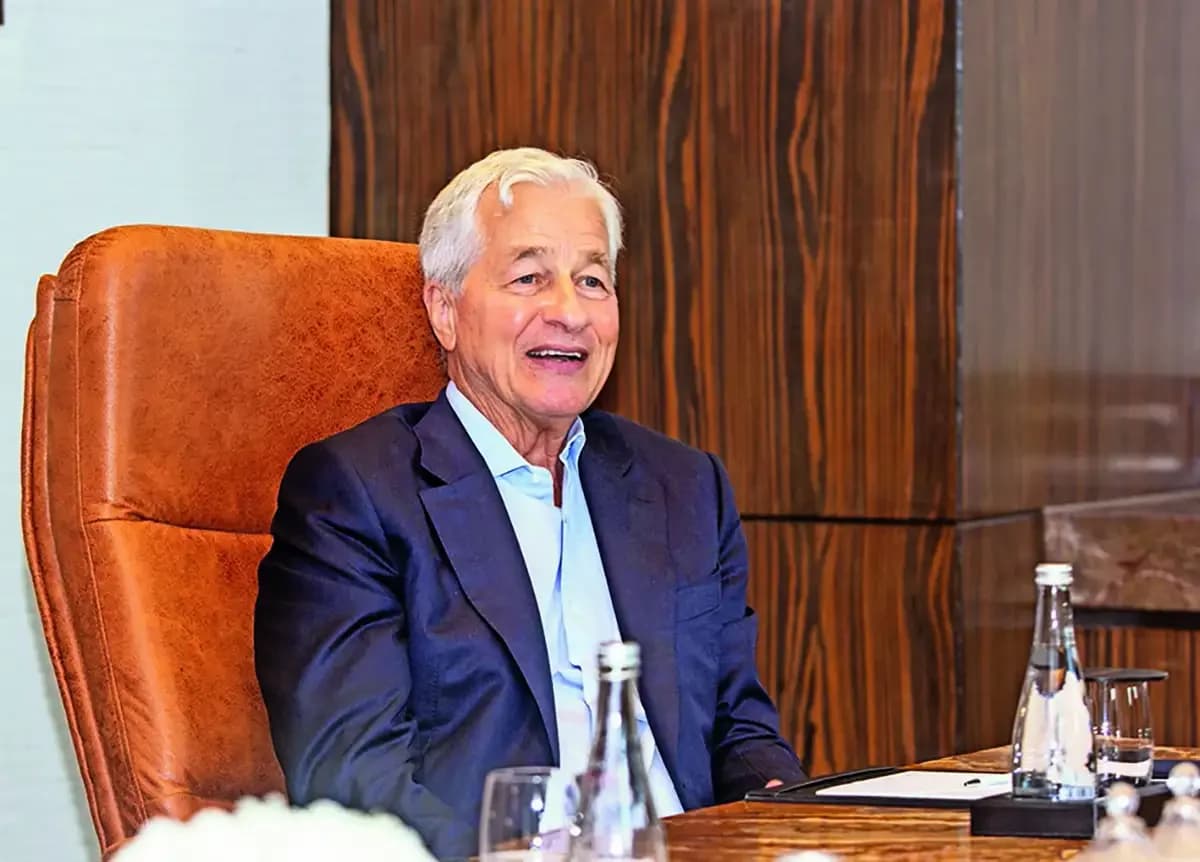
JPMorgan CEO Jamie Dimon has made bold predictions about India's economic trajectory, stating that India's economy could triple in size over the next decade. Speaking exclusively to CNBC-TV18 on the sidelines of the JPMorgan India Investor Conference, Dimon outlined ambitious expansion plans for the bank's operations. "My guess is if we meet again in 10 years, there'll be 400 companies in research, there'll be 2,000 companies being covered, your economy 10 years from now will probably be three times the size," Dimon said. The bank currently covers around 200 companies in India through its research operations and works with multinational companies and Indian businesses expanding overseas. Dimon emphasized that JPMorgan's plan is to continue expanding alongside India's economy, noting that "we've seen the country grow. We've grown with it. And it's been a great experience."
Union Finance Minister Nirmala Sitharaman met Jamie Dimon, Chairman and CEO of JPMorgan Chase & Co., during the investment bank's 11th annual India Investor Conference in Mumbai on September 21. According to official posts from the Nirmala Sitharaman Office on social media platform X, "Mr Jamie Dimon, Chairman and CEO of JPMorgan Chase & Co., interacts with Smt @nsitharaman during the J.P. Morgan India Investor Conference in Mumbai, Maharashtra." The meeting took place during a conference that brought together more than 1,000 global investors, C-suite executives, policymakers and thought leaders for discussions on India's economic and investment landscape. The conference, which began in 2016, provides a platform for global investors and Indian business leaders to exchange views on key issues shaping the country's growth trajectory and its evolving role in the global economy.
JPMorgan has transformed its India operations dramatically since Dimon's first visit around 2005, when the bank operated from a small office in downtown Mumbai with just 10 investment bankers. As reported by CNBC-TV18, Dimon revealed that when he first visited India in 2005, JPMorgan had 6,000 employees, which has now grown to 60,000 employees across lots of technical areas, investment banking. The bank is constructing Asia's largest global capability centre in Mumbai's Powai, a 2 million square feet campus with capacity for around 30,000 employees, expected to be completed by 2029. In July 2026, JPMorgan announced plans to recruit around 1,000 technology professionals for its India GCCs, focusing on cloud architecture, cybersecurity and AI data pipelines. The bank has also expanded its operations in GIFT City in Gujarat, with its securities unit establishing a banking unit that can trade Indian equities, debt and derivatives for global clients.
JPMorgan Chase CEO Jamie Dimon maintains his bullish outlook on India's market potential, projecting that the Indian stock market worth $5 trillion could reach $20 trillion over the next 20 years. According to The Economic Times, Dimon has praised India's reform agenda under Prime Minister Narendra Modi, calling Aadhaar "an unbelievable achievement" and GST reforms "excellent." He believes that India's 6% growth could continue for 20 years with education and infrastructure investment. On geopolitical fronts, Dimon described India as a "natural friend of America" and emphasized that "I don't think we need to ask you to align; we should extend our hand, build relationships." Speaking about India's economic prospects, Dimon noted that "At 7.8%, India is probably the fastest-growing economy on the planet" and expressed confidence in the country's bright future, though he emphasized the need for "consistent regulations and taxing policies to strengthen foreign investment."
JPMorgan detailed its targeted investment stance across Indian equities, stating that "Our preferred positioning leans heavily towards high-growth domestic cyclicals." The brokerage's base/bull/bear case Nifty-50 targets remain 27,000/30,000/20,500 respectively. The review indicated that mid-sized and smaller entities outpaced larger peers in quarterly financial performance, with profit after tax for Nifty Midcap 100 companies, excluding the energy segment, advancing 42% year-on-year, while profit after tax for Nifty Smallcap 100 constituents rose 39%. Dimon also addressed global economic risks, noting that the global economy faces several risks, including persistent inflation, high government borrowing, geopolitical tensions and rising demand for capital. He said interest rates and bond yields could remain higher for longer, pointing to spending on infrastructure, AI and remilitarisation as factors that could keep demand for capital elevated. However, Dimon expressed optimism about AI investment, stating that spending across the hyperscaler ecosystem could reach around $1 trillion next year, from about $700 billion this year, and could eventually boost productivity and create deflationary forces.