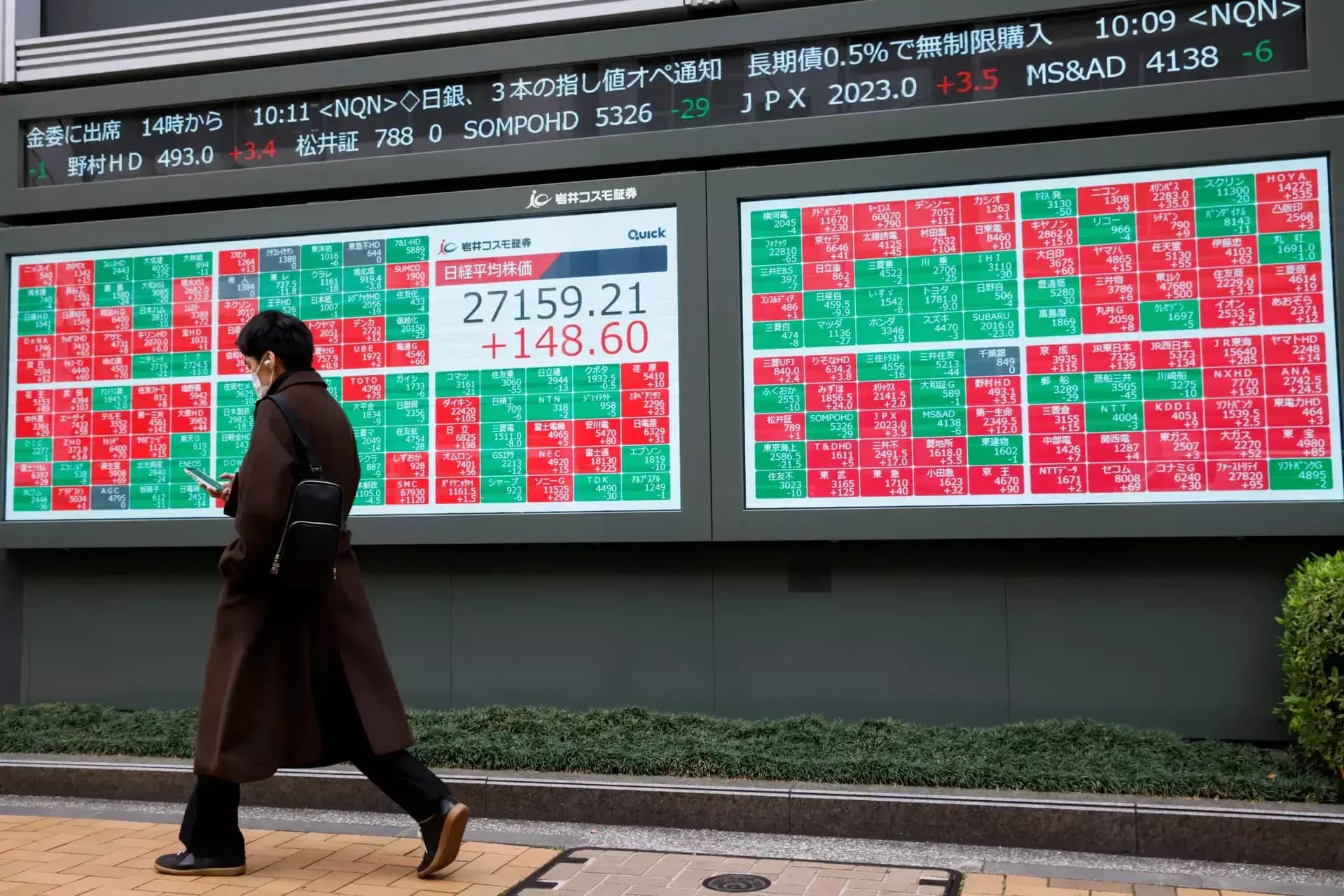
Japan's Nikkei 225 fell 1.17% to 64,911.99 in early trade on Friday, dragged down by a sharp decline in artificial intelligence and semiconductor-related stocks. According to Reuters, the decline was offset by broader market strength, with the Topix index edging up 0.04% to 4,057.47. Despite Friday's weakness, the Nikkei was still on track for a weekly gain of 0.8%, while the Topix was up 1.3% for the week. The broader market showed resilience with around 60% of stocks listed on the Tokyo Stock Exchange's Prime Market trading higher, indicating gains across several other sectors.

Semiconductor and artificial intelligence-related stocks came under heavy pressure, with memory chip maker Kioxia slumping 7.5%, Tokyo Electron declining 3.2%, and Advantest dropping 4.65%. According to Reuters, the weakness was more pronounced in chip-related counters despite healthy corporate earnings. SoftBank Group fell 4.3% even after reporting a smaller-than-expected 18% decline in first-quarter profit on Thursday, with market participants appearing unconvinced that the earnings performance was sufficient to drive a sustained rally. Investor sentiment toward AI and chip companies remained fragile after their recent strong run-up, with concerns over valuations continuing to weigh on the sector.
Gaming giant Nintendo surged 4.7% after reporting a 150.5% jump in operating profit for the April-June quarter, with the strong performance driven by robust demand for Switch and Switch 2 software, along with refunds related to U.S. tariffs. Sony Group also advanced 2.7%, providing additional support to the broader market. Financial stocks traded higher as well, with Mitsubishi UFJ Financial Group rising 0.39% and Sumitomo Mitsui Financial Group gaining 0.47%. According to Reuters, the divergence between value and growth stocks remained evident, with the Topix value share index climbing 0.26%, while the growth stock index slipped 0.35%, reflecting investors' continued preference for value-oriented sectors amid weakness in high-growth technology names.
The market's decline came despite the yen's rebound, with the currency strengthening to the upper-157 yen level against the dollar, far stronger than July's low near 163.99. According to BigGo Finance, lingering concerns that the currency market would shift to a yen-appreciation trend following the Japan-U.S. coordinated intervention triggered selling centered on export-related stocks. Toyota Motor (7203.T) closed lower even after raising its earnings outlook, demonstrating how export-oriented companies remain vulnerable to yen strength. Finance Minister Satsuki Katayama said Tuesday morning that regarding her statement on the coordinated intervention with the U.S. on July 31, she had "nothing particular to say about the implementation or status of intervention on other days." Market participants noted that it's unclear why Japan and the U.S. went out of their way to conduct coordinated intervention, making it hard for the stock market to find direction.
Investors are also awaiting earnings from SoftBank Group, scheduled after the market close, with the company's disappointing market reaction despite beating expectations highlighting continued caution toward technology stocks. Oil prices eased further after Iran and Oman reached an agreement on the partial reopening of the Strait of Hormuz, reducing concerns over energy prices and inflation. The decline in the market came despite supportive global developments, with lower oil prices potentially improving the interest rate outlook by easing inflationary pressures. The market's performance reflects the ongoing tension between technology sector volatility and broader market resilience, with investors closely watching for developments in AI-related companies and their impact on the overall market direction.