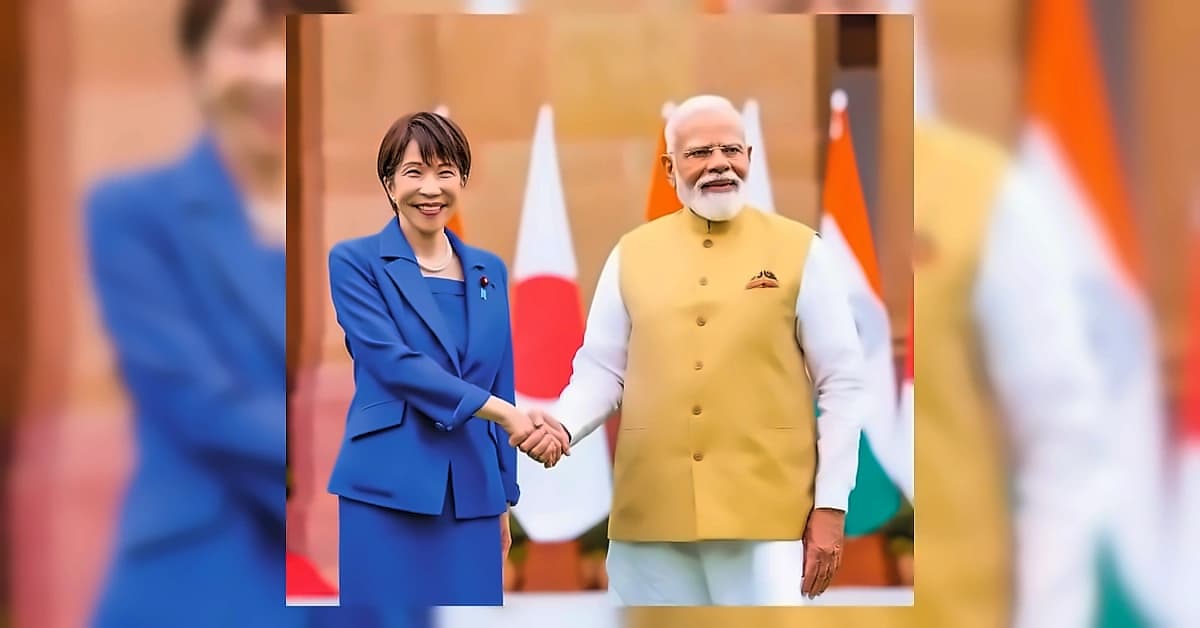
Japan's defence ministry has requested a record 8.9 trillion yen ($55.6 billion) budget for the fiscal year starting April 2027, as reported by The Nikkei. The ministry's request comes amid growing security tensions with neighbours including China, North Korea and Russia, with the final budget potentially reaching 10 trillion yen according to unnamed ruling party lawmakers cited by The Nikkei. This represents a significant escalation from the current 8.8 trillion yen ($55 billion) defence budget, as Japan gradually sheds its traditional pacifist stance to meet volatile geopolitical realities. The budget request is part of Prime Minister Sanae Takaichi's conservative agenda, with Japan's ties with China deteriorating sharply after she suggested in November that Japan could intervene militarily in any conflict over Taiwan, which Beijing insists is its territory.
Under its five-year defence strategy set in 2022, Japan has doubled its defence spending to about 2% of its gross domestic product to build up its Self-Defence Forces' offensive role. The latest budget request focuses on countering "new ways of warfare" with an emphasis on AI, drones and standoff missiles. As reported by The Nikkei, the ministry plans to use attack drones in coordination with long-range missiles for more cost-effective counterstrikes, with funding requested for unmanned attack drones for launch from above or under water. The ministry also seeks to develop hypersonic missiles that can be launched from submarines to further strengthen its counterstrike capability, building on recent fortification of its southwestern region with longer range missiles and interceptors. Additionally, plans include establishing a new unit to bolster defences against cognitive warfare, a growing threat aimed at shaping public opinion through disinformation campaigns.
The ministry plans to introduce an AI-powered decision support system to speed up decision-making in the face of tense security conditions. According to The Nikkei, Japan is considering using existing foreign AI technologies, including those of the US, while also developing and strengthening domestically developed AI. The ministry seeks to build a 'AI orchestrator' platform that would integrate and use multiple AI systems while ensuring autonomous selection and operation. Additionally, plans include building a 'Defence Ministry cloud' for highly sensitive data transmission and stable communications networks in emergencies. The budget request also includes funding for low-cost drones that can work in tandem with long-range missiles to neutralise enemy assets, representing a significant advancement in Japan's drone capabilities.
The budget request includes funding to support companies' defence-related research and development or restructuring to strengthen their production and efficiency. As reported by The Nikkei, the ministry has requested an unspecified amount to fund a state-owned, contractor-operated system to ensure stable defence equipment production and supplies, with the government acquiring factories and outsourcing manufacturing to private firms. This initiative addresses concerns about supplier withdrawal risks and aims to reduce shortages caused by uncertain business outlooks that have led to dozens of companies withdrawing over the past decades. The current request did not specify the estimated costs of many products and services, including missiles, drones and digital systems, with these figures to be finalised once the government finishes its revision of core national security documents by the end of the year.
Profits at major suppliers such as Mitsubishi Heavy Industries, Kawasaki Heavy Industries and IHI Corp. have risen as Japan builds up its military and expands arms exports. Under Takaichi's leadership, the government is expected to make an overall budget request of around 143 trillion yen, a sharp increase from 122.4 trillion yen requested for the ongoing fiscal year, according to The Nikkei. The ministry plans to use low-cost uncrewed weapons for domestic development and mass-production to reduce costs, minimize casualties and build a more cost-efficient air defence network. However, experts note that developing fully homemade drones, given Japan's commercial market is dominated by imports from China, would present significant challenges. China has expressed alarm at what it sees as a return to "new militarism" by Japan, with Beijing's mounting pressure on Taiwan and escalating territorial disputes with Japan fueling Japanese policymakers' concerns about potential conflicts in East Asia.