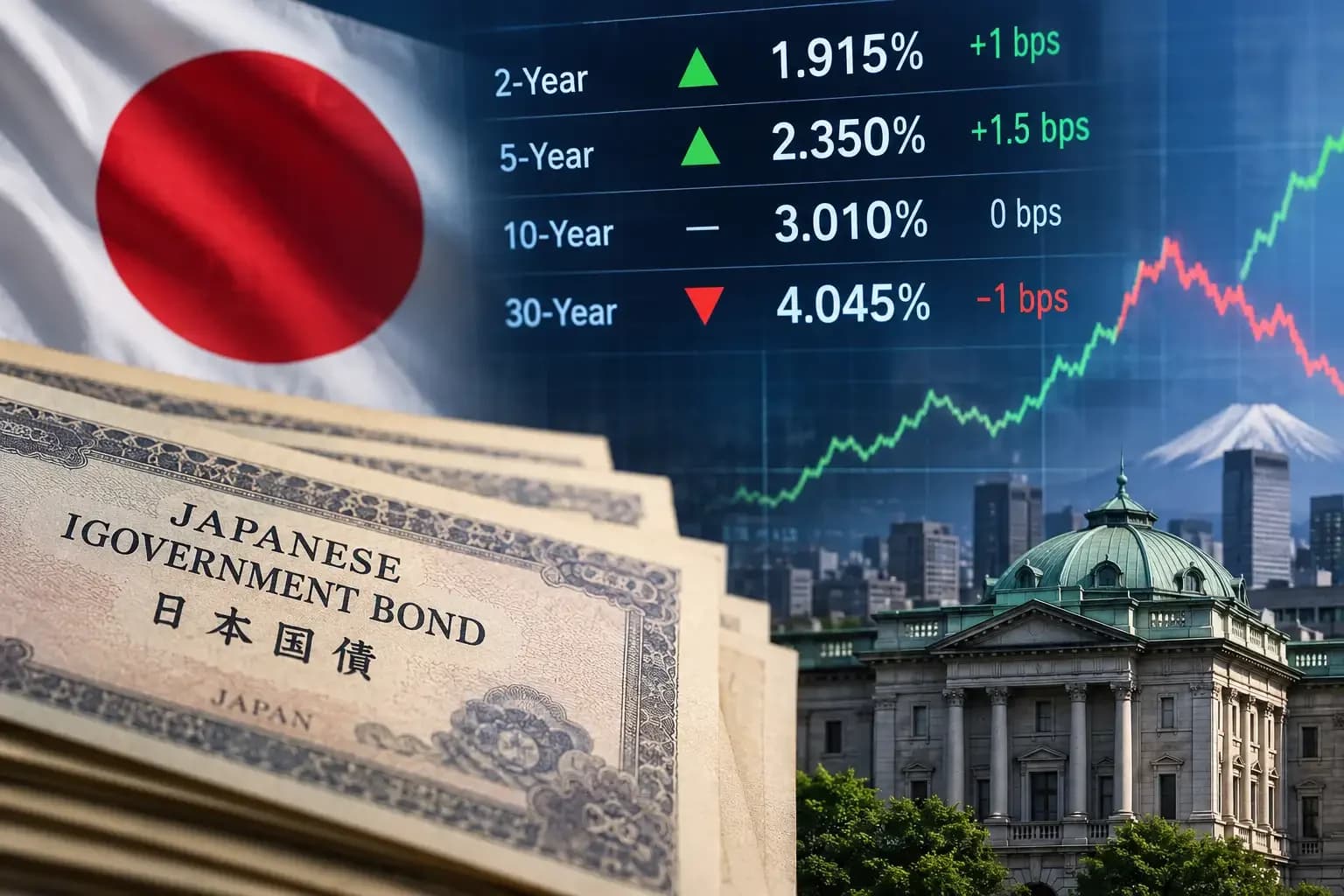
Japan's major life insurers remain divided over their investment plans for the next six months, with some preparing to increase purchases of domestic government bonds while others remain cautious amid rising yields. According to reports from The Economic Times and Reuters, five of Japan's major life insurers collectively manage about 362 trillion yen ($2.30 trillion) in assets, giving their investment decisions significant influence over domestic bond markets. The mixed outlook comes as Japanese investors increasingly retreat from foreign debt markets, potentially redirecting funds towards domestic bonds and influencing yields on long-dated Japanese government bonds.
Japan's net sales of foreign long-term bonds have reached 5.27 trillion yen so far this year, the highest level for the corresponding period since 2022. As reported by The Economic Times, Japanese investors extended their selling streak to six consecutive weeks through October 24, with net sales of 92.6 billion yen ($586.56 million) during the latest week, marking their smallest weekly net sales in six weeks. The selling trend has been partially moderated by falling US Treasury yields, with the benchmark 10-year US Treasury yield declining by around 37.2 basis points from its 24-1/2-year high of 5.3645% earlier this month. Analysts see this trend as a potential shift in capital allocation towards domestic bonds, supported by rising Japanese yields and concerns over the government's spending policies.
Investment plans announced by the five insurers indicate that the shift towards domestic debt is unlikely to be uniform. According to The Economic Times and Reuters, Meiji Yasuda Life, Japan Post Insurance and Daiichi Life Insurance have signalled an inclination to increase their JGB exposure, while Sumitomo Life is taking a more cautious approach. Nippon Life, Japan's largest life insurer, plans to reduce its JGB holdings for a second consecutive year, despite the attractive yields. Sumitomo Life is monitoring yield movements closely and plans to reduce bonds held in its asset-liability management portfolio throughout the year, as reported by Reuters citing the insurer's investment planning department head, Tadakazu Izumi.

The 30-year JGB yield touched a record 4.25% this month before retreating as concerns surrounding the artificial intelligence sector boosted demand for safe-haven assets. As reported by The Economic Times and Reuters, concerns over persistent inflation and widening government budget deficits have pushed sovereign bond yields to multi-decade highs in several markets. With the 30-year JGB yield hovering around 4%, institutional investors have greater incentives to rebalance their portfolios towards yen-denominated bonds, though a sharp increase in yields, fuelled by concerns over fiscal expansion and government borrowing, has complicated investment decisions as buyers wait for more attractive returns.
Meiji Yasuda Life bought 550 billion yen of bonds in the first half of the fiscal year and plans to continue buying even if yields rise further, reflecting an effort to lock in currently attractive returns. Japan Post Insurance has identified opportunities in three-year and five-year JGBs after the recent yield rise and could accelerate purchases in the second half of the fiscal year. Daiichi Life Insurance plans to focus on bonds with maturities ranging from 30 to 40 years as it continues to replace securities in its yen-denominated portfolio, with full-year bond-swap activity expected to exceed its target of 1 trillion yen. Despite the challenges, Nippon Life has indicated that it will retain its French bond holdings, even as higher yields reduce the market value of existing bonds.