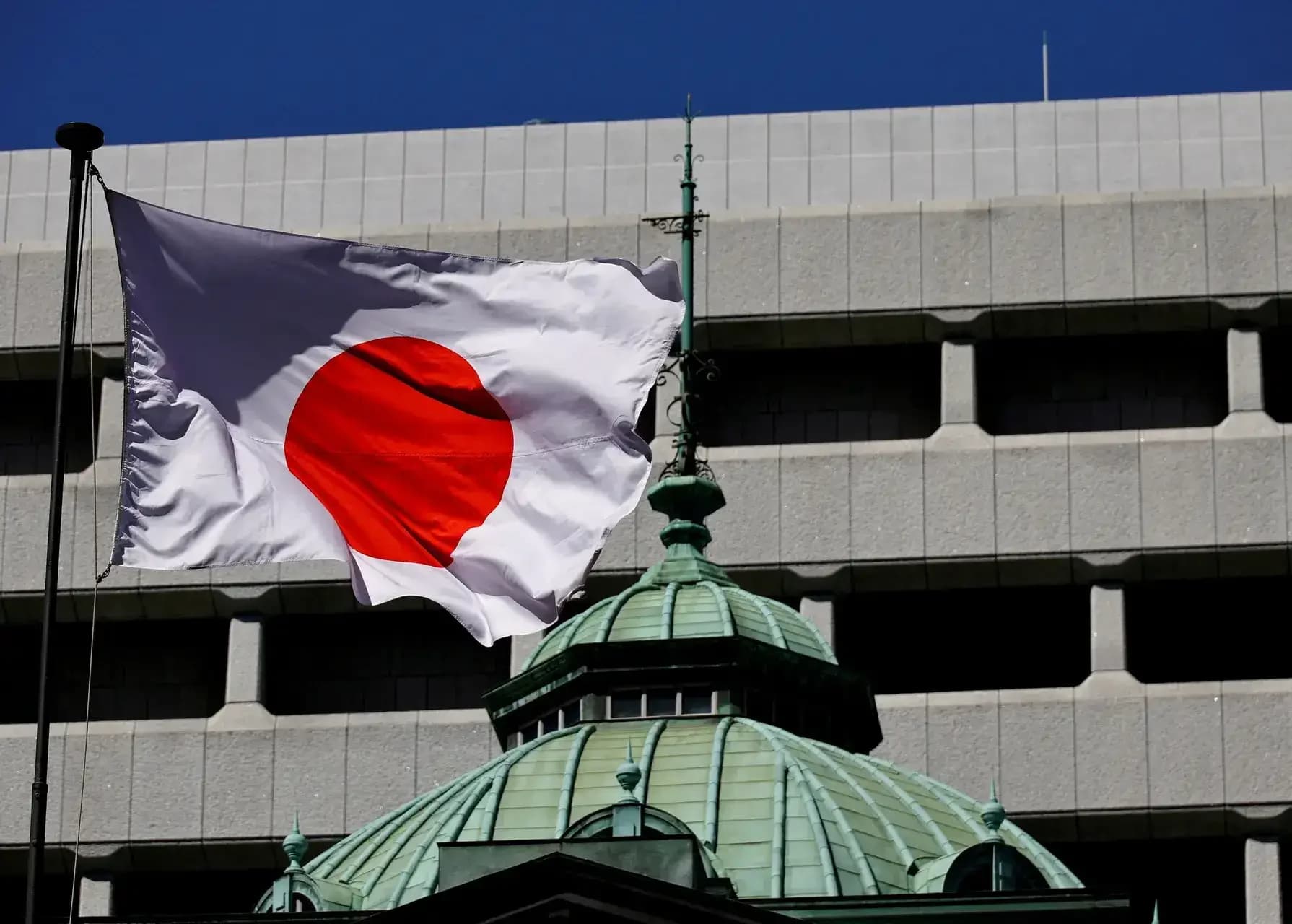
Japan's 10-year government bond yield hit 3% on Tuesday for the first time since September 1996, marking a historic milestone in the country's bond market. The yield rose to 3.000% before settling at 2.995% as of 0533 GMT, representing a significant escalation from the 3% level that was already considered a milestone when it was first touched on Tuesday. This represents a dramatic shift from the 10-year JGB yield, used as a benchmark for mortgages and corporate borrowing, which has more than tripled in two years. The 10-year JGB yield, used as a benchmark for mortgages and corporate borrowing, has more than tripled in two years, highlighting the dramatic shift in Japan's bond market dynamics amid a global sell-off in sovereign debt. As per The Economic Times, this marks a major departure from the low-rate environment that has dominated Japan's financial markets for decades and signals that inflation, fiscal risks and monetary normalisation are fundamentally reshaping the JGB market.
Japan's 10-year government debt sale passed smoothly despite the yield on the key maturity hitting the milestone of 3% and investors positioning for an interest rate hike. The bid-to-cover ratio at Tuesday's sale was 3.29, compared with 2.56 at the last auction and a 12-month average of 3.26. According to Reuters, the auction results showed robust demand, helping anchor the yield around the psychological 3% threshold. The five-year rate is at a record high of 2.265%, and the two-year yield is at a 31-year peak of 1.795% as markets priced in a near certainty that the BOJ will raise interest rates at its meeting this month. As per SMBC Nikko Securities's Miki Den, "The result was as expected by the market, or perhaps slightly weaker than anticipated. The auction showed that investors are looking for a yield above 3% on 10-year JGBs." However, The Economic Times reports that demand at a 10-year JGB auction in August was the weakest in a year, highlighting growing investor concerns about the outlook for Japanese government borrowing.
Bank of Japan Deputy Governor Ryozo Himino kept the door open to an increase this month in a speech last week, as reported by CNBC TV18. The spike in yields signals investor doubts about Prime Minister Sanae Takaichi's ability to balance fiscal responsibility with ambitions to ramp up investment in strategic areas such as semiconductors and AI. As per BNP Asset Management's Kimura, "With 3 per cent being a psychological threshold, it may draw out a certain amount of demand." The Middle East crisis stoking inflation fears globally and pressure on the Bank of Japan to accelerate rate hikes has accelerated the move higher across the Japanese government bond curve. An auction of two-year debt last week saw weak demand, with overnight index swaps showing around a 90% chance of a BOJ rate increase in September. The Middle East crisis stoking inflation fears globally and pressure on the Bank of Japan to accelerate rate hikes has intensified amid inflation and mounting fiscal pressures across Asia. The Economic Times notes that bond yields in the United States, Germany and France have consequently climbed to multi-year highs in recent weeks as investors reassess inflation and interest-rate expectations globally.
Prime Minister Sanae Takaichi's government is supportive of a near-term rate hike, with the next move likely either in September or October, according to people familiar with the matter. The government assumed a 3% long-term interest rate to calculate debt-servicing costs in Japan's fiscal 2026 budget, and a move above that level would add further strain to the country's finances. Finance Minister Satsuki Katayama declined to comment when asked about the benchmark yield approaching 3% after the first day of the Group of 20 finance leaders meeting. She explained Japan's commitment to fiscal discipline by steadily reducing the debt burden, reforming the budget process and funding consumption tax relief without issuing additional deficit-financing bonds. The barometer of long-term interest rates crossed the key threshold a day after the estimated size of budgetary requests stood at a record 143 trillion yen ($890 billion), reflecting Prime Minister Takaichi's drive to ramp up spending despite the heavily indebted nation's fiscal limitations. Japan's debt burden makes it especially vulnerable to rising borrowing costs, with debt exceeding 200% of gross domestic product.
Inflationary pressures and the yen, languishing near a four-decade low, have exerted pressure on the BOJ to speed up rate hikes. The central bank has faced criticism at home and abroad that it was "behind the curve" in normalising monetary policy, which includes a gradual drawdown of its massive JGB holdings. As per BNP Asset Management's Kimura, "Through the rise in yields so far, the bond market has to some extent been sounding a warning against fiscal expansion." He noted that "from the bond market's perspective, I think there is now something of a sense of resignation — tinged with helplessness — about rising interest rates." The spending, along with planned tax cuts, has stoked concerns that Japan could worsen its precarious financial position, with the government's investment-led growth path targeting strategic industries since October. The Economic Times reports that the BOJ has faced criticism that it has been slow to bring monetary policy back toward normal levels, and the central bank is also gradually reducing its large holdings of Japanese government bonds, adding another layer of uncertainty to the bond market. The combination of tighter monetary policy expectations and reduced central-bank support has contributed to the sharp rise in JGB yields.