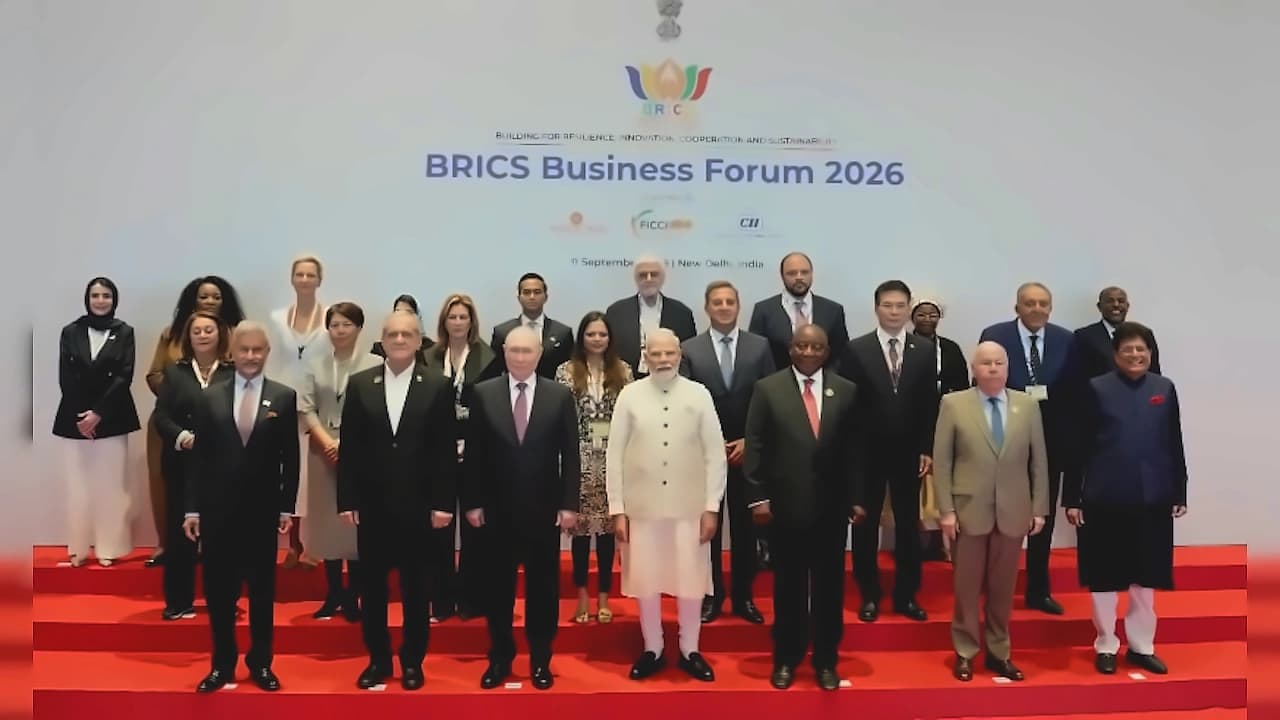
The BRICS Foreign Ministers' Meeting in New Delhi successfully issued a joint statement on the West Asia crisis, marking a significant development from the earlier failure to reach consensus. According to Sudhakar Dalela, Secretary (Economic Relations), there was 'a frank and candid exchange of assessments and national positions among all BRICS members' during the meeting. The joint statement reflects 'almost all issues' reaching consensus, as reported by DD News, with the outcome document being 'transparently shared' with all member nations. This represents a notable shift from the previous situation where India, which hosted the meeting, said members shared 'different perspectives' on issues related to Gaza, maritime security, and protection of civilians. The joint statement addresses 'the need for an early resolution of the current crisis, the importance of dialogue and diplomacy, respect for sovereignty and territorial integrity, adherence to international law, ensuring the safe and unimpeded flow of maritime commerce through international waterways, and the protection of civilian infrastructure and lives'.
Iranian Foreign Minister Abbas Araghchi delivered a comprehensive critique of global governance during the BRICS Foreign Ministers' Meeting in New Delhi, warning of 'a period of structural instability and a deep crisis of trust' in the current international order. Speaking on Friday, Araghchi emphasized that existing post-World War II institutions are no longer equipped to handle 21st-century challenges, arguing that reform was not optional but essential for restoring credibility to multilateralism. He criticized what he described as 'multilateralism in name only,' alleging that some global institutions are being used to preserve unilateral dominance rather than ensure equal participation among nations. According to Araghchi, the gap between developed and developing countries has resulted in what he termed 'widespread injustice' in the distribution of power, wealth, and development opportunities. The Iranian minister called for structural reform of the UN Security Council to ensure fair representation across regions, including Asia, Africa, and Latin America, advocating for 'a Council that truly represents all continents and regions of the world, a Council in which power is distributed responsibly and fairly, and not just in the interests of a few abusive and aggressive powers.'
External Affairs Minister S Jaishankar held detailed conversations with Iranian Foreign Minister Seyyed Abbas Araghchi during the BRICS Foreign Ministers' Meeting in New Delhi, focusing specifically on the situation in West Asia and its implications. According to Jaishankar's official post on X, the discussions also encompassed exchange of views on bilateral issues of mutual interest. As reported by Firstpost, Araghchi thanked India for its humanitarian support and praised its diplomatic outreach during these high-level interactions. With the Strait of Hormuz under pressure and regional instability growing, India is navigating a delicate balance between Iran, the US, and Israel while pushing for dialogue, stability, and stronger multilateral cooperation through the BRICS platform. The discussions occurred at a time when the effectiveness of global governance and the credibility of multilateralism are under increasing scrutiny.
As BRICS completed 20 years, India hosted the foreign ministers' meet in New Delhi, with the group now including Brazil, Russia, India, China, South Africa, Egypt, Ethiopia, Iran, the United Arab Emirates, and Indonesia. According to Business Standard, Jaishankar pointed to institutions like the New Development Bank as examples of how BRICS countries are building alternatives to Western-led global institutions. He said BRICS should now focus more on delivering practical results in areas such as digital connectivity, startups, climate action, clean energy, and supply chain resilience. India also warned against unfair trade practices and overdependence on limited supply chains, with Jaishankar stating that the world still needs a rules-based and open trading system with the World Trade Organisation at its centre, but one that also addresses the concerns of developing countries. The group's message focused on 'reformed multilateralism,' where emerging economies and developing countries get a bigger role in global decision-making.
Jaishankar outlined a four-point reform agenda addressing critical global governance challenges. According to Business Standard, he emphasized the urgent need to reform the international financial architecture to effectively deal with various economic challenges including vulnerabilities in supply chains, pressures on food and energy security, and inequalities in accessing critical resources. He also called for strengthening and reforming the multilateral trading system, noting that non-market practices, concentration of supply chains, and uncertain market access have exposed the global economy to new risks. His remarks highlighted the need for multilateral cooperation to address the complex challenges facing the global economy. Araghchi, while criticising 'multilateralism in name only', said 'What we witness today in some international institutions is not ''multilateralism,'' but rather an attempt to preserve ''unilateralism'' under the guise of international law.' He warned that 'The instrumental use of laws, the imposition of unilateral sanctions, and the disregard for the rights and national sovereignty of countries are signs of a deep crisis in global governance.'
Araghchi's comments come as several key global partners are gathered in New Delhi for the Brics Foreign Ministers' Meet. According to Business Standard, Jaishankar noted that peace and security remained 'central' to the global order during his remarks at the BRICS conclave. The Iranian Foreign Minister warned that empires in decline will stop at nothing to arrest their fates, comparing the situation to a 'wounded animal' that will desperately claw and roar on its way down. His remarks highlight the common challenges faced by nations and the need for collective response to regional tensions and international pressures. Araghchi stated that 'Security Council reform, according to Araghchi, is 'not an option, but a necessity for the survival of the United Nations.' He called for 'a Council that truly represents all continents and regions of the world, a Council in which power is distributed responsibly and fairly, and not just in the interests of a few abusive and aggressive powers.'