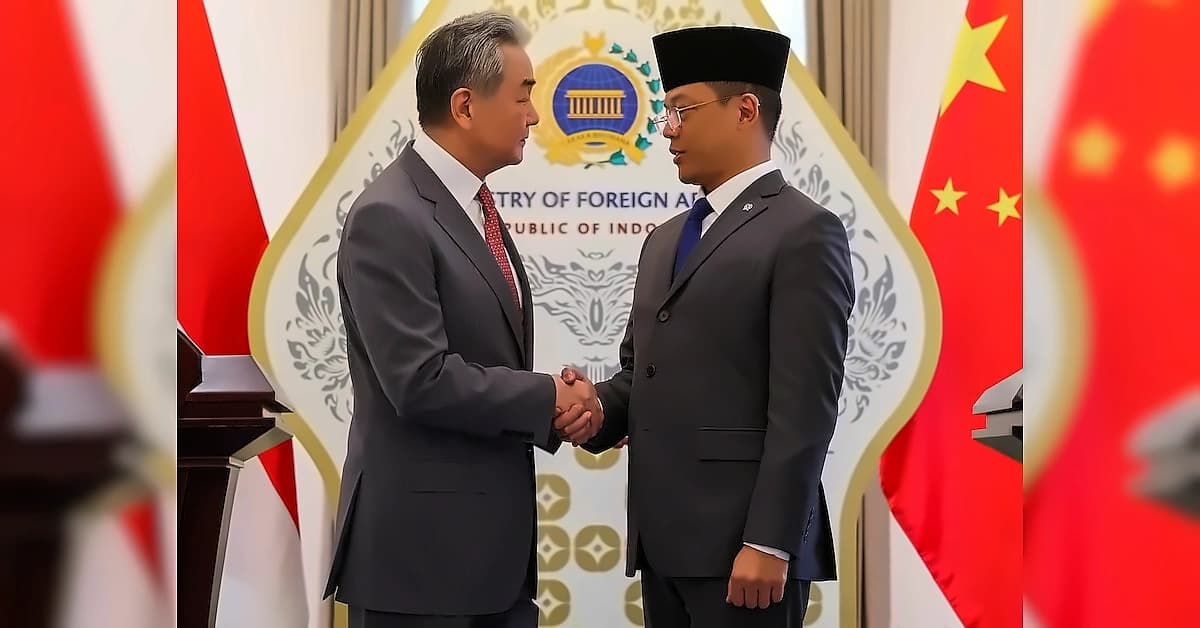
Top ministers from Indonesia and China held comprehensive discussions in Jakarta on Friday, focusing on strengthening defence cooperation and enhancing food and energy security between the two Asian nations. According to reports from Associated Press, Indonesian Foreign Minister Sugiono emphasized that their aim was to ensure the new bilateral dialogue delivered progress toward priorities including political, economic, security, maritime and people-to-people relations. China's Foreign Minister Wang Yi stated that Indonesia and China agreed to better coordinate on major priorities of development and security to provide strong safeguards for both countries' modernization. As reported by Associated Press, Wang said both sides agreed to support each other's core interests and will cooperate more in energy and mineral resources. The dialogue aims to bolster relations and enhance resilience across various sectors, including food and energy. In a joint statement, Wang emphasized their commitment to jointly oppose unilateral bullying and power politics, while remaining vigilant against attempts to challenge World War II outcomes and turn back history. The new bilateral dialogue is expected to send a clear signal to the world of solidarity and cooperation between the two major emerging-market countries.
Indonesia's Defence Minister Sjafrie Sjamsoeddin and his Chinese counterpart Dong Jun met separately to discuss enhanced defence cooperation, including material cooperation, strengthening personnel, and the two countries' defence industries. As reported by Associated Press, Sjamsoeddin invited the Chinese armed forces to participate in joint exercises, specifically mentioning the Heping Garuda exercise as a concrete example of the relationship between the Indonesian National Armed Forces and Chinese armed forces. The defence cooperation extends beyond traditional military ties to include advanced technology initiatives, with both countries committed to joint technological advancements and military exercises. Chinese Defence Minister Dong was greeted on Friday by a military guard of honour as he arrived for talks with his Indonesian counterpart. "The prospects for cooperation between the two militaries are broad, and that such cooperation is becoming higher in quality and more effective," Dong said. Sjafrie confirmed there would be increased defence activities between their militaries, including joint exercises and officer exchanges. After the defence and foreign ministers' meeting, Sjafrie told reporters that they also discussed a joint munitions factory in Indonesia, producing ammunition, missiles and rockets and including a possible transfer of technology from China. The factory is expected to start operation by 2027, as confirmed by Sjafrie to reporters. This represents a progressive step in building Indonesia's defence power capabilities. According to AFP, Sjafrie later confirmed that Jakarta and Beijing will hold another military exercise this year under Heping Garuda, a recurring joint drill focused on humanitarian assistance, disaster relief and military-to-military cooperation.
Indonesia's economic ties with China have reached significant levels, with bilateral trade reaching approximately ₹14,000 crore ($167 billion) in 2025. According to Associated Press, Sugiono stated they agreed to facilitate trade, including market exploration and expansion of market access for Indonesia's flagship commodities. China has become Indonesia's largest trading partner and has invested billions in major infrastructure projects, including the Jakarta-Bandung high-speed railway and Southeast Asia's largest floating solar power project at Cirata in West Java. As reported by Associated Press, while disagreements have emerged over the pricing and timing for projects, China has been determined to follow through on them in keeping with President Xi Jinping's signature "Belt and Road" initiative to build infrastructure throughout the region. However, China dominates investment in Indonesia's nickel processing sector, but recent policy changes, including on exports and tighter mining quotas, have pushed some companies to seek alternative supplies elsewhere. China has invested billions in major infrastructure projects, including the Jakarta-Bandung high-speed railway and Cirata, Southeast Asia's largest floating solar power project at Cirata in West Java.
The ministers emphasized their commitment to jointly oppose unilateral bullying and power politics, while remaining vigilant against attempts to challenge World War II outcomes and turn back history. As reported by Associated Press, Wang stated their new bilateral dialogue would send a clear signal to the world of solidarity and cooperation between the two major emerging-market countries. Sugiono highlighted discussions on strengthening food, energy and mineral security through the development of industries supporting national resilience, which will encompass areas such as artificial intelligence and joint development of communications satellites. According to Associated Press, both countries pledged to cooperate across multiple areas from artificial intelligence, defence and rail transport to green energy, satellites and fisheries. Wang said both sides agreed to support each other's core interests and will cooperate more in energy and mineral resources. Resource-rich Indonesia, a $1.4 trillion G20 economy, has vast deposits of nickel, tin, copper, gold and bauxite and is the world's largest exporter of palm oil and of thermal coal, with China among its top buyers. Indonesia also has its own disagreements with China over developments in the South China Sea, which Beijing claims almost in its entirety. Jakarta has been measured in its remarks, however, and sees itself as not being party to wider territorial disputes involving China and the Philippines, Malaysia and Vietnam.
Despite Indonesia's growing defence cooperation with China, international relations researcher Pieter Pandie of the CSIS think tank told AFP that Jakarta still leaned "much more" towards Washington than Beijing. "From the security and defence side of things, the Indonesia-China relationship is still very much less developed... compared with Indonesia's security cooperation with other Western and Asian partners," he said. "I wouldn't look too much into whether or not (Friday's meeting) signals some sort of 'realignment' for Indonesia towards Beijing," added Pandie. Last year, Indonesia joined the BRICS bloc of emerging economies that includes Russia and China, but President Prabowo Subianto has also signed a trade deal with US President Donald Trump and joined his so-called "Board of Peace." The cooperation comes amid broader geopolitical tensions, with recent joint military exercises between Chinese and Indonesian navies conducted east of Taiwan. Last week, Taiwan, which China claims as its own territory, was angered by a rare joint military exercise between the Chinese and Indonesian navies that took place east of Taiwan. Indonesia's navy said a vessel conducted routine exercises, not only with China, but also with Japan and the United States. Defence analyst Curie Maharani said that while Indonesia saw the exercise as routine, the location enabled China to signal a different political message. "Indonesia learned a valuable lesson about how great powers use defence diplomacy more as an instrument of influence projection," she said.