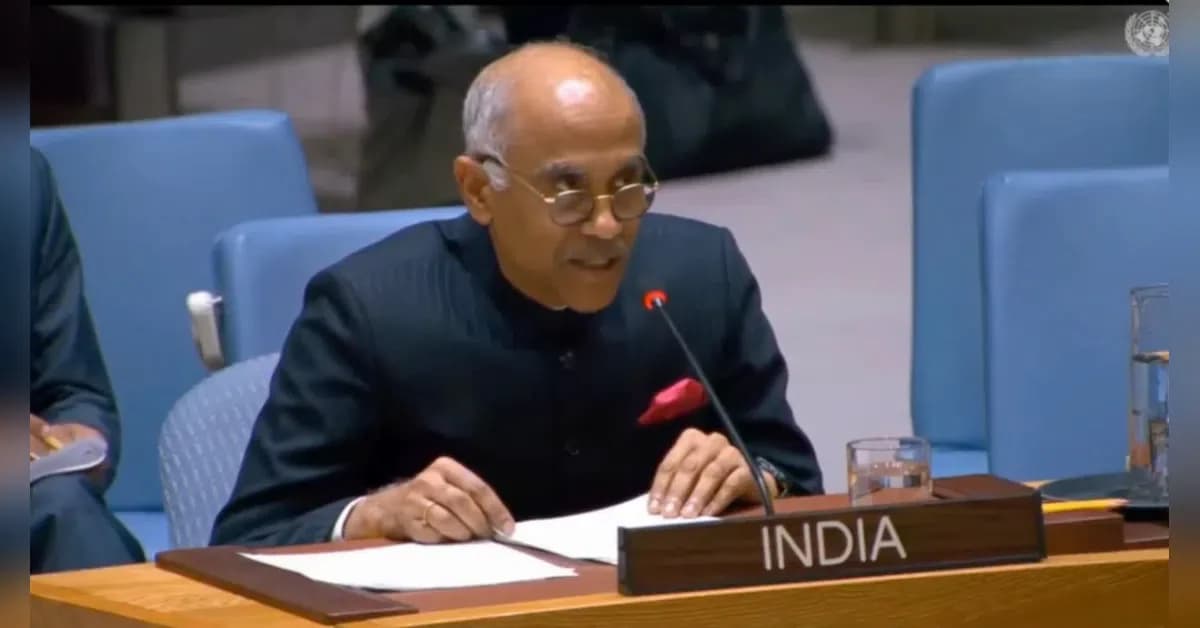
India delivered a robust response to Pakistan at a United Nations Security Council meeting on Wednesday, with Permanent Representative Harish Parvathaneni warning that Pakistan must accept consequences for its sponsorship of cross-border terrorism. According to reports from The Hindu BusinessLine, Parvathaneni stated that 'India has every right to defend itself from such cross-border terrorism' and emphasized that Pakistan will face consequences for its actions. The strong response came during the Security Council debate on 'Upholding the purposes and principles of the UN Charter and strengthening the UN-centred international system'. 'I am compelled to respond to baseless and unwarranted remarks made by Pakistan today. India would like to set the facts straight,' Parvathaneni said during the meeting. The envoy's latest remarks come barely a week after the envoy had rebuked Pakistan at another UNSC debate on the protection of civilians in armed conflict, where Pakistan had attempted to raise Jammu and Kashmir, prompting a forceful response from the Indian side.
The diplomatic exchange followed Pakistan's reference to the April 2025 Pahalgam terror attack in which 26 civilians were killed. As reported by The Hindu BusinessLine, Pakistan Deputy Prime Minister and Foreign Minister Ishaq Dar had raised the issue of Jammu and Kashmir and referred to the Indus Waters Treaty, which India put in abeyance in response to the attack. The Resistance Front (TRF), a front for Pakistan-based terrorist group Lashkar-e-Taiba (LeT), had claimed responsibility for the deadly attack. According to the latest reports, Parvathaneni emphasized that Pakistan's alleged support for extremist and violent networks has continued since its formation, adding that such patterns are well-documented in the public domain. He stated that 'Pakistan must credibly and irrevocably end its support for all forms of terrorism'.
During the Security Council debate, Parvathaneni highlighted growing concerns over the 'legitimacy, efficacy and relevance' of the United Nations, especially the role of the UN Security Council in delivering on its mandate of maintenance of international peace and security. As reported by The Hindu BusinessLine, he pointed out that 'World War II was not our war, but India paid dearly for it. Therefore, becoming UN's founding member was reflective of our yearning for peace'. The Indian ambassador called for reforms in the Security Council, stating that 'The world is now characterised by fragmentation and confrontation. Central to UN's challenges today is an architecture that is frozen in the 1940s'. He stressed that 'The UN Security Council must be a living instrument, not a fossil' and called for greater transparency in the Council's functioning. Parvathaneni also demanded expansion in the permanent category of the UNSC to make its decision-making process more representative, while calling for strengthening the UN General Assembly.
Parvathaneni provided historical context during his UN address, noting that 'Independent India began its life battling with cross-border aggression by Pakistan, which coveted Indian territories that had become a part of India as a result of their complete, legal and irrevocable accession'. According to The Hindu BusinessLine, he emphasized that by waging several wars and inflicting unprovoked aggression against India, and through its continued sponsorship of cross-border terrorism, Pakistan has violated the principles of sovereignty and territorial integrity and peaceful coexistence. The Indian envoy further stated that 'Pakistan's harnessing of the malevolent forces of terrorism, religious extremism, violent radicalism, and anti-India rhetoric has continued unabated since its creation'. He slammed Pakistan's doctrine of 'bleeding India by a thousand cuts' and accused Pakistan of exposing its hollow rhetoric regarding UN Charter commitments, stating that 'The use of cross-border terrorism by Pakistan and its doctrine of 'bleeding India by a thousand cuts' exposes its hollow rhetoric of commitment to the UN Charter'.
Separately, India also rejected references to Jammu and Kashmir in a recent joint statement issued by China and Pakistan. MEA spokesperson Randhir Jaiswal said Jammu & Kashmir and Ladakh 'have been, are and will always remain integral and inalienable parts of India'. India also reiterated its opposition to projects under the China-Pakistan Economic Corridor in territories claimed by India, saying such moves impinge on India's sovereignty and territorial integrity. According to The Hindu BusinessLine, Parvathaneni also lashed out at Pakistan at another UNSC debate on the protection of civilians in armed conflict, referencing documentation by the United Nations Assistance Mission in Afghanistan (UNAMA) alleging that Pakistani military action caused 750 civilian deaths and injuries in Afghanistan in the first three months of 2026 due to cross-border armed violence allegedly perpetrated by Pakistani forces. The Indian envoy also accused Pakistan of 'repeatedly violating the principles of sovereignty, territorial integrity and peaceful coexistence through wars, unprovoked aggression and terror activities directed against India'.