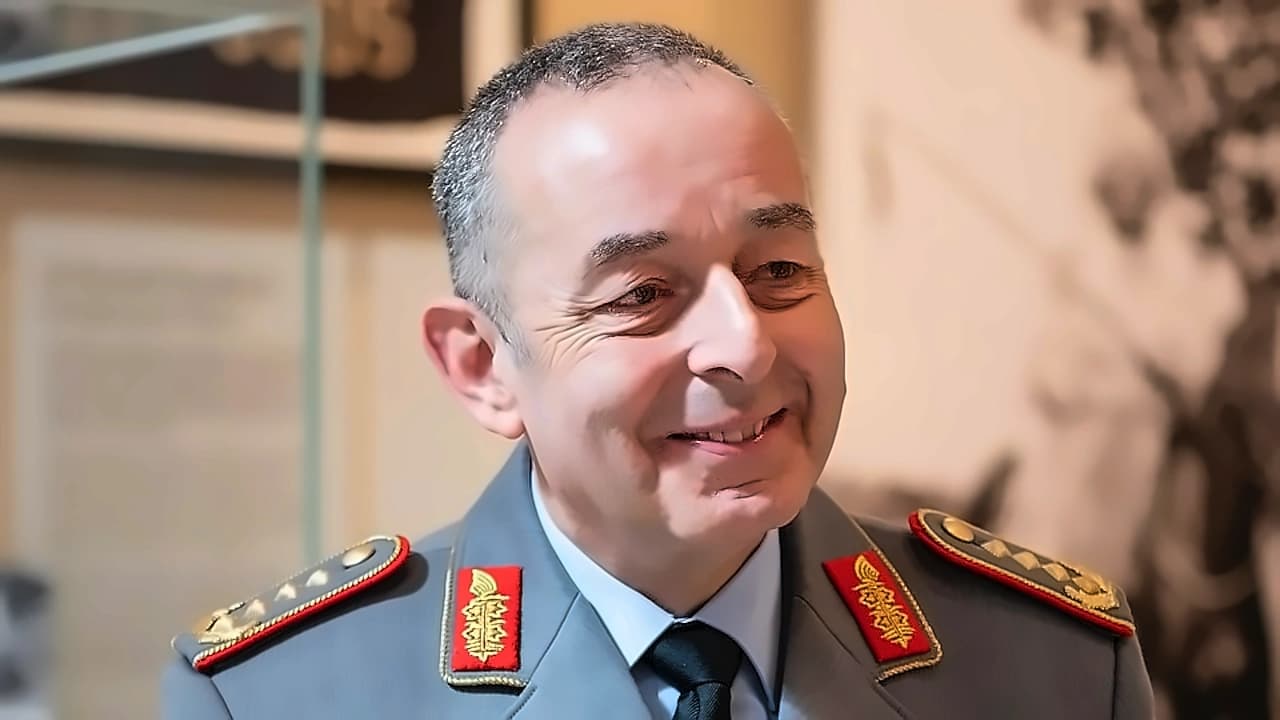
NATO's 32 military chiefs have elected German Defence Chief General Carsten Breuer as the next Chair of the Military Committee, with the 61-year-old former COVID crisis head taking office in July 2027 for a three-year term. According to reports from Reuters and Anadolu, military chiefs from the alliance's 32 member countries elected Breuer at a meeting in Copenhagen on Saturday, with current Chair Italian Admiral Giuseppe Cavo Dragone announcing the result. Breuer will assume the leadership position next summer, succeeding Dragone. As reported by Reuters, Dragone praised Breuer's operational judgment and leadership skills, highlighting the trust placed in him at a crucial time for Euro-Atlantic security, writing "Your operational judgement, your deep familiarity with this Alliance and your leadership of the German Armed Forces will serve NATO well. The Chiefs of Defence have placed their trust in you at a demanding moment for Euro-Atlantic security."
General Jennie Carignan, Canada's Chief of the Defence Staff, ran against Breuer for the top NATO position and would have made history as the first woman to hold the military committee chair. According to Reuters, Carignan's candidacy reflected her exceptional leadership, experience and deep commitment to Allied collaboration. In a social media post, Defence Minister David McGuinty congratulated Breuer on his election, stating "Canada was proud to nominate Gen. Jennie Carignan, whose strong candidacy reflected her exceptional leadership, experience and deep commitment to Allied collaboration." Carignan said in a statement posted to social media Saturday that it was an honour to stand as a candidate and to engage with fellow allied chiefs of defence throughout the process. "I look forward to continuing that collaboration with all of my allied colleagues," she said. "There is important work ahead for our alliance, and I know General Breuer will bring strong leadership to his new role." Carignan will continue serving as chief of the defence staff and leading the transformation of the Canadian Armed Forces.
As head of NATO's senior military authority, Breuer will serve as the principal military adviser to the alliance's political leadership and Secretary General Mark Rutte, as reported by Reuters. The committee serves as NATO's top military authority and key advisory body for political leaders, with the chair position being the main military adviser to the political chief. Alongside the Supreme Allied Commander Europe (SACEUR), the chairman of the Military Committee is among the most influential figures in NATO. In this role, Breuer will serve as chief military advisor to Secretary-General Mark Rutte and act as the primary bridge conveying recommendations from alliance chiefs of staff to senior political decision-makers. The leadership transition comes amid significant geopolitical shifts and evolving transatlantic relations, with Breuer assuming the role as US expects Europe to take primary responsibility for the continent's defense after decades of American leadership. The appointment reflects the alliance's focus on strengthening military coordination and strategic planning amid significant changes in NATO's operational environment.
The NATO Military Committee Conference held in Copenhagen on September 18-19, 2026 marked a significant milestone for the alliance's military leadership. Opening the event, Chair of Military Committee Admiral Giuseppe Cavo Dragone highlighted the conference's priorities, stating "We – the NATO Chiefs of Defence, together with SACEUR and SACT – will do the work that follows from the Ankara Summit, as we shift focus from committing budgets to delivering on capabilities that will enable NATO to deter adversaries and defend the Euro-Atlantic area." The conference addressed collective deterrence and defence, innovation and technology, and accelerated adoption of new defence capabilities. During a joint press conference with the Chief of Defence of Denmark, General Michael Wiggers Hyldgaard, Admiral Cavo Dragone conveyed a message of unity among Allied militaries, noting "Over recent weeks and months, we have seen once again the reckless behaviour of Russia, including airspace violations, drone incidents, hybrid activities and attempts to test Allied resolve." The topics discussed throughout the weekend included implementation of NATO Summit decisions and capability targets, acceleration of Allied readiness, and strengthening the ability to operate in a multi-domain environment.
The leadership transition occurs amid heightened security concerns following Russia's invasion of Ukraine, with European nations steadily raising military outlays. According to Reuters, Germany is planning to double its defense spending to over €200 billion ($230 billion) by 2030. This significant increase in defense budgets across European member states reflects the alliance's commitment to strengthening military capabilities and preparedness for potential security challenges, with many European nations responding to Russia's invasion of Ukraine and past pressures from former President Trump. Germany, Europe's largest economy, has led the spending surge driven both by Russia's 2022 invasion of Ukraine and Trump's threats not to honour US commitments to NATO. As reported by German media, the escalating threat from Russia as European partners take greater responsibility for conventional deterrence while the United States broadens its strategic focus to other regions adds urgency to NATO's strengthened military posture.
Breuer brings extensive operational and administrative experience to the post, having joined the German military in an air defense unit in 1984 and training at the German General Staff College in Hamburg and the US General Staff College in Fort Leavenworth, Kansas. As reported by Reuters, his military career includes a 2014 deployment to Kabul, Afghanistan, with NATO's International Security Assistance Force (ISAF). He later earned the moniker 'the chancellor's general' after former Chancellor Olaf Scholz appointed him to direct Germany's national COVID-19 pandemic response crisis team from 2021 to 2022. Breuer, a 61-year-old army officer, currently serves as Inspector General of the Bundeswehr since March 2023 and previously led the Bundeswehr's Territorial Command, which he established. An army air defence officer who enlisted in 1984, Breuer is married with three children. German Defence Minister Boris Pistorius praised the appointment, stating that Breuer had demonstrated exceptional strategic foresight and played a pivotal role in restructuring the Bundeswehr, highlighting that "Now he will bring all his strength and experience to NATO, which faces major, historic challenges."
Ahead of his transition to NATO, Lieutenant General Christian Freuding is expected to succeed Breuer as Inspector General of the Bundeswehr before the end of 2026, according to Reuters. However, a successor to fill Breuer's current post as Inspector General has yet to be named, creating a gap in Germany's military leadership structure. This succession planning ensures continuity in Germany's military leadership structure while Breuer prepares to assume his new role as NATO's senior military authority, with Freuding set to replace Breuer before the end of the year. The transition comes as Breuer takes on his new responsibilities amid significant changes in NATO's operational environment and the alliance's evolving strategic priorities. Current military chair, Italy's Admiral Giuseppe Cavo Dragone, will leave his post next year, with Dragone saying on social media that Breuer's operational judgement, deep familiarity with the alliance and leadership of the German armed forces would "serve NATO well." "The Chiefs of Defence have placed their trust in you at a demanding moment for Euro-Atlantic security," he said. "You will have the full support of the Committee and of the International Military Staff through the transition, and I look forward to working closely with you until the handover."