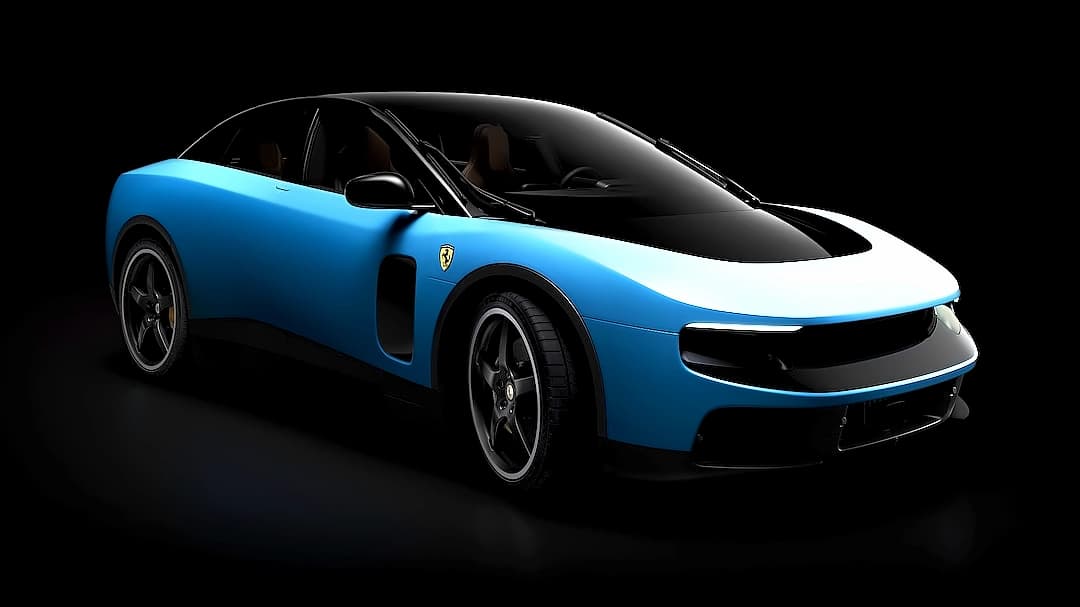
Ferrari's first electric vehicle, the Luce, garnered significant social media backlash following its unveiling on Monday, with the company's shares declining 8% in Milan and 5.3% in US markets. According to reports from CNBC, analysts said the stock reaction was partially due to "design hate," with Michael Field, chief equity strategist at Morningstar, noting that "many fans are disappointed that Ferrari is embracing the EV concept, believing it dilutes the supercar brand, which has modelled itself around classic design and raw, combustion-engine power." The Milan-listed stock had already decreased more than 32% over the last 12 months, highlighting ongoing investor concerns about the luxury carmaker's strategic pivot. As reported by The Telegraph, investors fear the Luce launch "could become a repeat of Jaguar Land Rover's controversial failed rebrand" in 2024, when the luxury British carmaker "tried to shift the marque away from its traditional 'Jag man' image towards ultra-wealthy customers."
The electric vehicle, which retails at €550,000 or approximately ₹6 crore, has been criticized for its minimalist and curved aesthetic designed in collaboration with LoveFrom, Jony Ive's firm. As reported by NDTV, netizens have labeled the Luce as a "generic EV" and "beautifully ugly," with some comparing it to a "toaster on wheels" and arguing it should be branded as an "Apple car." The criticism stems from concerns that consumer electronics aesthetics don't translate well to sports cars, with some stating the design looks like it was "designed by ChatGPT in eight seconds." The controversy has extended beyond social media, with former Ferrari executive Luca di Montezemolo stating "I hope that they take off the prancing horse [logo] from that car" during a business conference in Rome, according to Reuters. Ferrari declined to comment on di Montezemolo's remarks, while Italy's transport minister Matteo Salvini wrote on social media "I wonder what Enzo Ferrari would say," questioning the car's departure from traditional Ferrari design principles. As reported by Politico, the Luce's futuristic shell-like form, silent engine and £475,000 price tag were always going to be "controversial," with critics comparing it to "the concept for a Honda Hydrogen vehicle from 2002" and "one of the 'this is what the future will look like from the 90s' cars from 'Demolition Man,' only worse."
The Luce controversy has prompted reflection within the luxury automotive industry, with Lamborghini CEO Stephan Winkelmann defending his company's decision to cancel EV plans. Speaking exclusively to CNN, Winkelmann said "our decision to go from [traditional internal combustion engine] to plug-in was a very important one for us, and it worked out." He explained that "by observing the market ... we saw that the acceptance curve [of EVs] for our type of customers is not increasing, and that therefore we decided to move away from a full-electric car into a plug-in hybrid." Lamborghini, owned by German automaker Volkswagen, was among the global automakers that pulled back on EV investments due to weak demand. Winkelmann declined to comment directly on the Ferrari Luce but emphasized that "innovation is paramount" to success, though innovation should not be forced upon customers. According to Forbes, mass-production brands like Ford, GM, Honda and Volvo have "all retreated from their EV initiatives in one way or another as consumer demand plummets, profit falls and policy makers deprioritise moving away from traditional gas power," with luxury and performance brands following suit. "Underscoring the energy transition challenge for luxury carmakers," the "initial negative reaction to Ferrari's new model was not surprising," said the Financial Times.
Ferrari CEO Benedetto Vigna has repeatedly stated that the Luce is intended to be "polarising" and appeal to people outside Ferrari's core market among the ultra-wealthy. As reported by MotorTrend, the Luce represents Ferrari's first four-door, five-seat vehicle, effectively making it a family car for the luxury brand. The electric motor configuration allows for lateral acceleration capabilities that traditional sports cars cannot match, with the car capable of reaching 0-100km/h in 2.5 seconds. Industry experts believe Ferrari will find buyers among "reforming petrolheads, tech founders and lovers of quiet luxury," with the company expanding its market beyond traditional sports car enthusiasts. The Luce's design departs significantly from Ferrari's traditional aerodynamic cues, featuring a "skateboard" structure that pushes the top of the car to just 4cm shy of the Purosangue SUV, representing a fundamental shift in Ferrari's engineering approach for electric vehicles. According to Car magazine, the Luce has had a "rather long gestation period," with a Ferrari EV in the works for "a few years" before development officially started in 2021, when "EVs were riding high and increasing in popularity in the premium, sport and luxury space." However, "the world slightly reassessed that overly positive attitude to EVs not long after and so did Ferrari," as noted by Forbes.
Even Ferrari's chief design officer, Flavio Manzoni, admitted that the design was "polarising," but he's confident fans will embrace the new car with time. As reported by The Week, "whether most current Ferrari customers think the Luce is cool is irrelevant" for executives, according to Scott Sherwood, an independent analyst of luxury carmakers. "If it tested well enough with the tech crowd to fill the order book, that's all they are concerned with." The key challenge for Ferrari is "to fill the order book with the highly specific clients it had targeted for the Luce," according to analysts. The controversy has even managed to unite Italy's fractious politics, with far-right transport minister Matteo Salvini slamming it on social media while centrist opposition politician Carlo Calenda called it an "aesthetic and technological insult to anyone who loves Ferrari." The Luce's design departs from Ferrari's traditional "purist" approach, with critics like Luke Plunkett on Aftermath noting it "risks destroying the myth" of the legendary cars and should be stripped of the company's prancing horse logo.